Nvidia Launches Nemotron 3.5 Lightning and NeMo Switchyard

Synopsis
Nvidia has launched Nemotron 3.5 Lightning, a customizable model for high-volume specialized inference, and NeMo Switchyard, which routes AI agent workflows across multiple models. The dual release deepens Nvidia's push from GPU hardware into full-stack AI software infrastructure for enterprise teams.
Key Takeaways
Nvidia announced two new AI products on 11 August 2026 : Nemotron 3.5 Lightning and NeMo Switchyard .
Nemotron 3.5 Lightning is a customizable language model designed for high-volume, domain-specific inference workloads.
NeMo Switchyard enables AI agents to dynamically route each workflow step across multiple models within the NeMo framework.
The releases extend Nvidia's strategy of building full-stack AI software infrastructure on top of its dominant GPU hardware business.
Primary beneficiaries are enterprise AI teams and AI developers running complex, cost-sensitive production pipelines.
The announcements continue a line of successive Nemotron model variants and NeMo tooling expansions Nvidia has pursued in recent years.
Two new tools. One clear signal: Nvidia is no longer just selling the picks and shovels of the AI gold rush — it wants to own the mine. On Tuesday, 11 August 2026, the chip giant announced NVIDIA Nemotron 3.5 Lightning, a customizable language model built for high-volume, specialized inference, alongside NVIDIA NeMo Switchyard, an orchestration layer that lets AI agents dynamically route each workflow step across whichever models they choose.
Nemotron 3.5 Lightning: Built for the Enterprise Grind
Nemotron 3.5 Lightning is positioned squarely at enterprise teams running demanding, domain-specific workloads — the kind of repetitive, high-throughput inference that general-purpose frontier models are often too expensive or too slow to handle at scale. The 'customizable' framing matters: Nvidia is signalling that this is not a one-size-fits-all release but a foundation that AI developers can shape to their vertical, whether that is legal document processing, financial analysis, or industrial automation. This follows a line of Nemotron variants Nvidia has released as part of its push deeper into the software and model layer. Each release has sharpened the value proposition — lighter, faster, more tunable — targeting the cost-sensitive deployment reality that most enterprise AI teams actually live in.NeMo Switchyard: The Traffic Controller for Multi-Model Agents
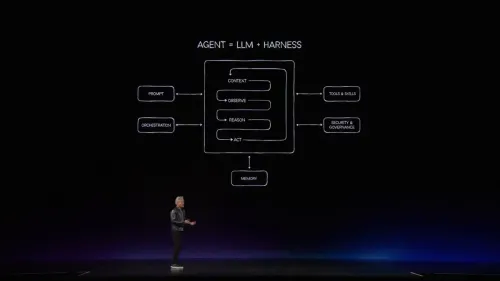
NVIDIA NeMo Switchyard addresses one of the messiest problems in production AI: deciding, in real time, which model should handle which step of a complex agent workflow. As enterprises move from single-model pipelines to multi-model architectures — mixing large reasoning models with smaller specialist models — routing logic becomes a critical bottleneck. Switchyard bakes that routing intelligence into the NeMo framework, letting agents make smarter, step-level decisions without custom engineering overhead. The practical upside is significant. A legal AI agent, for instance, could route document summarization to a lightweight fast model and contract risk analysis to a more capable one — all within a single orchestrated workflow, without the developer having to hard-code every handoff.Nvidia's Software Stack Play Deepens
Taken together, the two announcements extend Nvidia's well-documented pivot from pure hardware dominance into full-stack AI infrastructure. The company has methodically built out the NeMo ecosystem — covering training, fine-tuning, inference, and now multi-model orchestration — to ensure that enterprises building on Nvidia GPUs also build with Nvidia software. That lock-in logic is deliberate and compounding. For AI developers and enterprise AI teams in India and globally, the releases represent practical tooling that lowers the barrier to deploying customized, cost-efficient AI at scale. The question now is how quickly these tools find traction in production environments — and whether Switchyard's routing intelligence proves robust enough to handle the chaotic reality of real enterprise agent pipelines. Nvidia did not just announce two products today — it added another layer to the stack it is quietly making indispensable.Point of View
Nvidia is addressing the two most acute pain points in enterprise AI deployment: cost-efficient specialization and workflow complexity. This mirrors a broader industry pattern where hardware leaders — facing commoditization pressure — race to embed themselves in software and tooling that creates durable switching costs. The real test is whether NeMo Switchyard can become the default routing standard before open-source alternatives or hyperscaler-native tools fill that gap.
NationPress
26 Sept 2026
Frequently Asked Questions
What is NVIDIA Nemotron 3.5 Lightning?
NVIDIA Nemotron 3.5 Lightning is a customizable large language model released by Nvidia on 11 August 2026 , designed for high-volume, domain-specific inference workloads in enterprise AI applications.
What does NVIDIA NeMo Switchyard do?
NeMo Switchyard is a component of Nvidia's NeMo framework that helps AI agents automatically route each step of a workflow to the most appropriate model, enabling smarter and more efficient multi-model AI pipelines.
How is Nemotron 3.5 Lightning different from other Nvidia AI models?
Nemotron 3.5 Lightning is positioned as a lighter, faster, and customizable model for specialized enterprise use cases, contrasting with larger general-purpose models — making it more cost-effective for repetitive, high-throughput tasks.
Who benefits from Nvidia's NeMo Switchyard?
Enterprise AI teams and AI developers building multi-model agent pipelines benefit most, as Switchyard removes the need for custom routing logic when orchestrating workflows across several AI models.
Is Nvidia moving beyond GPU hardware into AI software?
Yes. Nvidia has been systematically expanding into AI software through its NeMo ecosystem, covering model training, fine-tuning, inference, and now multi-model orchestration — a strategy designed to deepen its role across the full AI infrastructure stack.