Sam Altman teases AI's Navier-Stokes solution in milestone shirt
Synopsis
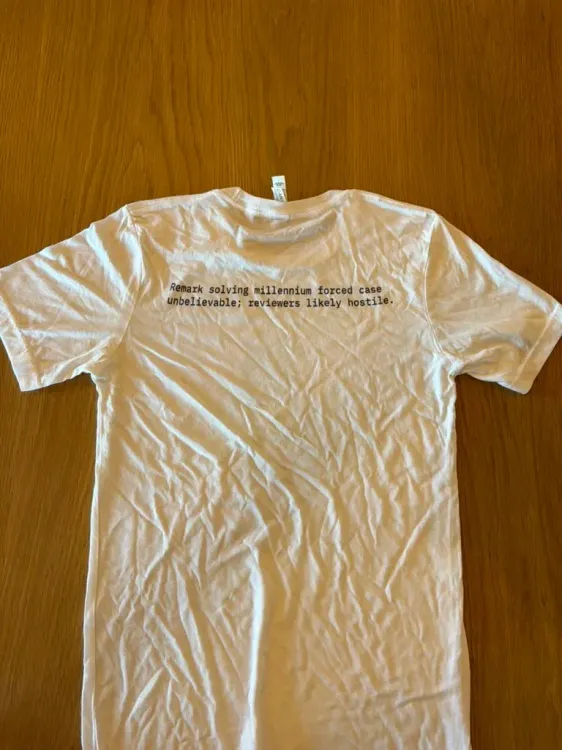
OpenAI CEO Sam Altman posted a photo of a 'milestone shirt' displaying the final line of a chain-of-thought output linked to a claimed AI solution of the Navier-Stokes equations — one of mathematics' seven unsolved Millennium Prize Problems — triggering global anticipation for formal verification.
Key Takeaways
Sam Altman publicly hinted at a possible AI-generated solution to the Navier-Stokes equations via a post on 16 October 2026 .
The Navier-Stokes existence and smoothness problem is one of seven Clay Mathematics Institute Millennium Prize Problems , each worth $1 million .
Only one Millennium Prize Problem — the Poincaré Conjecture — has ever been officially solved, by Grigori Perelman in 2003 .
The shirt's text references a chain-of-thought output, pointing to the AI reasoning technique OpenAI has advanced in recent years.
A valid solution requires peer-reviewed publication and at least two years of verification scrutiny before the Clay Institute awards the prize.
Any confirmed result would mark the first time an AI system anchored an official solution to a Millennium Prize-level mathematical problem.
OpenAI chief executive Sam Altman offered the world a cryptic but electrifying glimpse on Friday, 16 October 2026 — the back of what he called a 'milestone shirt' bearing the final line of a chain-of-thought output that, if verified, would represent one of the most consequential moments in the history of both artificial intelligence and pure mathematics: a claimed solution to the Navier-Stokes equations.
What the Navier-Stokes equations actually are — and why they matter
The Navier-Stokes equations are a set of partial differential equations that describe how fluids — water, air, plasma — move. Since the 19th century, mathematicians have known these equations work in practice: engineers use them to design aircraft wings, model ocean currents, and simulate weather. The problem is that nobody has ever mathematically proved whether smooth, globally well-behaved solutions always exist in three dimensions, or whether they can 'blow up' into singularities.
That gap between engineering utility and mathematical proof is precisely why the Clay Mathematics Institute listed Navier-Stokes existence and smoothness as one of its seven Millennium Prize Problems in 2000, each carrying a $1 million prize. Of the seven, only one — the Poincaré Conjecture — has ever been solved, by Grigori Perelman in 2003. Navier-Stokes has resisted every serious attempt since.
Chain-of-thought reasoning and the road to formal proof
The detail Altman chose to highlight is not just the result — it is the method. The 'last line of the chain-of-thought from the solution' points directly at the reasoning architecture that OpenAI has developed over recent years: large language models trained to decompose hard problems into explicit intermediate steps before arriving at a conclusion. Applied to competition-level mathematics, this technique has already crossed thresholds once thought years away.
Extending chain-of-thought to a Millennium Prize Problem is a categorically different challenge. Formal mathematical proof requires not just plausible reasoning but logical closure — every step must be verifiable. The shirt's imagery suggests Altman believes that closure has been reached, or at least demonstrated to a degree worth commemorating publicly.
What verification would actually require
A claimed solution to a Clay Prize Problem does not become official on social media. The Clay Mathematics Institute requires any proposed solution to be published in a peer-reviewed journal and to survive two years of scrutiny by the broader mathematical community before a prize is awarded. Perelman's proof of the Poincaré Conjecture took several years to fully verify even after publication. The road from a celebratory shirt to a confirmed Fields Medal-adjacent result is long — but the road has to start somewhere.
AI researchers and mathematicians worldwide will now be watching for a formal paper, an announcement of independent verification, or a response from the Clay Institute. If the claim holds, it would be the first time an AI system — rather than a human mathematician working alone or in collaboration — anchored a solution to one of the hardest open problems in science.
The equations that govern every wave, every gust of wind, and every turbine on the planet may finally have met their match — and the proof, apparently, fits on a shirt.
Point of View
A Navier-Stokes result would shift the debate from 'can AI do hard maths' to 'how do we govern AI-generated mathematical knowledge' — a question institutions like the Clay Institute have no established playbook for. The chain-of-thought framing is also significant: it signals that interpretability, not just capability, was part of the claimed result, which matters enormously for peer verification. This moment, verified or not, will accelerate investment in AI-assisted formal proof systems globally.
NationPress
17 Oct 2026
Frequently Asked Questions
What are the Navier-Stokes equations?
The Navier-Stokes equations are a set of partial differential equations that describe how fluids such as water and air move. They are fundamental to engineering and physics but have never been formally proved to always produce smooth, well-behaved solutions in three dimensions — a gap that makes them one of mathematics' hardest open problems.
Has the Navier-Stokes problem been solved?
No official solution has been confirmed. OpenAI CEO Sam Altman's post on 16 October 2026 hinted at a potential AI-generated solution, but formal verification by the Clay Mathematics Institute — which requires peer review and two years of scrutiny — has not yet occurred.
What is the Clay Mathematics Millennium Prize?
The Clay Mathematics Institute announced seven Millennium Prize Problems in 2000, each carrying a $1 million reward for a verified solution. Only one — the Poincaré Conjecture, solved by Grigori Perelman in 2003 — has been officially resolved to date.
What is chain-of-thought reasoning in AI?
Chain-of-thought reasoning is a technique used in large language models where the AI breaks a complex problem into explicit intermediate steps before reaching a conclusion. It has significantly improved AI performance on difficult mathematical and logical tasks.
What happens next after Sam Altman's Navier-Stokes hint?
The global mathematics and AI communities will watch for a formal paper submission to a peer-reviewed journal and any response from the Clay Mathematics Institute. Verification of a Millennium Prize solution typically takes several years even after initial publication.