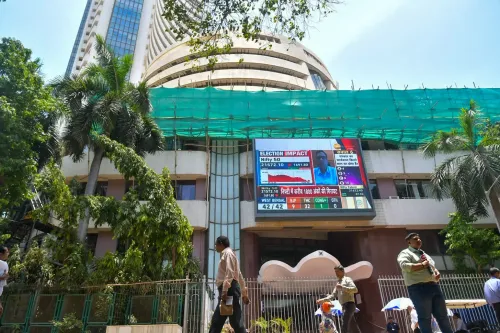
Sensex drops 300 points, Nifty at 24,388 as global sell-off hits early trade

Synopsis
Indian benchmarks opened sharply lower on 6 November as a 5.6% Nasdaq crash sent shockwaves through global markets — yet Nifty IT jumped 2%, and FIIs have pumped ₹35,781 crore into Indian equities over five sessions. The divergence tells a bigger story: India may be positioned to absorb the global AI-trade unwind better than most.
Key Takeaways
Sensex fell nearly 300 points to 79,016.05 and Nifty50 dropped 148.55 points to 24,388.05 in early trade on 6 November .
Nifty Metal led sectoral losses, down 2% ; Nifty Realty fell 1.56% .
Nifty IT bucked the trend, rising approximately 2% amid the global tech sell-off.
FIIs bought equities worth ₹35,781 crore over the last five sessions ; Thursday alone saw net purchases of ₹14,974 crore .
Brent crude rose 2% to $100.31 per barrel , raising concerns about India's import bill.
The Nasdaq fell 5.6% overnight on data-centre spending slowdown fears, the primary trigger for the global sell-off.
The BSE Sensex fell nearly 300 points or 0.37% to 79,016.05 in early trade on Friday, 6 November, while the Nifty50 slid 148.55 points or 0.60% to an intraday low of 24,388.05, as a sharp sell-off across US and Asian markets rippled through domestic equities. The decline tracked a 5.6% rout on the Nasdaq overnight, triggered by fears of slowing data-centre spending and a broader deceleration in the artificial intelligence trade.
Sector Breakdown: Metals and Realty Lead Losses
Nifty Metal was the worst-hit sector, dropping 2% in morning deals, followed by Nifty Realty, which declined 1.56%. Nifty Chemicals, Nifty Oil & Gas, Nifty Consumer Durables, Nifty PSU Bank, Nifty FMCG, and Nifty Auto also declined, falling up to 1.34%.
Bucking the broader trend, Nifty IT surged approximately 2%, with Nifty MidSmall IT & Telecom, Private Bank, and Media also trading in positive territory. The divergence underscores how the global tech slowdown narrative is being read as a potential competitive advantage for India's export-oriented software sector.
Why India May Be the Least Impacted
Market experts noted that while the bloodbath in US markets will weigh on most global indices, India is likely to emerge as a relative outperformer. 'The 5.6% rout in Nasdaq was triggered by concerns of a big slowdown in data centre spending. The tech rout, particularly the sharp deceleration in AI trade, will turn out to be beneficial for India,' analysts said.
They pointed to robust institutional buying as a stabilising force: foreign institutional investors (FIIs) have net-purchased equities worth ₹35,781 crore over the last five trading sessions. On Thursday, FIIs recorded net equity purchases of ₹14,974 crore — their fifth consecutive session of net buying — while domestic institutional investors (DIIs) remained net sellers, recording outflows of ₹10,444 crore.
Earnings Growth and Large-Cap Valuations Underpin Rally
Analysts attributed the ongoing market resilience to better-than-expected corporate earnings growth. The rally, they noted, has been driven largely by large-cap stocks, which had become attractively valued after months of underperformance relative to mid- and small-caps. This fundamental support differentiates the current phase from purely liquidity-driven moves.
Crude Oil Adds a Complicating Factor
Energy markets added a note of caution, with Brent crude rising approximately 2% to $100.31 per barrel and US West Texas Intermediate (WTI) gaining more than 1% to $91.91 per barrel. A sustained crude rally above $100 could widen India's import bill and add inflationary pressure, potentially complicating the Reserve Bank of India's rate trajectory in the months ahead.
Point of View
And India's IT sector — a services play, not a hardware one — is being re-rated upward in real time. The ₹35,781 crore FII inflow over five sessions is not noise; it reflects a structural reallocation. The real risk to watch is not the equity sell-off but Brent crossing $100 — an oil price shock is the one variable that can quickly undo macro stability and RBI's carefully managed rate pause.
NationPress
6 Nov 2026
Frequently Asked Questions
Why did Sensex and Nifty fall on 6 November?
Sensex and Nifty fell in early trade on 6 November tracking a sharp sell-off in US and Asian markets, led by a 5.6% crash in the Nasdaq. The Nasdaq decline was driven by fears of slowing data-centre spending and a deceleration in the AI trade.
Which sectors fell the most on the Indian market today?
Nifty Metal was the worst performer, falling 2%, followed by Nifty Realty at 1.56%. Nifty Chemicals, Oil & Gas, Consumer Durables, PSU Bank, FMCG, and Auto also declined up to 1.34%.
Why did Nifty IT rise even as the broader market fell?
Nifty IT jumped approximately 2% because analysts believe the global slowdown in AI and data-centre spending could redirect technology investment toward India's services-oriented IT sector. India's IT exporters are seen as beneficiaries of a shift away from hardware-heavy US tech spending.
What has been the trend in FII activity in Indian markets?
Foreign institutional investors have been consistent net buyers, purchasing equities worth ₹35,781 crore over the last five trading sessions. On Thursday alone, FIIs made net equity purchases of ₹14,974 crore — their fifth consecutive session of net buying.
How does Brent crude crossing $100 affect India?
Brent crude rising above $100 per barrel increases India's oil import bill, which can widen the current account deficit and add inflationary pressure. This could complicate the Reserve Bank of India's monetary policy stance and affect household fuel costs if prices are passed on to consumers.