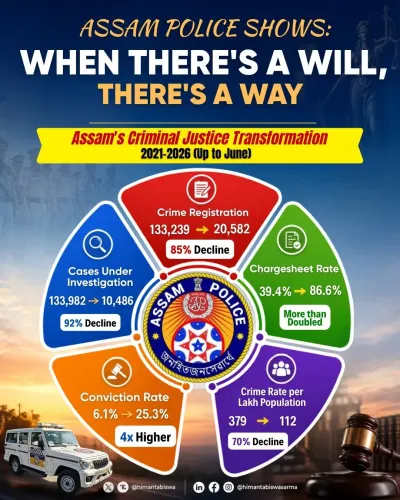
CM Himanta: Assam Police cut pending cases from 1.54 lakh to under 10,000

Synopsis
Assam CM Himanta Biswa Sarma claimed on Diwali that pending police investigations in the state have plummeted from 1.54 lakh in 2020 to under 10,000, crediting a structural shift in Assam Police's case-handling culture since his government took office in 2021.
Key Takeaways
Assam CM Himanta Biswa Sarma claimed pending police investigations fell from 1.54 lakh in 2020 to under 10,000 today.
The post was made on 6 November 2026 , using a Diwali 'sweet-box passing' metaphor to illustrate how file-passing culture in Assam Police has ended.
Sarma's government has prioritised case-pendency reduction since taking office in May 2021 , launching targeted clearance drives.
The claimed reduction represents a roughly 93 per cent drop in pending investigations over approximately five years.
Exact figures cited by Sarma are yet to be verified against official Assam Police annual crime statistics.
The data will likely face scrutiny in the state assembly and from political opposition.
A Diwali metaphor with a governance punch: Assam Chief Minister Himanta Biswa Sarma used the festival's tradition of re-gifting sweet boxes to make a pointed claim about his state's police reforms — that unlike the boxes, old cases no longer get passed along. On Friday, 6 November 2026, Sarma posted that pending investigations in Assam have fallen from 1.54 lakh in 2020 to under 10,000 today.
From 1.54 lakh cases to under 10,000 — the numbers behind the claim
The numbers, if accurate, would represent a reduction of roughly 93 per cent in pending police investigations over approximately five years. Sarma framed it plainly: 'Assam Police stopped passing on cases a while ago.' The implication is structural — that an internal culture of deferring files between officers has been replaced by accountability-driven case closure.
Since taking office in May 2021, Sarma's government launched targeted drives to clear long-pending cases and discourage routine file transfers between officers. Reducing case pendency was flagged early as a law-and-order priority, alongside more visible crackdowns on organised crime and illegal immigration.
Why police case pendency matters for ordinary Assamese
For crime victims and complainants, a pending investigation is not a statistic — it is a delayed trial, an unserved summons, a family waiting for closure. Assam, a state with a complex security history involving insurgency, border disputes, and high rates of crimes linked to trafficking, has long faced administrative strain on its police apparatus.
Clearing backlogs signals something deeper than cleaner ledgers: it means more cases are being actively investigated, witnesses are being examined, and charge sheets are being filed. The downstream effect reaches the courts, the prisons, and ultimately the streets.
A pattern across BJP-governed states — and what comes next
Assam's reported trajectory fits a wider pattern. Several BJP-governed states have emphasised law-and-order metrics — case disposal rates, encounter statistics, anti-encroachment drives — as governance report cards ahead of assembly cycles. Sarma, who also serves as convenor of the North-East Democratic Alliance (NEDA), has consistently positioned Assam as a model for northeastern governance reform.
The next empirical test will come when Assam Police releases its annual crime statistics or when state assembly questions probe the pendency data in detail. Until then, the 6 November 2026 Diwali post sets a benchmark the opposition will almost certainly examine.
The sweet box stops here — now comes the audit.
Point of View
Shareable story on a high-visibility day. The claimed 93 per cent reduction in pending cases, if verified, would be a remarkable law-enforcement achievement; if inflated, it hands the opposition a live grenade. Either way, it reflects a broader BJP strategy of governing through measurable, communicable targets — crime rates, encroachment clearances, scheme beneficiary counts — that can be weaponised in the electoral cycle. Assam's experiment will also be watched by other northeastern states in the NEDA fold as a template for police reform optics.
NationPress
6 Nov 2026
Frequently Asked Questions
How many pending police cases has Assam cleared under CM Himanta Biswa Sarma?
CM Sarma claimed on 6 November 2026 that pending investigations in Assam dropped from 1.54 lakh in 2020 to under 10,000 , a reduction of roughly 93 per cent. These figures have not yet been independently verified against official records.
What reforms did Assam Police implement to reduce case pendency?
Since the Sarma government took office in May 2021 , Assam Police launched targeted drives to clear long-pending cases and introduced accountability measures to end the practice of routinely transferring files between officers without resolution.
What did Himanta Biswa Sarma post on Diwali 2026?
Sarma used the Diwali tradition of re-gifting sweet boxes as a metaphor, saying 'Assam Police stopped passing on cases a while ago' and citing a dramatic fall in pending investigations from 1.54 lakh in 2020 to under 10,000 today .
Is Assam's police case pendency reduction figure verified?
The specific figures cited by CM Sarma — 1.54 lakh in 2020 falling to under 10,000 — have not been independently verified from public records as of now. Official confirmation would require Assam Police annual crime statistics or state assembly data.
How does Assam's police reform compare to other Indian states?
Several states have undertaken police backlog reduction initiatives, but Assam's claimed scale — a near-complete clearance of over 1.44 lakh pending cases in roughly five years — would stand out as one of the more dramatic reported improvements in case management among Indian states.