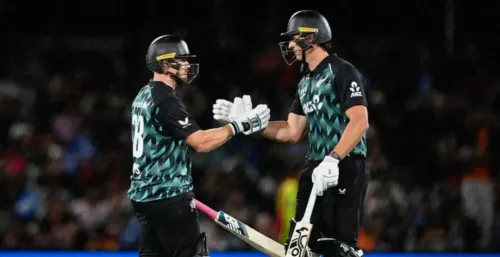
Glenn Phillips breaks T20I bilateral record as NZ beat India by 7 wickets in Hamilton

Synopsis
Glenn Phillips didn't just score runs in Hamilton — he rewrote history. His unbeaten 65 in the fifth T20I took his series tally to 341, breaking Phil Salt's bilateral record of 331, while Tim Seifert's 93 powered New Zealand's highest-ever T20I chase against India. India still won the series 3-2, but the final two matches exposed real cracks in their bowling.
Key Takeaways
New Zealand beat India by seven wickets in the fifth T20I at Seddon Park, Hamilton on 1 November .
Glenn Phillips finished with 341 runs in the series — a new world record for most runs in a single bilateral T20I series, surpassing Phil Salt's 331 against West Indies in 2023 .
Tim Seifert scored 93 , his first major knock of the series, anchoring New Zealand's chase of 192 .
Adam Milne took 4/19 to restrict India to 191/8 ; Ishan Kishan (61) and Shreyas Iyer (50) were India's top scorers.
India won the five-match T20I series 3-2 , having taken an unassailable lead in the first three matches.
New Zealand defeated India by seven wickets in the fifth and final T20I of the series at Seddon Park, Hamilton on 1 November, completing their highest-ever T20I chase against India with 12 balls to spare. A blazing 93 from Tim Seifert and an unbeaten 65 from Glenn Phillips — who shattered a world record in the process — powered the hosts to overhaul a target of 192 with authority.
Phillips Rewrites the Record Books
Glenn Phillips ended the series with 341 runs, surpassing Phil Salt's previous record of 331 runs scored against the West Indies in a five-match bilateral series in 2023. The tally — built across four half-centuries — makes Phillips the highest run-scorer in a single bilateral T20I series in history. His unbeaten 65 on Sunday was his fourth fifty of the series and arrived at a moment when New Zealand needed someone to put their foot down and kill the contest early.
Notably, this record-breaking series caps an extended purple patch for Phillips, who has established himself as one of the most reliable finishers in world cricket. His ability to accelerate without dismantling his technique was on full display throughout the series.
Seifert Anchors the Chase With 93
Tim Seifert registered his first major knock of the series, anchoring the chase with a fluent 93 before being dismissed in the 17th over, playing on off Nitish Kumar Reddy's bowling. He and Daryl Mitchell had earlier steadied the innings after New Zealand lost Finn Allen cheaply — caught at deep mid-wicket off Arshdeep Singh in the second over — to take the hosts to 59/1 at the end of the powerplay.
Seifert was granted a lifeline when Naman Dhir grassed a catch off Arshdeep's bowling with Seifert on just 13. After Varun Chakravarthy removed Mitchell in the ninth over, Seifert and Phillips joined forces to put on 86 runs off 42 balls for the third wicket — a partnership that effectively sealed the game. New Zealand raced to 138/2 after 13 overs, needing just 54 off 42 at that stage.
India's Bowlers Fail to Hold the Line
India's bowling lacked the discipline required to defend a competitive total. Bhuvneshwar Kumar was punished for 20 runs in the powerplay sixth over, and Varun Chakravarthy — despite generating LBW scares — went for 18 runs in the 13th over. Abhishek Sharma was also tried with the ball without impact. Only Arshdeep Singh, Varun Chakravarthy, and Nitish Kumar Reddy picked up wickets for India, one apiece.
This is the second consecutive T20I that India's bowling attack failed to defend a total in excess of 185, raising questions about the unit's ability to execute under pressure in the death overs.
India's Batting: Half-Centuries but Not Enough
Earlier, India posted 191/8 in their 20 overs. Ishan Kishan (61) and Shreyas Iyer (50) rescued the innings after openers Abhishek Sharma (1) and Sanju Samson (4) fell cheaply, putting on a 93-run stand for the third wicket. Cameos from Naman Dhir (33) and Nitish Kumar Reddy (22) provided late impetus, but India were ultimately held back from crossing 200.
Adam Milne was the standout bowler for New Zealand, claiming 4 wickets for 19 runs in four overs — a performance well in keeping with his strong record at Seddon Park. Nathan Smith and Blair Tickner chipped in with two wickets each.
Series Result: India Win 3-2
Despite the Hamilton defeat, India clinched the five-match series 3-2, having won the first three T20Is before New Zealand recovered to win the fourth and fifth. The result means the Kiwis end the home series on a high, even as India take away the overall series trophy.
Both teams will be assessing key personnel ahead of forthcoming bilateral commitments, with India's bowling stocks and New Zealand's batting depth both generating talking points heading into the next cycle.
Point of View
Not a one-off. Phillips's record also signals something broader: New Zealand are building a genuinely dangerous T20I middle order at home, and India's spinners, including Varun Chakravarthy, found no purchase on Hamilton's surface. The series trophy is India's, but the lessons belong to their bowlers.
NationPress
1 Nov 2026
Frequently Asked Questions
What record did Glenn Phillips break in the India vs New Zealand T20I series?
Glenn Phillips set a new world record for the most runs scored by a batter in a single bilateral T20I series, amassing 341 runs across the five matches. He surpassed Phil Salt's previous record of 331 runs, scored against the West Indies in a five-match series in 2023.
What was the result of the 5th T20I between India and New Zealand in Hamilton?
New Zealand beat India by seven wickets at Seddon Park, Hamilton on 1 November, chasing down a target of 192 with 12 balls to spare. It was New Zealand's highest-ever T20I chase against India.
Who won the India vs New Zealand T20I series 2024?
India won the five-match T20I series 3-2. They had claimed an unassailable 3-0 lead before New Zealand won the fourth and fifth matches to end the home series on a winning note.
How did Tim Seifert and Glenn Phillips perform in the 5th T20I?
Tim Seifert scored 93 — his first significant innings of the series — before being dismissed in the 17th over. Glenn Phillips remained unbeaten on 65, hitting his fourth half-century of the series. The two shared an 86-run partnership off 42 balls for the third wicket that effectively decided the match.
How did India's batting and bowling perform in the final T20I?
India posted 191/8, with Ishan Kishan (61) and Shreyas Iyer (50) putting on a 93-run partnership after an early collapse. Adam Milne was the pick of New Zealand's bowlers with 4/19. In the field, India's bowlers lacked discipline, with Bhuvneshwar Kumar and Varun Chakravarthy both going for heavy runs as New Zealand chased down the target comfortably.