Did Arsenal Say No to Crystal Palace's Rescheduling Request for the League Cup Match?
Synopsis
Arsenal's refusal to reschedule their League Cup quarter-final against Crystal Palace raises questions about fairness in fixture timing. With tight schedules looming, both clubs face significant challenges ahead. Discover how this decision impacts player welfare and competition integrity.
Key Takeaways
Fixture congestion is a growing concern for football clubs.
Player welfare must be prioritized in scheduling decisions.
Both teams face a demanding schedule leading up to the match.
Discussions with authorities can impact scheduling options.
Understanding competition integrity is crucial for clubs.
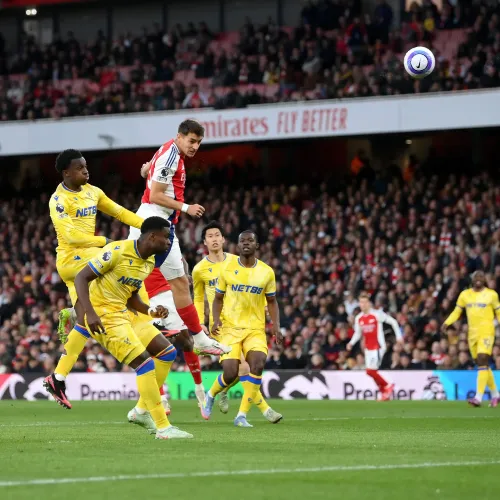
London, Nov 1 (NationPress) Arsenal has turned down the request from Crystal Palace to reschedule their League Cup quarter-final to December 23. Manager Mikel Arteta emphasized that it would be unfair for both teams to play two games within a 48-hour window.
The match is now set for December 16, coinciding with a grueling stretch for Palace, who will face four matches in just eight days: against Manchester City on December 14, KuPS in the Conference League on December 18, and Leeds United on December 21.
Palace contended that both teams deserved adequate recovery time, noting Arsenal's game against Wolves on December 13. They suggested moving the match to Christmas Eve, a proposal that was dismissed following talks with the Metropolitan Police and Transport for London, who cautioned about limited public transport availability.
Arsenal, as the home team, opposed a Christmas Eve match, and Palace's later suggestion of December 23 was also rejected since it would be just two days prior to Arsenal’s away fixture against Everton and would clash with Palace’s Premier League match against Leeds.
Arteta stated, "I don't think that's fair, because we have other competitions as well we have to try to accommodate. We knew at the start of the season the competitions that each club is playing in."
"On balance we have to try to accommodate the best possible way for everybody... There are other (options to December 23). Believe me, there are other options much better than this one. We already suggested that."
The Spanish manager warned that managing fixture congestion fairly and prioritizing player welfare is crucial, cautioning that clubs could reconsider their participation in certain competitions if these issues are not addressed properly.
"I hope we don't go (that far). If we have that big piece of paper with those two principles there in front before making any decision, all of us in our industry, we won't get there. If we don't and we just ignore that, then anything is possible," he remarked.
Point of View
The decision by Arsenal to reject Crystal Palace's request for rescheduling highlights the ongoing challenges of managing fixture congestion in modern football. Balancing player welfare with competitive integrity remains a critical issue as clubs navigate their demanding schedules.
NationPress
21 Sept 2026
Frequently Asked Questions
Why did Arsenal reject the rescheduling request?
Arsenal rejected the request because manager Mikel Arteta believes playing two matches within 48 hours would be unfair for both teams.
When is the League Cup match scheduled?
The League Cup match is scheduled for December 16.
What was Crystal Palace's argument for rescheduling?
Crystal Palace argued that both clubs deserved equal recovery time due to their busy match schedules.