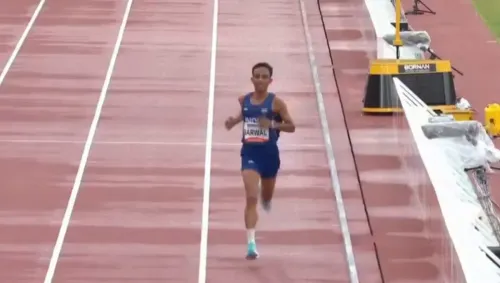
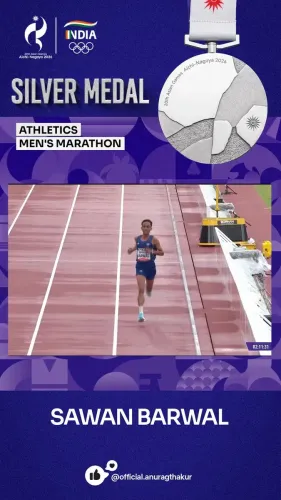
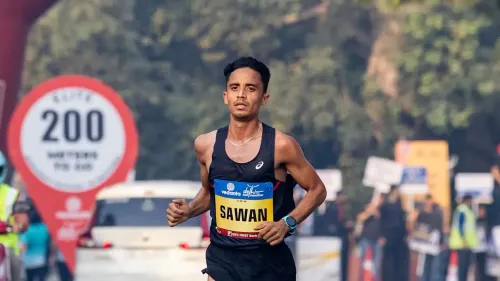
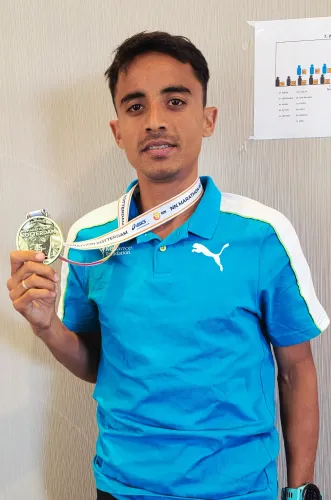
Sawan Barwal breaks India's 48-year marathon record from Himachal's hills
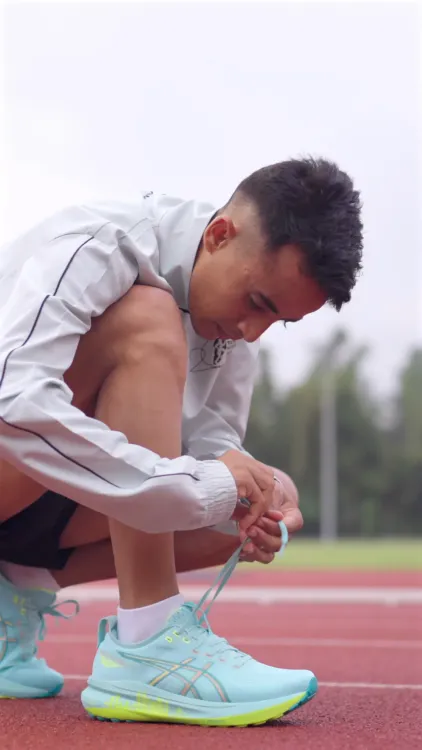
Synopsis
A soft-spoken Army runner from Himachal Pradesh's Joginder Nagar just erased a 48-year-old national marathon record. Sawan Barwal's rise — funded by a brother's salary, forged at altitude, and tested by a six-month injury — is the kind of story Indian athletics rarely tells loudly enough. With the Asian Games and the 2028 Olympics now in frame, it may be about to get much louder.
Key Takeaways
Sawan Barwal broke India's 48-year-old national marathon record earlier in 2025.
Barwal hails from Joginder Nagar, Himachal Pradesh and serves as an Army athlete .
A six-to-seven-month injury in 2023 tested his resolve before his record-breaking comeback.
His elder brother funded competition shoes worth around ₹20,000 during financially difficult early years.
Barwal targets the Asian Games in September , the Asian Marathon Championships , and the 2028 Los Angeles Olympics .
He estimates 40 to 50 per cent of marathon performance comes down to race experience.
Army athlete Sawan Barwal from Joginder Nagar, Himachal Pradesh has rewritten Indian marathon history by breaking a 48-year-old national record, a feat that has propelled the soft-spoken long-distance runner into the national spotlight. Barwal's journey — from the altitude-rich hills of Himachal to the record books — is one built on years of patience, family sacrifice, and a discipline that predates any formal training camp.
Mountains as the First Coach
Growing up in the hills of Joginder Nagar gave Barwal a physiological head start that no urban training centre could fully replicate. 'There is a benefit in the mountains physically as an athlete. If we talk about endurance running, we get a slight benefit from where we come from. It's a little challenging to go to the mountains, and there is a lot of physical activity needed. So definitely, the endurance is developed from the very beginning if you're living there,' Barwal said, noting that altitude training naturally sharpens competitive performance at lower elevations.
Access to professional facilities, however, was another matter entirely. Barwal trained with limited infrastructure in his home district before earning a national medal, only later moving to an excellence centre where recovery systems and nutritional support were available. 'When I moved to the city and trained in the excellence centres, it was pretty easy to train there with all facilities for recovery, nutrition, so it was easy for me to develop my body then,' he noted.
The Mindset Behind the Record
Long-distance running demands a particular mental architecture — hours of solitary effort with no immediate reward. Barwal's approach is methodical: he sets session-specific time targets one to two days in advance and treats each completed target as motivation for the next. 'We must break the training barriers. I set the targets before training and tell myself that I have to finish running in so-and-so time,' he explained. Teammates, he adds, are a crucial part of sustaining that drive. 'As soon as we achieve the target, we feel happy. I also have teammates, so we keep motivating each other.'
Family Sacrifices That Funded a Dream
Behind the record lies a story common to many Indian athletes from smaller towns. Barwal's elder brother stepped in financially during the early years, funding competition shoes that cost around ₹20,000 — an amount the runner could not afford on his own. 'My family has been very helpful since I started running. They cut out their own things and provided me with the training essentials. My elder brother helped me a lot. When he started his job, he supported me financially,' Barwal said. That financial scaffolding, he believes, was as important as any coaching intervention.
Injury, Self-Doubt, and the 2023 Setback
In 2023, a major injury sidelined Barwal for six to seven months, forcing him into one of the most psychologically demanding periods of his career. 'Thoughts start coming into your mind like maybe this will never heal properly, maybe I'm not able to do anything, or perhaps I should choose a different path altogether. Controlling those thoughts was very challenging,' he recalled. He also navigated the difficult transition from junior to senior competition, a phase he describes as taking one to two years of adjustment during which self-doubt routinely surfaces. 'If you keep those thoughts under control and continue training patiently and consistently, eventually you get to see the results of that hard work,' he said.
Road to Asian Games and the 2028 Los Angeles Olympics
Barwal now has his sights set on the Asian Games in September, the Asian Marathon Championships the following year, and ultimately the 2028 Los Angeles Olympics. He is candid that experience — which he estimates accounts for 40 to 50 per cent of marathon performance — was a missing ingredient in his first outing at the distance. 'We will have a lot of experience by the time the Olympic year is here. We didn't have that much experience in the first marathon but that won't be the case in 2028,' he said. His advice to younger runners mirrors his own story: expect the junior-to-senior transition to take four to six years, and resist the temptation to quit before results arrive. Barwal's record-breaking run suggests that patience, in marathon running, is not just a virtue — it is a strategy.
Point of View
Not because of it. His early years — no recovery infrastructure, shoes funded by a sibling's first pay cheque, training on hill terrain by necessity rather than design — expose a structural gap in how the country identifies and supports distance runners before they become headlines. The real question is whether the sporting establishment will now build pathways that find the next Barwal before he has to find himself.
NationPress
5 Oct 2026
Frequently Asked Questions
What national record did Sawan Barwal break?
Sawan Barwal broke India's 48-year-old national marathon record earlier in 2025, becoming one of the country's most prominent long-distance runners. The record had stood for nearly five decades before Barwal's run erased it.
Where is Sawan Barwal from?
Barwal is from Joginder Nagar in Himachal Pradesh and serves as an Army athlete. He credits the altitude and physical demands of hill life with building the endurance base that underpins his marathon performance.
What injury did Sawan Barwal suffer and how long did recovery take?
Barwal suffered a major injury in 2023 that kept him out of competition for six to seven months. He has described that period as one of the most psychologically challenging of his career, marked by self-doubt about whether he could return to form.
What are Sawan Barwal's upcoming targets?
Barwal is targeting the Asian Games in September 2025, the Asian Marathon Championships in 2026, and the 2028 Los Angeles Olympics. He believes accumulated race experience — which he rates at 40 to 50 per cent of marathon performance — will make him a stronger contender by the Olympic year.
How did Barwal's family support his running career?
Barwal's elder brother provided crucial financial support in the early years, including funding competition and spike shoes that cost around ₹20,000 — an expense Barwal could not cover himself. His family also cut personal expenses to fund training essentials.