Roberto Bautista Agut retires at 38 after 436 wins and 18 ATP seasons
Synopsis
Roberto Bautista Agut closed out 18 seasons, 436 wins, and 12 titles with a quiet first-round Wimbledon exit — and no regrets. His farewell is a reminder that the sport's golden age produced more than three legends: it also produced a generation of elite professionals who quietly outlasted almost everyone else.
Key Takeaways
Roberto Bautista Agut retired from professional tennis on 14 July at age 38 , after 18 seasons on tour.
He compiled an ATP record of 436 wins and 302 losses across more than 700 matches , winning 12 titles and reaching 11 additional finals.
His career-high ranking was No.
9 in the world, achieved in 2019 ; he spent 16 years inside the Top 100 and 10 years inside the Top 20.
His final match was a first-round loss to João Fonseca at Wimbledon on 29 June .
His greatest result was a Wimbledon 2019 semifinal , where only Novak Djokovic stopped him in four sets.
He is among only 15 Spaniards to win 12 or more ATP Tour titles in the Open Era.
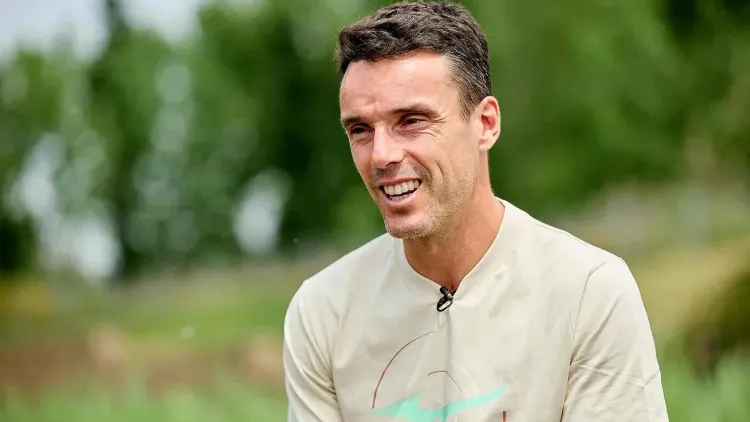
Spanish tennis veteran Roberto Bautista Agut announced his retirement from professional tennis on 14 July at the age of 38, drawing the curtain on an 18-season career that produced 436 wins, 12 ATP Tour titles, and a career-high ranking of No. 9 in the world. His final match came on 29 June at Wimbledon, a first-round defeat to João Fonseca — fittingly at the Grand Slam where he achieved his greatest result.
A Career Built on Consistency
Bautista Agut made his ATP Tour debut in Valencia in 2009 and went on to compile a tour record of 436 wins and 302 losses across more than 700 matches. He spent 16 consecutive years inside the ATP Top 100, and for 10 of those years he ranked inside the Top 20 — a feat he described as the defining achievement of his career.
'I've been in the Top 100 for 16 years, and for 10 of those I've been practically among the Top 20, which is the hardest part, because there are always injuries, difficult spells, and even personal challenges,' Bautista Agut said. 'I think being able to stay there for so many years is the greatest achievement of my career.'
Twelve Titles Across All Surfaces
Bautista Agut's trophy haul of 12 ATP Tour titles places him among only 15 Spaniards to reach that mark in the Open Era (since 1968). His first title came in 's-Hertogenbosch in 2014; his last arrived in Antwerp in 2024 — a decade-long run that spanned grass, clay, hard courts, and indoor surfaces. He also reached 11 additional finals without lifting the trophy.
'My goal was to reach the Top 100, then the Top 50, later the Top 20, and, finally, the Top 10. It took a lot of hard work, but I managed to achieve those goals one by one,' he said. 'I won a title on grass, then on clay; after that, I wanted to win on hard courts and indoors as well. These were challenges I set myself and managed to overcome.'
The Wimbledon Semifinal That Defined Him
Bautista Agut's most celebrated run came at Wimbledon 2019, where he reached the semifinals — only Novak Djokovic, in four sets, stood between him and the final. The journey was made more poignant by what had come before: in 2018, he had reached the semifinals at Halle before slipping and tearing his abdominal muscle, forcing him to miss Wimbledon entirely. Returning to the All England Club the following year and reaching the last four represented a personal redemption.
'After that injury and missing out on Wimbledon, I reached the semi-finals the following year; that's the strange way things go in tennis,' Bautista Agut reflected. Against Djokovic, he holds a 3–9 head-to-head record, meaning he did defeat the Serb on three occasions. He was, however, unable to beat either Roger Federer (0–9) or Rafael Nadal (0–3), though he counts those contests among his most treasured memories.
Why He Chose to Walk Away Now
Bautista Agut was candid about the physical and mental signals that prompted his decision. 'There comes a time when your body and mind say 'enough',' he told ATPTour.com. 'You have to know how to listen to yourself and step away from the Tour when the time is right. I don't think I'm physically in the same shape as I used to be, either. Given the state my body is in, I can't cope with four or five matches a week. It's time.'
He also acknowledged the rare privilege of his era. 'I really value the consistency my career had, being able to play the full calendar without worrying about my ranking, and having enjoyed being among the top players in the world,' he said, adding: 'I've lived through tennis's golden age.' With the retirement of Bautista Agut, an entire generation of players who competed alongside Federer, Nadal, and Djokovic at their peak continues to step away from the sport.
What Comes Next
No formal post-retirement plans have been announced. Bautista Agut's legacy, however, is already secure: a model of durability and professionalism in an era dominated by three of the greatest players in history. Spanish tennis, which has produced champions across every surface, will count him among its most decorated servants of the modern era.
Point of View
Nadal, or Djokovic — yet he outlasted virtually every peer who came up alongside him, spending a decade inside the Top 20 without a single Grand Slam title to his name. That is a harder achievement than it sounds: consistency at that level, without the psychological armour of a Major, demands something rarer than talent. His 0–9 record against Federer and 0–3 against Nadal tells one story; his three wins over Djokovic — the most dominant player of his era — tells a more interesting one. Spanish tennis will produce more champions. It will struggle to produce another Bautista Agut.
NationPress
13 Oct 2026
Frequently Asked Questions
Why did Roberto Bautista Agut retire from tennis?
Bautista Agut retired at age 38 citing physical decline and the inability to sustain the demands of four or five matches a week. He said his body and mind were sending him a clear signal that the time was right to step away from the ATP Tour.
What is Roberto Bautista Agut's career record?
Bautista Agut finished with an ATP win-loss record of 436–302 across more than 700 matches. He won 12 titles and reached 11 additional finals, with a career-high ranking of No. 9 in the world in 2019.
What was Roberto Bautista Agut's best Grand Slam result?
His best Grand Slam result was a semifinal appearance at Wimbledon in 2019, where he lost to Novak Djokovic in four sets. The run was especially meaningful as he had missed the previous year's Wimbledon due to an abdominal muscle tear.
When and where did Bautista Agut play his last match?
His final match was on 29 June at Wimbledon, a first-round defeat against João Fonseca. It was a fitting farewell venue given that Wimbledon was the site of his greatest career achievement.
How does Bautista Agut rank among Spanish tennis players historically?
He is among only 15 Spaniards to win 12 or more ATP Tour titles in the Open Era since 1968. He spent 16 consecutive years inside the ATP Top 100 and 10 years inside the Top 20, making him one of the most durable Spanish players of the modern era.