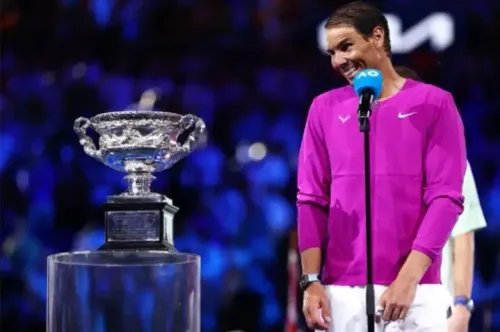
Rafael Nadal reveals career-long battle with pain and 22 Grand Slams

Synopsis
Nadal didn't just win 22 Grand Slams — he won them while managing a rare degenerative bone disorder, intestinal damage from painkiller overuse, and matches played on an anaesthetised leg. The Netflix series 'Rafa' finally puts numbers and words to what the trophies never showed.
Key Takeaways
Rafael Nadal was diagnosed with rare Müller-Weiss syndrome just two months before his first French Open title at age 19 .
He went on to win 13 more Grand Slams after the diagnosis, totalling 22 majors across his career.
Nadal received anaesthetic injections before certain matches and played his 2022 French Open final with near-total loss of feeling in one leg.
Prolonged painkiller use caused intestinal perforations ; he also battled recurring left knee tendinitis .
The Netflix documentary 'Rafa' documents the physical and mental toll of his professional career.
Nadal, now 39 , admitted he would have won 10 fewer Grand Slams had he not pushed through the medical risks.
Rafael Nadal, winner of a record 22 Grand Slam titles, has spoken candidly about the relentless physical toll that underpinned one of tennis's most extraordinary careers, revealing that he lived in constant fear of each season being his last as he managed a debilitating chronic foot condition. The retired Spanish champion made the disclosures in an interview with the BBC, timed to coincide with the release of the Netflix documentary series 'Rafa', which examines the physical and psychological demands of his professional life.
A Diagnosis That Could Have Ended Everything
Nadal received his first diagnosis of the rare Müller-Weiss syndrome — a degenerative bone disorder of the foot — just two months before winning his debut French Open title at the age of 19. During the 2005 Madrid Open final, he sustained a broken bone linked to the condition, a consequence partly attributed to the gruelling physical training regime overseen by his uncle, Toni Nadal, during his formative years.
Rather than accepting the diagnosis as a career death sentence, Nadal went on to claim a staggering 13 additional Grand Slams across nine years, winning at least one major title every season and cementing his status as the greatest clay-court player the sport has seen.
The Mental Weight Behind the Trophies
'Tennis became a race against time,' Nadal told the BBC. 'Always doubting my head about how long I can last with this foot? I never knew how long my career would last.' He added: 'I always thought, maybe it's the last year, so there's no time to stop.'
The public image of relentless triumph, he acknowledged, masked a private landscape of continuous uncertainty. Every title was shadowed by the question of whether his body would hold for another campaign.
Pain Management and Its Consequences
Sustaining a career at the sport's highest level also produced two serious secondary health complications: a recurring tendinitis in his left knee and intestinal perforations caused by the prolonged, excessive use of painkillers. During certain matches, Nadal had no option but to receive anaesthetic injections simply to take the court.
Most strikingly, his 2022 French Open victory — his 14th Roland Garros title and the final Grand Slam of his career — was achieved while playing with a leg in which he reportedly had almost no feeling. The win was, in retrospect, both his crowning achievement and a measure of how far he had pushed the limits of what the body can endure.
What Kept Him Going
Reflecting on the choices he made, Nadal was unapologetic. 'I've had to make decisions about my health, where you are on the borderline between right or wrong,' he said. 'But if I hadn't explored all that, I probably would have had 10 fewer Grand Slams... This is the reality.'
He identified passion as the decisive factor: 'The key was that the suffering was less than my passion and my happiness for what I was doing.' The 39-year-old, who was part of the sport's celebrated 'Big Three' alongside Roger Federer and Novak Djokovic, has since retired from professional tennis. The Netflix series 'Rafa' offers what is perhaps the most detailed public account yet of the sacrifices that lay beneath those 22 Grand Slam titles.
Point of View
But the pattern — chronic pain, painkiller dependency, injections to play — is not unique to him in professional tennis or sport at large. Whether governing bodies and coaches owe athletes a more protective framework is a conversation his candour has now made unavoidable.
NationPress
22 Sept 2026
Frequently Asked Questions
What is Müller-Weiss syndrome, the condition Rafael Nadal battled?
Müller-Weiss syndrome is a rare degenerative disorder affecting the navicular bone in the foot. Nadal was first diagnosed with the condition two months before winning his debut French Open title at 19, and it remained a defining medical challenge throughout his career.
How many Grand Slams did Nadal win after his foot diagnosis?
Nadal won 13 Grand Slams after his initial Müller-Weiss syndrome diagnosis, bringing his career total to 22 majors. He won at least one Grand Slam title per season across nine years following the diagnosis.
What is the Netflix documentary 'Rafa' about?
'Rafa' is a Netflix documentary series examining the physical and mental challenges Rafael Nadal faced during his professional tennis career. It prompted Nadal's detailed BBC interview about his chronic foot condition, painkiller use, and the personal sacrifices behind his record Grand Slam haul.
What health complications did Nadal suffer from painkiller use?
Prolonged and excessive use of painkillers to manage his chronic pain led to intestinal perforations, a serious secondary health consequence. He also developed recurring tendinitis in his left knee over the course of his career.
How did Nadal play the 2022 French Open with his condition?
Nadal competed in the 2022 French Open — his 14th Roland Garros title and final career Grand Slam — after receiving treatment that left him with almost no feeling in one leg. He has since confirmed this was among the most extreme examples of pain management he underwent to compete.