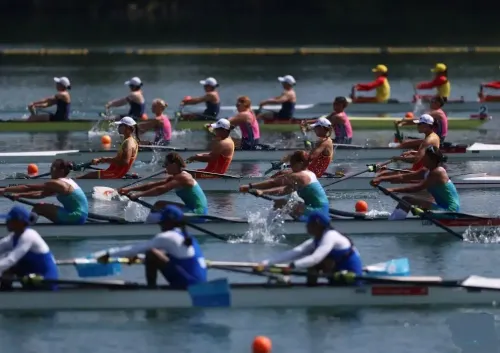
World Rowing president backs beach sprint's LA 2028 Olympic debut

Synopsis
One of sport's oldest disciplines is getting its most radical makeover yet. Beach sprint rowing — athletes running on sand, racing through waves, sprinting back to shore — makes its Olympic debut at LA 2028, with three medal events confirmed. World Rowing's president says the Qingdao finals proved the format is ready for the biggest stage.
Key Takeaways
World Rowing President Jean-Christophe Rolland described the 2026 World Rowing Beach Sprint Finals in Qingdao as a 'key milestone' ahead of the LA 2028 Olympics.
The IOC Executive Board approved beach sprint rowing for the Olympics in October 2023 ; three medal events — men's solo, women's solo, mixed double sculls — are on the programme.
Beach sprint is a knockout format combining a beach run, a two-leg 250-metre boat race around buoys, and a return sprint to the finish.
Rowing has been part of the Olympics since 1896 ; coastal rowing developed roughly two decades ago .
A World Beach Sprint Series launches in 2027 with stops in Türkiye and China .
World Rowing President Jean-Christophe Rolland has expressed strong confidence in beach sprint rowing's Olympic future, describing the 2026 World Rowing Beach Sprint Finals in Qingdao, China as a 'key milestone' on the road to the sport's debut at the Los Angeles 2028 Olympics. The event, held against a backdrop of crashing waves and beach-side music, offered a vivid preview of a format the International Olympic Committee (IOC) approved for LA 2028 in October 2023.
What Is Beach Sprint Rowing
Beach sprint is a head-to-head knockout format derived from coastal rowing — the open-water branch of the sport. Unlike classic flat-water rowing, beach sprint adds a dramatic third dimension: athletes begin with a run across the sand, leap into their boats, race through two 250-metre sections around buoys, and sprint back to the shore to hit the finish button.
'It is still rowing because we have a boat, a sliding seat and oars. But the concept, the environment and the rules are completely different,' Rolland said. That distinction, he argued, is precisely the format's appeal — shorter races, unpredictable wave conditions and a festival-like atmosphere make it, in his words, 'a little more fun' and 'faster-paced' for spectators.
Olympic Programme and Medal Events
Rowing has featured at the Olympics since the inaugural modern Games in 1896, but coastal rowing only took shape roughly two decades ago. The IOC Executive Board's October 2023 decision to include beach sprints at LA 2028 marked a significant expansion of the sport. At the Games, three medal events are on the programme: men's solo, women's solo, and mixed double sculls.
Rolland highlighted a logistical advantage of the format: 'At the Olympic Games, we can benefit from sharing a venue with other sports rather than needing a standalone venue,' he said — an increasingly important factor as the IOC pushes for leaner, cost-efficient Games.
Growth, Maturity and the Road Ahead
Rolland acknowledged that the discipline is still developing with two years to go before LA 2028. 'When the discipline started, it was limited to a very small number of countries. Now its inclusion in the Olympic programme has encouraged countries to invest in it,' he said. 'I would not say that we have reached maturity yet, but it is absolutely clear that this discipline really matters in rowing. It continues to grow year after year.'
World Rowing is streamlining the rulebook to keep the format accessible. A World Beach Sprint Series is set to launch in 2027, with planned stops in Türkiye and China — reflecting the sport's push into new geographies.
Qingdao's Role and China's Rising Presence
The Qingdao finals also served as a showcase for China's growing role in the sport. The city hosted both last week's World Rowing Coastal Championships — a six-kilometre endurance race with mass starts — and the beach sprint finals, with the two events illustrating the breadth of coastal rowing. Rolland's on-site interview underscored the significance World Rowing places on the Chinese market as the sport looks to expand its global footprint ahead of a North American Olympic showcase.
With the LA 2028 Games now firmly in sight, World Rowing's attention turns to refining competition standards, broadening national participation, and ensuring beach sprint arrives on the Olympic stage as a polished, audience-ready product.
Point of View
Timing — sit alongside Olympic ideals of pure athletic merit. That tension will define the debate as LA 2028 approaches and the format faces its first global primetime audience.
NationPress
22 Oct 2026
Frequently Asked Questions
What is beach sprint rowing?
Beach sprint rowing is a head-to-head knockout format where athletes run across sand, jump into a boat, race through two 250-metre sections around buoys, then sprint back to shore to hit a finish button. It is the open-water, compact variant of coastal rowing and will make its Olympic debut at Los Angeles 2028.
When was beach sprint rowing approved for the Olympics?
The IOC Executive Board approved coastal rowing beach sprints for the LA 2028 Games in October 2023. Three medal events are on the programme: men's solo, women's solo, and mixed double sculls.
How does beach sprint differ from classic rowing?
Classic rowing takes place on flat water using specialised lightweight boats, while beach sprint is contested in the open sea where waves require sturdier craft, and athletes must also run on the beach at the start and finish. The format is shorter, louder and more spectator-friendly, with knockout heats rather than lane races.
What is the World Beach Sprint Series?
World Rowing plans to launch the World Beach Sprint Series in 2027, with confirmed stops in Türkiye and China. The series is designed to build competitive depth and global participation ahead of the LA 2028 Olympics.
Why was beach sprint chosen for the Olympics?
World Rowing President Jean-Christophe Rolland cited the format's ability to reach new audiences, its beach-festival atmosphere and its logistical flexibility — beach sprint can share a coastal venue with other sports, removing the need for a costly standalone rowing facility. The IOC's drive for leaner Games was a key factor.