How Did Odisha Swimmer Pratyasa Ray Transform Water Therapy Into Success?
Click to start listening
Synopsis
Pratyasa Ray's journey from health struggles to becoming a top swimmer is inspiring. Discover how water therapy changed her life, leading her to win numerous medals and pursue her dreams in competitive swimming. This story highlights resilience, determination, and the power of unconventional healing methods.
Key Takeaways
- Pratyasa Ray overcame significant health challenges through water therapy.
- She has won a remarkable total of 18 medals in competitive swimming.
- Her story highlights the impact of alternative therapies on physical well-being.
- Pratyasa's determination exemplifies the spirit of resilience.
- She aspires to represent India in the upcoming Asian Games.
Jaipur, Dec 1 (NationPress) By the age of three, Pratyasa Ray's parents had consulted numerous hospitals searching for a solution to her persistent health issues and stunted growth. Her mother, Charushree, came across the idea that water therapy could be beneficial for children facing severe health challenges and decided to explore this option.
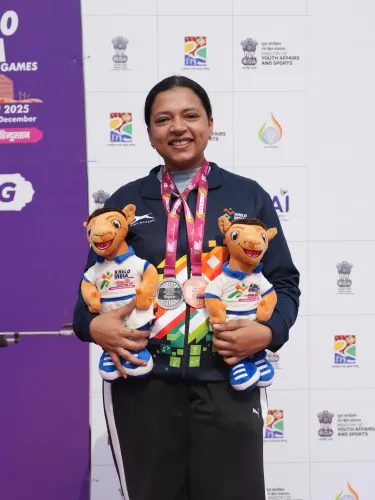
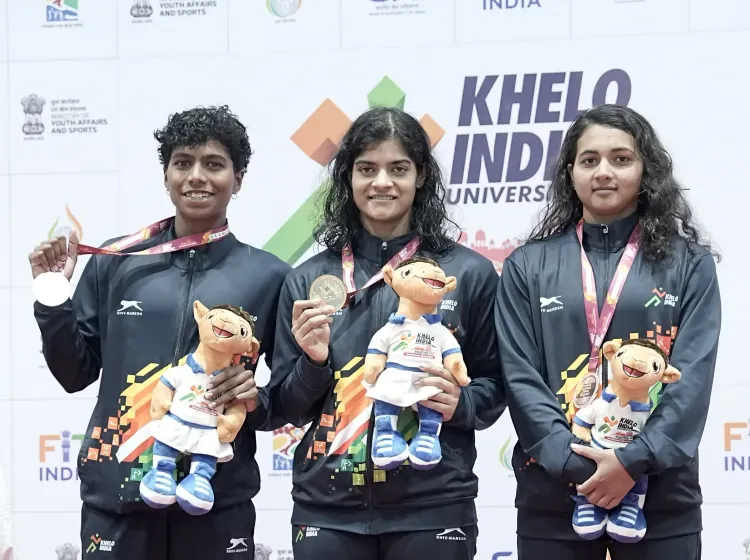
What initially started as a form of therapy has transformed into Pratyasa’s passion. Now 23, she ranks among the leading swimmers in the nation and showcased her skills at the Khelo India University Games Rajasthan 2025, where she earned three gold medals, one silver, and one bronze at the Sawai Man Singh Swimming Complex.
A student at Utkal University, she has amassed a remarkable total of 18 medals across the last four editions of the Khelo India University Games, including nine gold and seven silver medals. Additionally, she has achieved outstanding results at various national and international competitions.
Reflecting on the challenging times when Pratyasa's health was a significant worry, Charushree shared with SAI Media, “Pratyasa was born healthy. However, at just 21 days old, she was administered antibiotics to prevent an infection, which led to adverse reactions. This halted her natural physical growth. Our anxiety escalated. We aimed for a healthy child, but everything seemed to impede that goal. During that period, I read in Reader’s Digest that swimming could aid children with various health issues. Frustrated by constant hospital visits, I decided to take this leap of faith.”
“I began taking my three-year-old daughter to a swimming pool in Sambalpur. Since she was too young for admission, I entered the water with her. The initial days were filled with tears and anxiety, but gradually, the water transformed her fear into enjoyment. Within two months, our hospital visits decreased, and after three months, her health stabilized,” she recounted.
Six months after her introduction to swimming, Pratyasa expressed her desire to enter the pool without a floatation device for the first time. Her mother recalled, “It was as if water provided her relief. She began to relish her time in the water and realized it kept her away from hospitals. Over the next two to three years, she effortlessly increased her swimming distance from 25 meters to 50 meters.”
Pratyasa doesn’t remember those early experiences; everything she knows has been shared by her mother. She stated, “A local coach in Sambalpur identified my potential and encouraged me to pursue competitive swimming.”
At the age of eight, Pratyasa commenced her formal training at the Jharsa Khaitan Swimming Complex under Rangnidhi Seth.
“During this time, my father, Rajat Kumar Ray, who is employed by the Odisha government, was relocated to Bhubaneswar. I then began my professional training in Kalinga. While balancing my education and athletics, I am currently working towards a double postgraduate degree from Utkal University,” she shared.
Throughout these years, Pratyasa has secured numerous medals both nationally and internationally. In addition to her successes at the Khelo India University Games, she participated in three editions of the Khelo India Youth Games, earning four silver and three bronze medals.
Her standout performance at the KIUG took place last year in Guwahati, where she clinched four gold medals, one silver, and one bronze. This achievement led to her receiving the Eklavya Award from the Odisha Government.
However, shortly after those Games, she encountered a hairline fracture in her shoulder. “Surgery wasn’t necessary, but I required two months of rehabilitation. Due to this, I had to refrain from my primary backstroke events, but I remained determined. To keep my competitive edge, I began participating in freestyle and longer events of 200 and 400 meters.”
She made a timely recovery for the Senior Nationals in September last year, achieving gold in the relay and silver in the 100m backstroke. Currently, she aspires to join the Indian team for the 2026 Asian Games in Nagoya, Japan.
“My ambition is to compete in the Asian Games, but before that, I aim to participate in the World University Games and enhance my timings. I am passionate about swimming, and my goal is to swim while achieving personal milestones along the way.”
Point of View
I find Pratyasa Ray's story truly remarkable. It emphasizes the importance of alternative therapies in addressing health challenges and showcases the potential of sports to empower individuals. Her journey is not just inspiring; it serves as a beacon of hope for many who face similar struggles, reinforcing the idea that determination and innovation can lead to extraordinary outcomes.
NationPress
01/12/2025
Frequently Asked Questions
What health issues did Pratyasa Ray face?
Pratyasa faced health problems and stunted growth due to adverse reactions to antibiotics taken at a young age.
How did water therapy help Pratyasa?
Water therapy helped Pratyasa overcome her health challenges, reducing hospital visits and improving her physical development.
What medals has Pratyasa won?
Pratyasa has won a total of 18 medals at the Khelo India University Games and other national and international competitions.
What are Pratyasa's future goals in swimming?
Pratyasa aims to participate in the 2026 Asian Games and the World University Games, focusing on improving her timings.
Who coached Pratyasa during her training?
Pratyasa was initially trained by Rangnidhi Seth at the Jharsa Khaitan Swimming Complex.