Poovamma on India's 4x400m gold: 'We missed by microseconds last time'
Synopsis
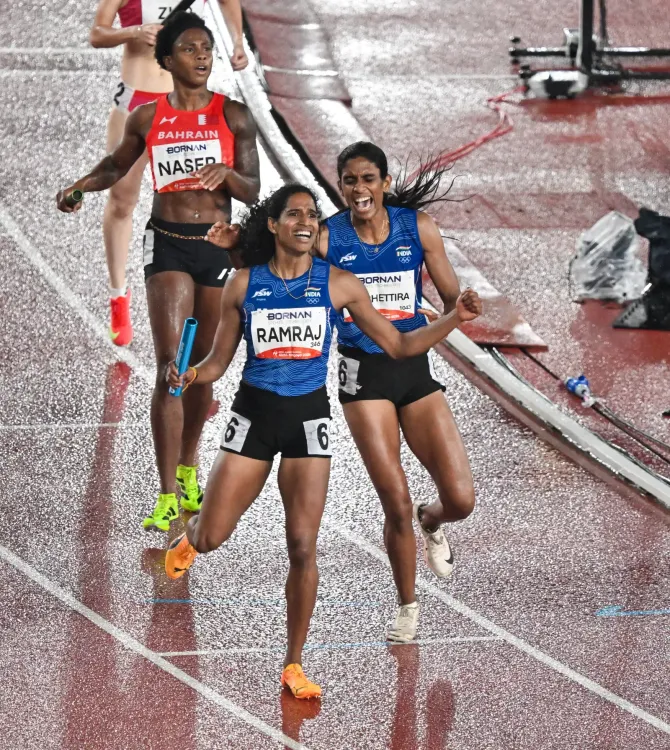
India's women's 4x400m relay team finally claimed the Asian Games gold they were denied by microseconds at the previous edition, clocking 3:29.69 in Nagoya. Poovamma, running the second leg, said the team carried the sting of that near-miss into this race — and let it fuel a historic first gold in the event for India.
Key Takeaways
India won their first-ever Asian Games gold in the women's 4x400m relay in Nagoya on 29 September 2026 .
The quartet — Kiran Pahal , M.R.
Poovamma , Prachi Choudhary , and Vithya Ramraj — clocked 3:29.69 .
Bahrain (3:30.21) and China (3:31.02) finished second and third.
India had missed gold at the previous Asian Games by microseconds, settling for silver.
The team credited training camps in Poland , the Czech Republic , and Tokyo , along with support from Khelo India , SAI , and AFI .
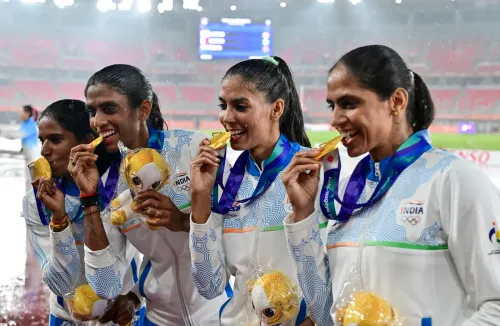
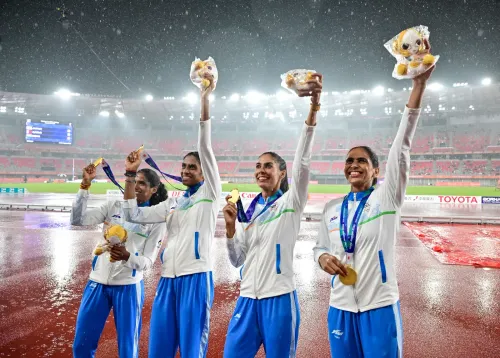
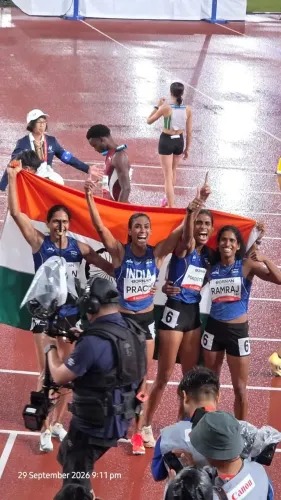
M.R. Poovamma said the memory of India narrowly missing the women's 4x400m relay gold at the previous Asian Games never left the team's mind — and that unfinished business drove the quartet to the top of the podium at the Asian Games in Nagoya on Tuesday, 29 September. The win marks India's first-ever gold in the women's 4x400m relay at the Asian Games.
A Gold Built on Unfinished Business
Running the second leg of the relay, Poovamma described the result as vindication of a promise the team had made to itself. 'Very proud because we wanted this gold very badly. The 4x400 women's team also wanted it badly because at the last Asian Games we missed it by microseconds. We wanted to keep that in mind, so we won the gold. We heard the national anthem, and we are all very proud,' she said after the race.
The Indian quartet — Kiran Pahal, M.R. Poovamma, Prachi Choudhary, and Vithya Ramraj — clocked a time of 3:29.69, finishing ahead of Bahrain (3:30.21) and China (3:31.02). The victory improved on India's silver-medal finish from the previous edition of the Games.
Poovamma's Message to the Next Generation
The veteran sprinter also used the occasion to send a message to younger Indian athletes navigating injuries and self-doubt. 'I just want to tell them to keep working hard no matter what. Age is just a number; it is not a barrier. It does not matter. Keep working hard; that is what matters. Whatever the injuries or whatever, if you are not able to perform, keep working hard and keep moving forward. Surely, hard work pays off,' she said.
Poovamma's longevity in Indian athletics makes the sentiment more than motivational boilerplate — it is a lived example of sustained high performance across multiple continental cycles.
The Role of Institutional Support
The gold medallist credited the Khelo India programme, the Sports Authority of India (SAI), the Athletics Federation of India (AFI), and the government for backing the team's preparation. A training camp in Poland, a subsequent camp in the Czech Republic, and a one-week camp in Tokyo were cited as key elements of the build-up. 'The support from them has been very important. Everything was very helpful, and that is what matters. We have won a gold,' she said.
This comes amid a broader push by the Indian government to fund elite athletics through structured international exposure ahead of major multi-sport events.
A Personal Triumph, A Family Dedication
After the race, Poovamma said she had spoken with her parents, husband, and brother — all of whom were overjoyed. She also revealed a personal milestone waiting at home: she had not seen her niece in six to seven months and was eager to return. 'I just want to reach home and see my baby... I have a niece, and I want to see her very badly,' she said.
She dedicated the medal to her country, her family, and all who had supported her career, including the AFI, SAI, and the government. With this gold in hand, India's women's 4x400m relay unit will look to build on the moment and cement their standing at the highest levels of Asian athletics.
Point of View
Czech Republic, and Tokyo suggest a calibrated approach to peak performance, not just raw talent. The result also underscores a quiet truth about Indian athletics: veterans like Poovamma, written off by age discourse, continue to deliver at the highest level. The bigger question now is whether this gold triggers sustained investment in relay infrastructure or remains a one-cycle story.
NationPress
29 Sept 2026
Frequently Asked Questions
Did India win gold in the women's 4x400m relay at the Asian Games in Nagoya?
Yes. India's women's 4x400m relay team won gold at the Asian Games in Nagoya on 29 September 2026, clocking 3:29.69. It is India's first-ever gold in this event at the Asian Games, improving on the silver won at the previous edition.
Who ran for India in the women's 4x400m relay at the Nagoya Asian Games?
The four runners were Kiran Pahal, M.R. Poovamma, Prachi Choudhary, and Vithya Ramraj. Poovamma ran the second leg of the relay.
What was India's time and how did it compare to other teams?
India clocked 3:29.69 to take gold. Bahrain finished second in 3:30.21 and China third in 3:31.02. The margin over silver was less than a second.
Why did Poovamma say the team 'wanted this gold very badly'?
Poovamma explained that at the previous Asian Games, India's women's 4x400m relay team missed gold by microseconds. The team carried that memory into Nagoya and channelled it as motivation, ultimately winning the gold.
What support did the Indian relay team receive ahead of the Asian Games?
The team credited the Khelo India programme, the Sports Authority of India (SAI), and the Athletics Federation of India (AFI). Their preparation included training camps in Poland, the Czech Republic, and a one-week camp in Tokyo.