Was the 77/6 Situation in Mumbai a Wake-Up Call for India in T20 World Cup?
Synopsis
In a recent press conference, India's assistant coach Ryan ten Doeschate reflected on the shaky beginnings of the T20 World Cup, emphasizing the importance of adapting to challenges after a dramatic 77/6 situation. With a resilient captain and a focus on strategy, India aims to reclaim its glory in the tournament. Will they rise to the occasion?
Key Takeaways
India's shaky start at 77/6 was a wake-up call.
Suryakumar Yadav's brilliant innings saved the match.
The need for adaptability in challenging conditions is crucial.
India's bowlers must find their form quickly.
Preparations for Namibia require understanding unfamiliar opponents.
New Delhi, Feb 10 (NationPress) India’s assistant coach Ryan ten Doeschate expressed that the team has taken on the challenge of defending their T20 World Cup title and is adapting to the unique pressures of tournament cricket following a rocky beginning in Mumbai, which he described as a valuable wake-up call.
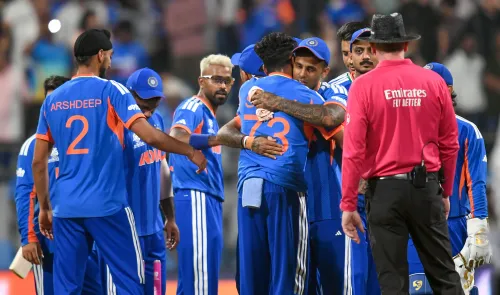
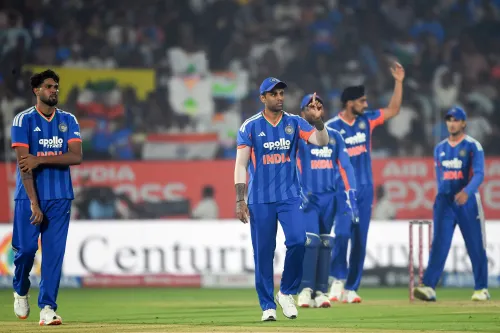
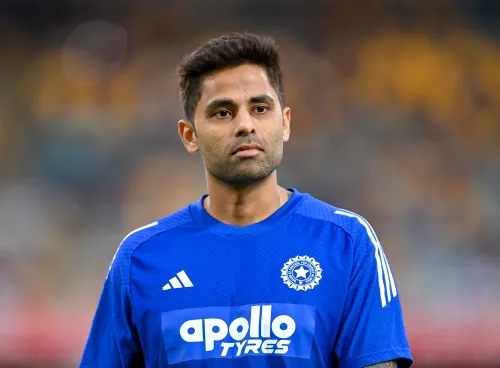
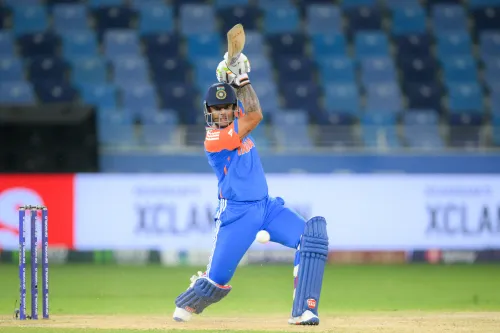
During their match at the Wankhede Stadium last week, India, the reigning champions and favorites, found themselves in a precarious position at 77/6 against the USA, who were on the verge of causing a major upset. However, captain Suryakumar Yadav, who had a close call when dropped at 15, turned the game around with a stellar performance, scoring 84 not out off 49 balls to help India finish at 161/9.
Indian fast bowlers Arshdeep Singh and Mohammed Siraj took three wickets within the first four overs, leaving the USA at 13/3, eventually restricting them to 132/8 in their 20 overs, allowing India to start their campaign with a victory.
“Participating in the New Zealand series helped us acclimate to the occasion, so it may not have been as shocking as entering a World Cup for the first time. Yet, we are fully aware of the responsibility we carry; we wish to play a specific style of cricket, and now it genuinely feels like we are in a World Cup,” ten Doeschate remarked to reporters during a press conference on Wednesday.
He also mentioned that India's batting collapse in their initial match underscored the necessity for flexibility, particularly as wickets could be tough to navigate during the early rounds of the tournament.
“In the modern game, the instinct is to go for the big hits. However, there are times when one must show restraint. The wicket in Mumbai, as you noted, required more application and possibly an adjustment in strategy,” he stated.
“Especially considering our situation, losing three wickets in the final over of the power play and being six down at 70, we needed to adapt. Fortunately, our captain stepped up. Despite having a rough past year, he maintained his approach and leadership style, and his performance last week was rewarding.”
Ten Doeschate further acknowledged that India's bowlers had yet to find their rhythm. “The wickets haven't quite played as we anticipated. We must be adaptable, and we definitely should have performed better in Mumbai, which is something we will address. I believe our bowlers have not yet reached their potential.”
“While it may be tempting to credit the USA for their bowling performance, it’s crucial to objectively analyze our placements and execution. We expect much more from our bowlers.”
“Having world-class bowlers allows batters more room for mistakes. If you continually aim for scores of 250, errors are inevitable, and we need to accept that. Some mistakes can be excused.”
As India prepares to face Namibia at the Arun Jaitley Stadium on Thursday, ten Doeschate emphasized the importance of adjusting to unfamiliar opponents and conditions. In a prior match, the Netherlands demonstrated better adaptability on a challenging pitch, winning by seven wickets.
“An 11 o'clock start compared to a 7 o'clock start does significantly impact play in India. We frequently compete against teams like Australia, Pakistan, England, and South Africa, where the players consistently score in the high 130s to early 140s, but now we face teams that play more in the 125 to 135 range.”
“Thus, our preparations may need to focus more on this aspect, and we have to consider that these are not teams we face regularly. When playing against Australia, for example, we know which four bowlers or two spinners to expect, and the patterns of their play.”
“The element of the unknown is something we can prepare for. However, we don’t want to overcomplicate things; it’s crucial to get into tournament mode and for players to adhere to their game plans, adjusting as necessary,” he concluded.
Point of View
I recognize the significance of India's performance in the T20 World Cup. Their ability to adapt and respond to challenges is crucial for maintaining their status as reigning champions. The focus on strategy and team resilience is commendable, and it will be interesting to see how they navigate future matches.
NationPress
24 Sept 2026
Frequently Asked Questions
What was India's score against the USA?
India scored 161/9 against the USA after being reduced to 77/6.
Who played a key role in India's recovery?
Captain Suryakumar Yadav scored 84 not out to help India recover from 77/6.
How did India's bowlers perform in the match?
India's bowlers managed to restrict the USA to 132/8, showcasing a strong performance.
What is the upcoming match for India?
India is set to face Namibia at the Arun Jaitley Stadium.
What challenges does India face in the tournament?
India needs to adapt to different opponents and conditions, especially against teams they don't play often.