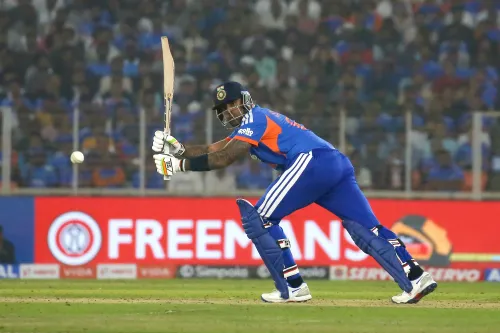
Does India Need a Strong Foundation to Chase Big Scores? Robin Uthappa Weighs In

Synopsis
In the wake of India's recent T20I defeat, Robin Uthappa critiques the batting strategy, emphasizing the necessity for clear roles amidst shifting tactics. Discover his insights on South Africa's dominant performance and India's need for a solid foundation to tackle high targets in international cricket.
Key Takeaways
India needs defined batting roles for effective chase strategies.
South Africa excelled in all departments, demonstrating strong cricket.
Flexibility is key , but a solid foundation is necessary for chasing big scores.
Early wickets can disrupt momentum; strategies must adapt.
Uthappa's insights highlight areas for improvement for India.
New Delhi, Dec 13 (NationPress) Former Indian cricketer Robin Uthappa offered a comprehensive analysis of the recently held second T20I in Mullanpur, commending South Africa's all-around proficiency while critiquing India's lack of defined batting roles during significant run chases.
India's approach to batting flexibility faced criticism after they fell short in a demanding run chase against the Proteas, allowing the visitors to equalize the five-match series at 1-1.
Reflecting on South Africa's response after losing the first match on JioHotstar's 'Follow The Blues,' Uthappa highlighted their dominance across all three facets of the game, stating, “South Africa batted and bowled brilliantly to recover from the first game. They were exceptional with the new ball on that pitch; Lungi Ngidi's delivery to Shubman Gill was a stunning ball, and the one to Abhishek Sharma restricted him on a challenging back of a length. They consistently targeted the right areas and kept India under pressure.”
“With the bat, they made a decisive statement by aggressively targeting India's top bowlers, including Jasprit Bumrah and Arshdeep Singh, right from the outset. Quinton de Kock was outstanding, forming solid partnerships with Aiden Markram, running excellently with Dewald Brevis, and maintaining a high tempo by scoring in his preferred areas. Donovan Ferreira and David Miller finished the innings with style. It was an all-around performance from South Africa, and on a rare off day for Bumrah and Arshdeep, they outperformed India in every department,” he added.
India's run chase lost momentum after early wickets fell, but Uthappa believes the main concern lay in the construction of the innings once Shubman Gill was dismissed, especially given the depth of India's batting lineup.
“You can lose early wickets, but the real issue for me was the batting strategy after Shubman Gill's dismissal. If Axar Patel comes in at that point with such a deep batting order, he needs to play as a pinch-hitter—someone you are willing to risk early for quick runs to relieve pressure from Abhishek Sharma. Instead, his 21 off 21 didn’t effectively achieve that, and as wickets fell around him, he had to change his method and slow down, which hampered the chase,” he mentioned.
The former opener stressed the need for clearly defined roles for batters in international cricket, particularly when pursuing a substantial target.
“At the international level, batters must have clearly defined roles and a strong understanding of how to build their innings. Flexibility with match-ups after the first six to eight overs is acceptable, but a solid foundation is essential before attempting to chase a large score—you can’t construct a skyscraper without a strong base,” he emphasized.
Uthappa concluded by cautioning against excessive tactical fluidity too early in an innings, as it can complicate decision-making and scoring patterns. He stated, “Asking players to prepare for various roles in the same game complicates run-scoring, and that's where India is missing a trick. I don't support being overly flexible too early in the innings, beyond the openers.”
Point of View
It is imperative to highlight the evolving nature of international cricket strategies. Uthappa's insights resonate with the current challenges faced by India, especially in high-pressure situations. A clear understanding of roles is essential for any team's success, and India's batting lineup must adapt to these demands to remain competitive on the global stage.
NationPress
7 Oct 2026
Frequently Asked Questions
What did Robin Uthappa say about India's batting strategy?
Uthappa stressed the importance of having clearly defined roles for batters, particularly when chasing big scores. He criticized the lack of clarity in India's batting order after early wickets fell.
How did South Africa perform in the second T20I?
South Africa displayed an all-around performance, excelling in batting and bowling, which allowed them to level the series against India.
What is the significance of a solid foundation in cricket?
A solid foundation is crucial for successfully chasing big targets, as it helps maintain momentum and reduces pressure on the remaining batsmen.
Why is flexibility in batting roles important?
Flexibility allows teams to adapt to match situations, but clear roles are essential to ensure effective innings construction, particularly in international matches.
What lessons can India learn from this match?
India needs to reassess their batting strategy to ensure clear roles are established, especially in high-pressure scenarios, to enhance their chances of success.