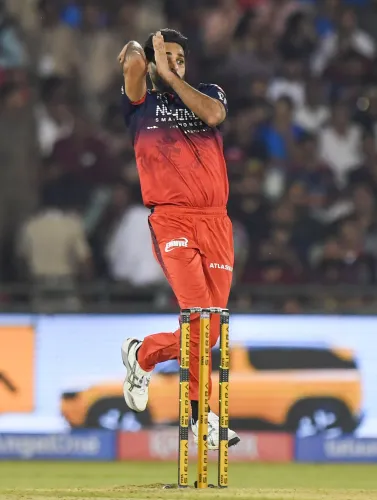
Bhuvneshwar Kumar embodies swing bowling's enduring relevance in modern cricket: Vaas

Synopsis
Chaminda Vaas's assessment of Bhuvneshwar Kumar cuts deeper than mere praise—it's a meditation on why swing bowling, despite the modern game's obsession with power-hitting, remains cricket's most intelligent art form. From Wasim Akram's late movement to Anderson's seam control, Vaas traces a lineage of bowlers who understood that control, not speed, is the true currency of excellence.
Key Takeaways
Chaminda Vaas credits Bhuvneshwar Kumar as a modern exemplar of swing bowling's relevance in white-ball formats.
Swing bowling succeeds through intelligence, discipline, and deception—not raw pace alone.
Wasim Akram is cited as the complete fast bowler, excelling with both new and reverse swing across all phases.
Reverse swing , pioneered by Akram and Waqar Younis , fundamentally altered fast bowling by extending bowlers' effectiveness with older balls.
James Anderson 's longevity and seam control, combined with Dale Steyn's pace-swing fusion, represent modern mastery.
Swing bowling is as much a mental and strategic discipline as a technical skill, requiring setup, consistency, and understanding of batsmen's weaknesses.
Former Sri Lanka cricketer Chaminda Vaas has lauded India bowler Bhuvneshwar Kumar as a masterclass in swing bowling within contemporary cricket, highlighting how the Indian seamer's mastery with the new ball continues to unsettle even the most belligerent batters across white-ball formats. In an interview with Olympics.com, Vaas underscored that swing bowling remains a potent weapon despite the modern game's emphasis on aggressive batting and flat pitches.
Bhuvneshwar's craft in white-ball cricket
Vaas remarked, "Bhuvneshwar showed that swing bowling is still very relevant, even in white-ball formats. With the new ball, he could move it both ways and trouble top-order batsmen. It's about control and knowing your strengths." The former cricketer emphasised that while conditions matter, exceptional bowlers transcend environmental variables through technical adjustment. "People often say swing bowlers need good conditions, but great bowlers find a way. They adjust their lengths, angles, and how they use the crease," Vaas added.
Swing bowling as an art form
Vaas characterised swing bowling as one of cricket's purest disciplines, rooted in intelligence and deception rather than raw pace. The craft demands rhythm, fitness, and a cerebral approach—qualities that separate practitioners from artists. He illustrated this through comparisons with historical greats who redefined the discipline across eras.
Wasim Akram's unmatched completeness
Vaas singled out Wasim Akram as the quintessential complete fast bowler. "He had everything—pace, control, and the ability to swing the ball both ways. But what really made him special was how late the ball would move. Batsmen had very little time to adjust," Vaas explained. Akram's adaptability across phases proved transformative: he extracted wickets with the new ball and returned later to replicate that success with reverse swing—a duality few bowlers have mastered. "Not many bowlers in the history of the game have had that kind of impact in all phases," Vaas noted.
The reverse-swing revolution
The partnership between Akram and Waqar Younis fundamentally altered fast bowling's trajectory through reverse swing. Waqar brought a different dimension: greater pace through the air and devastating reverse-swing yorkers. "When he got the old ball reversing, it was tough for any batsman in the world," Vaas said. Reverse swing itself was transformative—it negated the conventional advantage batsmen gained as the ball aged. "Earlier, once the ball got old, it became easier for batsmen. But with reverse swing, bowlers always had a chance," Vaas reflected.
Modern exemplars: Anderson and Steyn
James Anderson earned particular praise for his seam control and late movement, especially in English conditions. "In English conditions, especially, he is almost unplayable. The way he controls the seam position and gets that late movement is beautiful to watch for any fast bowler," Vaas said. Anderson's longevity underscores the discipline required: "To do it year after year, in different situations, and still be effective is not easy. Swing bowling requires rhythm and fitness, and he has maintained both for a very long time."
Dale Steyn represented a contrasting archetype—an attacking bowler who fused speed with swing. "Steyn was more of an attacking bowler. He could swing the ball at high pace, which is always dangerous. When you mix speed with movement, the margin for error for the batsman becomes very small," Vaas observed.
The mental and strategic dimensions
Vaas underlined that swing bowling transcends technique; it is fundamentally a mental and strategic exercise. Bowlers must operate in disciplined corridors, sometimes enduring periods without immediate reward, trusting that persistent pressure yields returns. "You can't rush it. You have to bowl in the right areas consistently. Sometimes the wickets don't come immediately, but if you keep asking questions, you will eventually get the reward," he explained.
Strategy separates competent bowlers from craftsmen. "Swing bowling is a thinking bowler's game. You have to set batsmen up, understand their weaknesses, and then use swing as your weapon. It's not just about moving the ball—it's about when and how you do it," Vaas asserted. Even amid cricket's evolution toward power-hitting, swing bowling's leverage remains undiminished. "No matter how much the game changes, if the ball is swinging, the bowler is always in control. You can have power hitters and fast scoring rates, but one good spell of swing bowling can change the match completely."
Point of View
Far from being a victim of flat pitches, is instead a victim of neglect. Fewer bowlers are learning the craft because it demands patience and intelligence rather than the immediate gratification of pace bowling. That Vaas must invoke Akram and Anderson to remind us of swing's potency suggests the art form is endangered—not by the game's evolution, but by coaching cultures that prioritize pace over craft.
NationPress
25 Sept 2026
Frequently Asked Questions
Why does Chaminda Vaas praise Bhuvneshwar Kumar's swing bowling?
Vaas credits Bhuvneshwar with demonstrating that swing bowling remains highly effective in white-ball cricket. Bhuvneshwar's ability to move the ball both ways with the new ball and trouble top-order batsmen exemplifies how control and technique can outweigh raw pace in modern formats.
What makes swing bowling effective according to Vaas?
Swing bowling succeeds through intelligence, discipline, and deception rather than speed alone. Bowlers must adjust lengths and angles, operate in disciplined areas consistently, and understand batsmen's weaknesses to set them up strategically.
How did Wasim Akram and Waqar Younis change fast bowling?
Akram and Younis pioneered reverse swing, which transformed the game by allowing bowlers to remain effective with older balls. Previously, once the ball aged, batsmen gained an advantage. Reverse swing negated this, ensuring bowlers always had a chance to take wickets.
Which modern bowlers does Vaas highlight as exemplars of swing bowling?
Vaas praises James Anderson for his seam control and late movement in English conditions, and Dale Steyn for combining speed with swing. Both represent different approaches—Anderson as a technical craftsman and Steyn as an attacking bowler—yet both mastered swing's strategic dimensions.
Is swing bowling still relevant in modern cricket?
Yes, according to Vaas. Despite the modern game's focus on power-hitting and flat pitches, swing bowling remains potent. A sustained spell of quality swing bowling can change match outcomes, and bowlers who master the craft—like Bhuvneshwar—continue to trouble even aggressive batters.