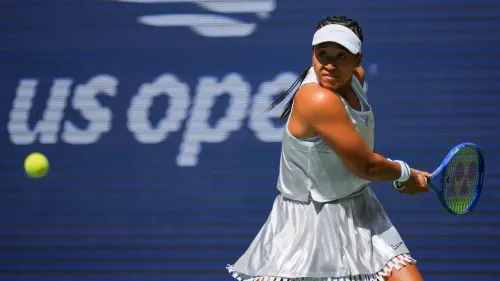
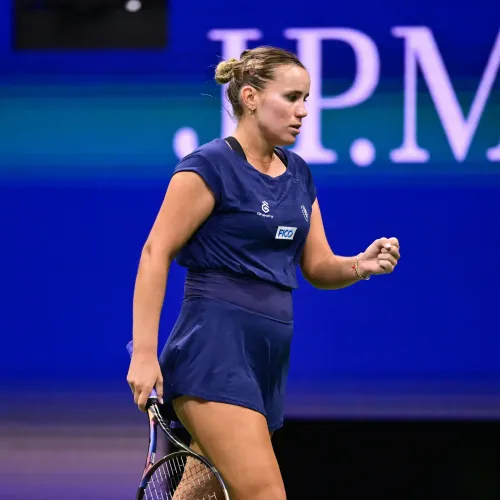
Venus Williams loses US Open 2026 first round after midnight start against Kenin

Synopsis
Venus Williams, at 46, squandered seven set points and lost a midnight thriller to Sofia Kenin at the US Open 2026 — a match that only began at 12:15 am after Djokovic's four-hour marathon. Her post-match remarks have reignited the debate over the US Open's late-night scheduling practices.
Key Takeaways
Venus Williams lost to Sofia Kenin 2-6, 7-6(6) in the US Open 2026 first round on 31 August .
The match began at 12:15 am local time at Arthur Ashe Stadium , delayed by Novak Djokovic's four-hour-36-minute loss to Mariano Navone .
Williams, 46 , had seven set points in the second set but failed to convert a single one.
She held four consecutive set points at 6-2 in the tie-breaker before losing six straight points.
Williams called the scheduling 'extremely late' and said there was 'room for improvement.'
Seven-time Grand Slam champion Venus Williams exited the US Open 2026 in the first round on 31 August, falling to compatriot Sofia Kenin 2-6, 7-6(6) in a match that did not begin until 12:15 am local time at Arthur Ashe Stadium, New York. The two-time US Open champion was vocal about the scheduling after the match, calling the late start 'extremely late' and unlike anything she had experienced before.
A Night That Stretched Past Midnight
The Williams-Kenin clash was pushed deep into the night after Novak Djokovic's marathon first-round loss to Argentina's Mariano Navone — a match that ran for four hours and 36 minutes — delayed proceedings on Arthur Ashe Stadium. By the time Williams and Kenin walked onto the court, it was well past midnight, making it one of the latest start times in recent US Open memory.
'It was extremely late. I've never played a match that late before,' Williams said at her post-match press conference. 'It's not ideal. I would have preferred something else. I think it wasn't great for either of us. I definitely think there's room for improvement there,' she added.
How the Match Unfolded
Williams was outplayed in the opening set, losing it 2-6. She rallied strongly in the second, building a commanding position with seven set points across the set. At 5-4, she held three consecutive set points but could not convert any, allowing Kenin to force a tie-breaker.
The tie-breaker proved equally dramatic. Williams surged to 6-2, earning four more set points, but lost the next six consecutive points to hand Kenin the match. The 46-year-old veteran was left to reflect on a string of missed opportunities that ultimately decided the contest.
Williams Acknowledges Kenin's Quality
Despite the frustration of squandering multiple set points, Williams was measured in her assessment of Kenin's performance. 'I think she played well. Maybe I had a loose point here or there, but I don't think I just gave it away. I think it was just a little bit unlucky, and I think it's some of the best tennis she's played lately, for sure,' Williams said.
Kenin, a former Australian Open champion, has been working her way back to form on the tour, and this victory over a Grand Slam great will rank among the more notable wins of her recent career.
Scheduling Under Scrutiny
The late finish reignites a recurring debate around night-session scheduling at the US Open, particularly when marquee matches overrun and push subsequent fixtures past midnight. Both players had to endure the wait with no certainty over when they would take the court. This is not the first time the US Open's scheduling has drawn criticism — organisers have faced pressure in past editions to introduce firmer cut-off times for late-night play. Williams's comments are likely to add fresh momentum to those calls.
With Williams's first-round exit, attention now turns to whether the US Open 2026 will revisit its scheduling protocols ahead of the tournament's later rounds.
Point of View
Prioritising prime-time TV slots for marquee matches — but when a Djokovic marathon runs to nearly 4:37 am, the collateral damage falls on the next players in line, regardless of their age or stature. A 46-year-old playing a tight second-set tie-breaker at 2 am is not a fair contest. The tournament's silence on structural reform after repeated late-night controversies is becoming harder to defend, and Williams's candid remarks will ensure this conversation does not fade quietly.
NationPress
16 Oct 2026
Frequently Asked Questions
What happened to Venus Williams at the US Open 2026?
Venus Williams was eliminated in the first round of the US Open 2026 on 31 August, losing to compatriot Sofia Kenin 2-6, 7-6(6) in a match that started at 12:15 am local time at Arthur Ashe Stadium. She had seven set points across the second set and tie-breaker but could not convert any.
Why did the Venus Williams match start so late at the US Open?
The match was delayed because Novak Djokovic's first-round loss to Argentina's Mariano Navone ran for four hours and 36 minutes, pushing the Williams-Kenin fixture past midnight. Williams said it was the latest she had ever played a match.
What did Venus Williams say about the late-night scheduling?
Williams said 'It was extremely late. I've never played a match that late before,' adding that it was 'not ideal' and that there was 'room for improvement' in how the US Open handles late-night scheduling.
How did Venus Williams perform despite the late start?
Williams lost the first set 2-6 but fought back strongly in the second, accumulating seven set points. She was unable to convert any of them, including four consecutive set points at 6-2 in the tie-breaker, eventually losing the last six points of the match.
Who is Sofia Kenin and why is this win significant?
Sofia Kenin is an American tennis player and former Australian Open champion who has been working to rebuild her form on tour. Her victory over seven-time Grand Slam champion Venus Williams is considered one of the more significant results of her recent career.