Nagaland anti-drug campaign: 180 students join Kiphire drive backed by Army

Synopsis
With an estimated 2.5 lakh addicts and a 215-km porous border feeding narcotics from Myanmar's post-coup drug surge, Nagaland is ground zero for India's Northeast drug crisis. A school campaign in Kiphire backed by the Army's Spear Corps underscores how deeply the state's security, public health, and insurgency challenges are intertwined with the narcotics trade.
Key Takeaways
180 students participated in an anti-drug campaign at Agape Higher Secondary School, Kiphire, Nagaland on 24 August 2026 .
The event was organised by Akehda Amulung NGO under the Nasha Mukt Bharat Abhiyaan , with support from the Army's Spear Corps .
Nagaland shares a 215-km unfenced border with Myanmar , a major source of heroin and methamphetamine since the 2021 coup .
Experts estimate the actual number of drug addicts in Nagaland could exceed 2.5 lakh , against an official figure of 1.2 lakh .
Consumption estimates suggest Nagaland may absorb up to 10,000 kg of narcotics annually , according to a senior police official.
Investigations have confirmed a link between the drug trade and militant outfits operating across the Myanmar border.
An anti-drug awareness campaign was held at Agape Higher Secondary School in Kiphire, Nagaland, on Monday, 24 August 2026, drawing participation from nearly 180 students. The event was organised by Akehda Amulung, a non-governmental organisation functioning as an implementing support agency for the Nasha Mukt Bharat Abhiyaan, and received backing from a unit of the Army's Spear Corps.
Why Nagaland Is a Frontline State
Nagaland shares a 215-km porous, largely unfenced border with Myanmar and sits close to the Golden Triangle — the world's largest opium-producing region, spanning parts of Myanmar, Laos, and Thailand. Traffickers exploit ethnic linkages and the open terrain to move narcotics into the Northeast. The situation worsened after Myanmar's 2021 military coup, which turned the country into a primary source of heroin and methamphetamine, leaving states such as Nagaland, Mizoram, and Manipur acutely exposed.
Scale of the Drug Crisis
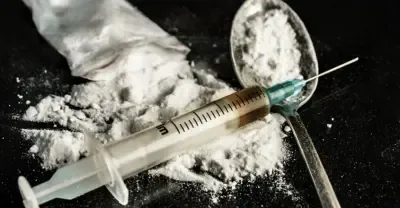
Official estimates put the number of drug addicts in Nagaland at roughly 1.2 lakh, but experts believe the actual figure may have crossed 2.5 lakh. A growing concern is the shift from traditional narcotics to synthetic drugs. Even accepting the conservative official figure, the consumption volumes are staggering: a senior police official noted recently that if half of the 1.2 lakh addicts consume heroin or brown sugar — locally known as Shan Flower — at an estimated 0.5 grams per person per day, the state could be absorbing close to 30 kg per day, or roughly 10,000 kg annually. Beyond the narcotics crisis itself, the widespread use of unsterilised syringes has fuelled the spread of Hepatitis B and HIV among addicts, placing a significant burden on the state's public health infrastructure.
The Drug-Militancy Nexus
Security agencies have established a clear link between the narcotics trade and militant outfits that maintain camps across the border. These groups reportedly fund their operations through drug trafficking, making the drug menace inseparable from the region's broader insurgency challenge. 'The menace will have to be curbed to bring about prolonged peace in the region. Insurgency will stop once the outfits are starved of funds. We have already cracked down on extortion and abduction. Now, all agencies will have to come together to stop the trafficking of narcotics,' an official said.
What the Campaign Involved
Students at the Kiphire school participated in drug-awareness competitions and an audio-visual presentation on the harmful effects of substance abuse. 'Promoting youth awareness and collective responsibility towards a drug-free society, a formation under Spear Corps supported the District-Level Drug-Free Campaign organised by Akehda Amulung under the Nasha Mukt Bharat Abhiyaan at Agape Higher Secondary School, Kiphire, Nagaland. Around 180 students participated in various drug-awareness competitions, while an informative audio-visual presentation highlighted the harmful effects of drug abuse and the importance of a healthy, drug-free lifestyle,' the Spear Corps posted on X.
Community and Institutional Response
The church and women's groups — both of which carry considerable influence over Nagaland's youth — have been active participants in the broader campaign against drugs. Experts note that conditions have improved since the 1980s and 1990s, aided by greater institutional intervention and a growing cohort of young people leaving the state for higher education or employment. However, they caution that much more remains to be done, and that educational institutions must serve as the primary arena for sustained outreach.
Point of View
But a single school event in one district barely registers against a crisis of this scale. Nagaland's drug problem is structural — rooted in a porous border, a post-coup Myanmar flooding the region with cheap synthetics, and a militant-trafficking nexus that has survived decades of security operations. The shift from heroin to synthetic drugs is particularly alarming because it is harder to detect and faster to addict. School awareness drives matter, but without a coordinated border-sealing strategy, a credible addiction treatment network, and a serious assault on the drug-funding pipelines of armed groups, these campaigns risk becoming optics rather than outcomes.
NationPress
9 Oct 2026
Frequently Asked Questions
What was the anti-drug campaign held in Kiphire, Nagaland?
A district-level drug-free awareness campaign was organised at Agape Higher Secondary School in Kiphire on 24 August 2026 by Akehda Amulung NGO under the Nasha Mukt Bharat Abhiyaan, supported by the Army's Spear Corps. Around 180 students took part in awareness competitions and watched an audio-visual presentation on the dangers of drug abuse.
Why is Nagaland particularly vulnerable to drug trafficking?
Nagaland shares a 215-km porous, unfenced border with Myanmar and is geographically close to the Golden Triangle — the world's largest opium-producing zone. After Myanmar's 2021 military coup, the flow of heroin and methamphetamine into the Northeast intensified significantly, making Nagaland, Mizoram, and Manipur especially vulnerable.
How many drug addicts are there in Nagaland?
Official figures cite approximately 1.2 lakh drug addicts in Nagaland, but experts believe the actual number may have crossed 2.5 lakh. A senior police official has estimated that narcotics consumption in the state could be as high as 10,000 kg per year.
What is the link between drug trafficking and militancy in Nagaland?
Investigations have established that militant outfits operating across the Myanmar border fund their activities through drug trafficking. Officials have stated that curbing the narcotics trade is essential to cutting off insurgent financing and achieving lasting peace in the region.
What role do community institutions play in Nagaland's anti-drug efforts?
The church and women's groups, both of which hold significant influence over Nagaland's youth, have been active partners in anti-drug campaigns. Experts say their involvement has contributed to measurable improvement since the 1980s and 1990s, though they stress that educational institutions must remain the primary focus of sustained outreach.