Is Aatmanirbharta Transforming India's Defence Industrial Landscape?

Synopsis
Discover how India's commitment to Aatmanirbharta is reshaping its defence manufacturing landscape. From a reliance on imports to becoming a significant global player, this transformation is crucial for India's future. Learn about the impressive statistics and strategic initiatives that are paving the way forward.
Key Takeaways
Aatmanirbharta is reshaping India's defence landscape.
Defence production value increased by 174% over a decade.
Defence exports rose from Rs 686 crore to Rs 23,622 crore .
Budget for defence has nearly tripled, showing strong commitment.
75% of capital procurement now reserved for domestic industry.
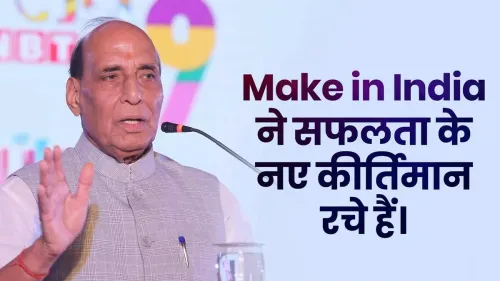
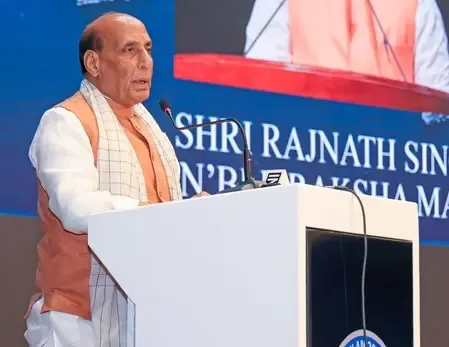
New Delhi, Dec 8 (NationPress) In his address on Armed Forces Day, Defence Minister Rajnath Singh reaffirmed the government's resolve to achieve Aatmanirbharta in defence manufacturing. He emphasized that India, previously reliant on imports, is now experiencing a significant transformation.
He pointed out that the country once lacked a robust framework for arms and equipment production, making it heavily dependent on defence imports.
However, the last decade has seen a remarkable evolution, with the value of India's defence production soaring by an astonishing 174 percent. From Rs 46,000 crore in 2014-15, it has escalated to a record Rs 1.51 lakh crore in 2024-25. Notably, exports have also skyrocketed — rising from a modest Rs 686 crore in 2013–14 to Rs 23,622 crore in 2024–25. India now supplies defence systems to over 90 countries.
A senior official highlighted that Prime Minister Narendra Modi has consistently positioned self-reliance in defence as pivotal to India's journey toward becoming a secure, confident, and developed nation by 2047. His focus on India achieving Aatmanirbharta in defence and evolving into a global manufacturing hub indicates a strategic shift.
Referencing successful missions like Operation Sindoor, PM Modi underscored that indigenous platforms, once validated in combat, enhance deterrence, boost national confidence, and establish India as a reliable supplier.
The government's initiative to open the defence sector to private enterprises has significantly broadened the industrial landscape. Prioritizing domestically produced military hardware has been instrumental in the rapid growth of the defence industrial ecosystem.
The Defence Minister also pointed out the robust economic expansion that has allowed the government to allocate more resources. The defence budget has surged nearly threefold, rising from Rs 2.53 lakh crore in 2013–14 to Rs 6.81 lakh crore in 2025–26.
Recently, approximately 75 percent of the capital procurement in the defence budget has been earmarked for domestic industries. This consistent demand has encouraged both public and private sectors to invest in new capacities, technologies, and partnerships, thereby accelerating the transformation of the defence industrial ecosystem.
Officials noted that prior to 2014, India's procurement framework was bogged down by bureaucracy, leading to the defence forces being deprived of essential equipment due to this 'policy paralysis.'
“There has been a remarkable change in the speed of weapon system procurement, with emergency procurement provisions facilitating timely equipping of the armed forces. This was particularly evident during the Ladakh border standoff with China, where cutting-edge equipment like drones were procured,” a senior official remarked.
Point of View
It's clear that India's push for self-reliance in defence is a pivotal move. This approach not only strengthens national security but also boosts the economy by fostering indigenous industries. The transformation witnessed in recent years is commendable, and the government's proactive measures are crucial for India's future in the global defence arena. Our nation stands firm in its pursuit of self-sufficiency and resilience.
NationPress
2 Oct 2026
Frequently Asked Questions
What is Aatmanirbharta in defence?
Aatmanirbharta refers to India's initiative to achieve self-reliance in defence manufacturing, reducing dependence on imports and boosting domestic production.
How much has India's defence production grown?
India's defence production value has surged by 174 percent over the last decade, rising from Rs 46,000 crore in 2014-15 to Rs 1.51 lakh crore in 2024-25.
What is the significance of the defence budget increase?
The defence budget has increased nearly threefold, from Rs 2.53 lakh crore in 2013-14 to Rs 6.81 lakh crore in 2025-26, reflecting a strong commitment to enhancing national security.
What role do private companies play in defence?
The government has opened the defence sector to private companies, which has expanded the industrial base and increased the production of indigenous military hardware.
Why is the procurement process important?
An efficient procurement process is crucial for ensuring that the armed forces receive timely and essential equipment, enhancing operational readiness and national security.