Is the Government Committed to Making India Self-Reliant in Ammunition Production?

Synopsis
In a bold declaration, Defence Minister Rajnath Singh reaffirms the Indian government's commitment to self-reliance in ammunition manufacturing. This initiative seeks to transform India into a global production hub, reducing dependence on imports while enhancing domestic capabilities. Discover how this strategic plan aims to bolster national defense and support the growing role of the private sector.
Key Takeaways
Commitment to Self-Reliance: The government is focused on achieving self-reliance in ammunition production.
Private Sector Role: Increased participation from the private sector is crucial for success.
Technological Advancements: India is developing advanced defence technologies.
Export Growth: Defence exports are significantly increasing, showcasing India's capabilities.
National Security: Preparedness for modern warfare is vital for the nation's defence strategy.
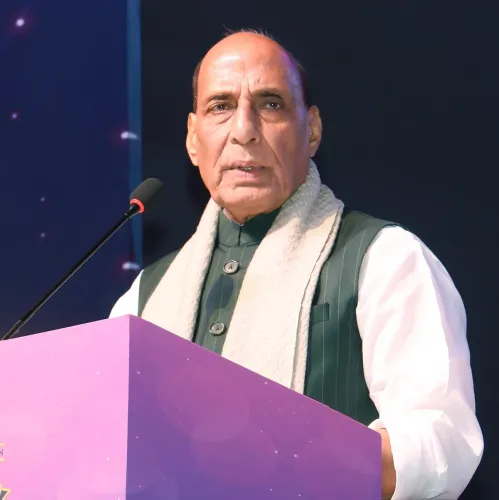
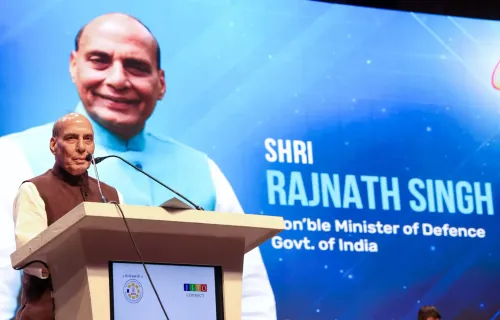
Nagpur, Jan 18 (NationPress) Defence Minister Rajnath Singh announced on Sunday that the Union government is dedicated to realizing 'Aatmanirbharta' (self-reliance) in the production of ammunition, aiming to position the country as a global manufacturing hub.
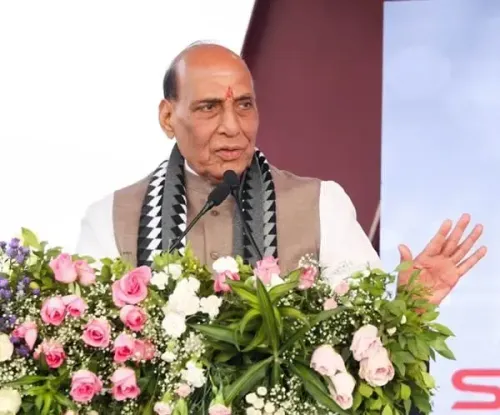
During the inauguration of the Medium Calibre Ammunition Manufacturing Facility at Solar Defence and Aerospace Limited in Nagpur, he recalled the challenges posed by ammunition shortages that affected the nation's defence readiness, leading the government to prioritize self-sufficiency in this sector.
The newly inaugurated facility is a fully automated plant designed for the production of 30mm ammunition, which is widely utilized by both the Indian Army and the Indian Navy.
Singh also visited the Pinaka Rocket manufacturing site and marked the commencement of the first batch of Guided Pinaka rockets being sent to Armenia.
Applauding the role of the private sector in enhancing the defence industry's 'Aatmanirbhar' (self-reliant) status, the Defence Minister highlighted the nation's progress in ammunition production, emphasizing the quality and reliability of the products being developed.
He specifically recognized the delivery of the multi-mode hand grenade, an entirely Indian-made product produced by the private sector, to the Indian Army in 2021.
Singh mentioned that the Nagastra drones, developed by the Solar Group, were successfully deployed during Operation Sindoor, effectively targeting terrorist positions and showcasing their strategic capabilities.
He expressed confidence in the advancements of the Nagastra, stating that the weapon systems will be highly effective against adversaries if required in future conflicts.
Rajnath Singh noted that the successful test launch of the 'Bhargavastra' Counter Drone System, developed by the Solar Company, reflects the technological prowess of the private sector.
Additionally, he mentioned that exports of Pinaka missiles from the facility have commenced, showcasing the defence industry's potential to bolster the country’s export capabilities.
He emphasized that India is transitioning from being a mere importer to rapidly evolving into an exporter of defence products.
The Defence Minister underlined that the Union government aims for the private sector's contribution to defence manufacturing to reach 50% or more.
Rajnath Singh expressed optimism that the private sector's capabilities and innovations will soon realize this goal.
He added, “Even for items we cannot produce, we have ensured at least 50% indigenous content is mandated. These initiatives have successfully increased our local content in various sectors, boosting the morale of private enterprises.”
Listing the achievements resulting from the government’s unwavering emphasis on self-reliance, the Defence Minister stated that domestic defence production has surged from just Rs 46,425 crore in 2014 to a remarkable Rs 1.51 lakh crore today.
He highlighted that over Rs 33,000 crore of this output comes from the private sector, signifying that private companies are becoming integral partners in realizing the vision of 'Aatmanirbhar Bharat'.
Moreover, he pointed out that the increasing involvement of the private sector has propelled India’s defence exports, which were under Rs 1,000 crore a decade ago, to a record of Rs 24,000 crore.
Rajnath Singh declared that India possesses a unique and effective amalgamation of both public and private sectors in its defence manufacturing ecosystem, calling this synergy the nation’s greatest strength.
The Union Minister referred to Operation Sindoor as a prime example of the significance of self-reliance for the country.
He underscored the complexity of modern warfare, emphasizing the necessity for the nation to prepare itself for such challenges.
Point of View
It's vital to recognize the Union government's strategic focus on self-reliance in defence. This commitment not only enhances national security but also fosters innovation and growth within the private sector. By collaborating with private entities, India can significantly reduce its dependency on foreign ammunition supplies, paving the way for a robust defence ecosystem. Overall, this initiative is a crucial step towards ensuring the nation's preparedness in an increasingly complex global landscape.
NationPress
30 Sept 2026
Frequently Asked Questions
What is the government's goal regarding ammunition production?
The government is committed to achieving self-reliance in ammunition production, aiming to establish India as a global manufacturing hub.
What does 'Aatmanirbharta' mean?
'Aatmanirbharta' translates to self-reliance, emphasizing the importance of local production and reducing dependency on imports.
How has the private sector contributed to defence manufacturing?
The private sector has played a crucial role in increasing domestic production and innovation, now contributing over Rs 33,000 crore to defence manufacturing.
What are some products being developed in India?
India is now producing various defence products, including multi-mode hand grenades and advanced rocket systems like the Pinaka.
What are the expected benefits of this initiative?
The initiative aims to enhance national security, boost local employment, and increase India's export potential in defence products.