How Global Rivalries and AI Technology are Transforming Security Threats

Synopsis
US intelligence warns that the rapidly advancing technologies of AI and missile systems are intensifying the rivalry with China and Russia, reshaping the global security environment. This evolving landscape includes new missile threats and sophisticated cyber operations.
Key Takeaways
China and Russia are key strategic competitors to the US.
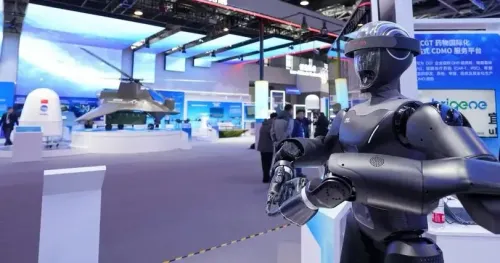
Advancements in AI are reshaping military and cyber operations.
Missile threats are projected to increase significantly by 2035.
Non-state actors are launching more sophisticated ransomware attacks .
Competition is growing in space and the Arctic .
Washington, March 19 (NationPress) The United States faces growing strategic competition from China and Russia, according to US intelligence officials, who highlighted that swift advancements in artificial intelligence, cyber capabilities, and missile systems are fundamentally altering the global threat landscape.
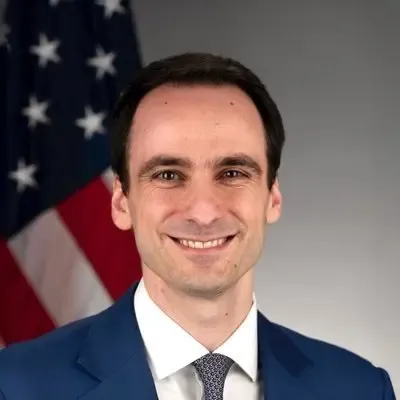
During a Congressional hearing, the Director of National Intelligence Tulsi Gabbard indicated that the intersection of technological and geopolitical rivalries is creating a more unpredictable and perilous security environment.
“The Intelligence Community (IC) evaluates that China stands as the most formidable competitor in the realm of artificial intelligence,” she remarked, emphasizing that AI is becoming pivotal in both civilian and military sectors.
She further noted that adversarial nations are increasingly incorporating AI into cyber operations, intelligence collection, and decision-making on the battlefield.
“Innovations in artificial intelligence will likely heighten these threats within the cyber domain,” Gabbard warned lawmakers.
According to the assessment, China and Russia are viewed as the most active and capable actors in both cyber and military realms.
“The IC believes that China and Russia pose the most enduring and active threats,” she stated, referencing their ongoing attempts to infiltrate US government and private sector networks.
The intelligence report also underscored the escalating missile threats directed at the United States.
“The IC projects that threats to the homeland could exceed 16,000 missiles by 2035, up from the current estimate of over 3,000,” Gabbard explained.
China and Russia are advancing sophisticated systems intended to breach US defenses.
“The IC assesses that these nations are developing advanced delivery methods designed to penetrate or evade US missile defense systems,” she stated.
North Korea and Iran are also integral to this expanding threat landscape, with Pyongyang continuing to enhance its nuclear and missile capabilities while Iran maintains a technological base for pursuing long-range systems.
Beyond conventional military threats, the intelligence community cautioned that cyber threats are becoming more intense in both scale and complexity.
Notably, North Korea's cyber activities “likely pilfered $2 billion” in cryptocurrency by 2025, financing its weapon initiatives, according to Gabbard.
Meanwhile, financially and ideologically driven non-state actors are launching more aggressive ransomware campaigns.
“Ransomware groups are now shifting to quicker, high-volume attacks that are more challenging to identify and counter,” she noted.
AI is compounding these dangers by facilitating faster and more intricate operations, including data extortion campaigns targeting governments, healthcare facilities, and public services.
The intelligence community also pointed out that competition is intensifying in emerging arenas such as space and the Arctic.
“The IC perceives the space sector as increasingly contested, as China and Russia develop counterspace capabilities,” Gabbard remarked.
In the Arctic, Russia is bolstering its military infrastructure, while China seeks both economic and strategic advantages.
“The IC assesses that Russia is deploying additional military forces and establishing new permanent facilities,” she noted.
The overall global environment is characterized by rising instability and an increased readiness among nations to resort to force.
“The global security landscape is marked by volatility and complexity, with armed conflicts becoming more prevalent,” Gabbard stated.
She added that strategic adversaries are increasingly inclined to combine military, economic, and technological means to further their objectives.
The annual threat assessment highlights a shift towards multi-domain competition, where AI, cyber power, and advanced weaponry converge with traditional geopolitical rivalries.
Point of View
It's crucial to recognize the implications of technological advancements on global security. The report emphasizes the need for vigilance and strategic planning to address the multifaceted threats posed by state actors like China and Russia.
NationPress
19 Sept 2026
Frequently Asked Questions
What are the main threats identified by US intelligence?
The US intelligence community has identified persistent threats from China and Russia, particularly in artificial intelligence, cyber operations, and missile capabilities.
How is artificial intelligence impacting security?
AI is being integrated into military and cyber operations, enhancing the capabilities of adversaries and accelerating threats in these domains.
What is the projected growth of missile threats?
The intelligence community estimates that missile threats to the US could grow from over 3,000 to more than 16,000 by 2035.
What role do non-state actors play in cybersecurity threats?
Non-state actors are increasingly launching aggressive ransomware campaigns, complicating the cybersecurity landscape.
How does the competition extend beyond traditional military domains?
Competition is intensifying in emerging areas like space and the Arctic, with nations developing countermeasures and expanding military infrastructures.