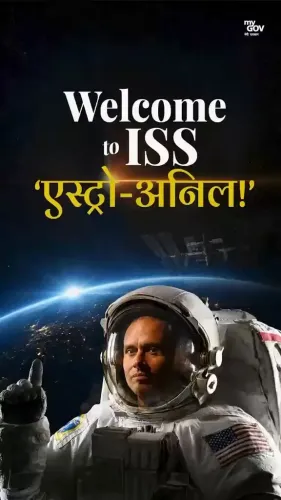
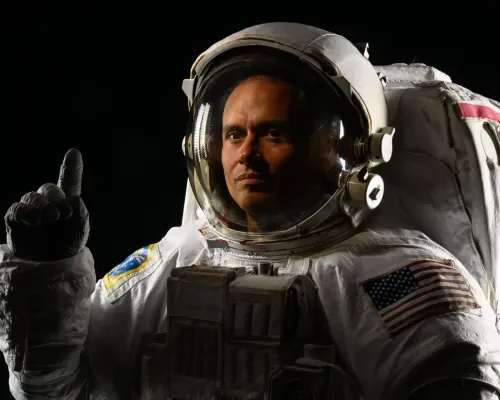
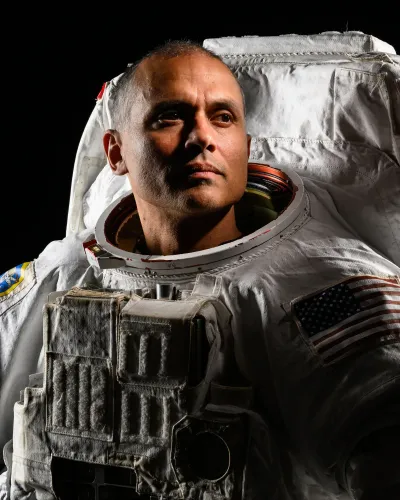
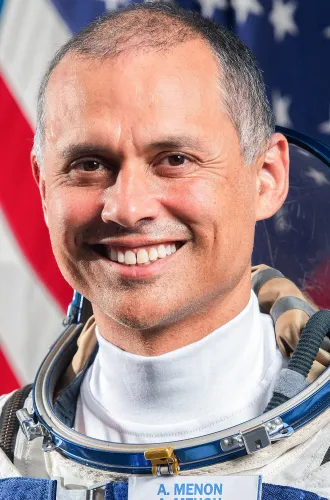
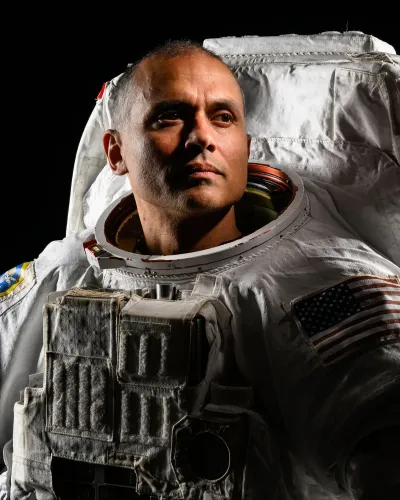
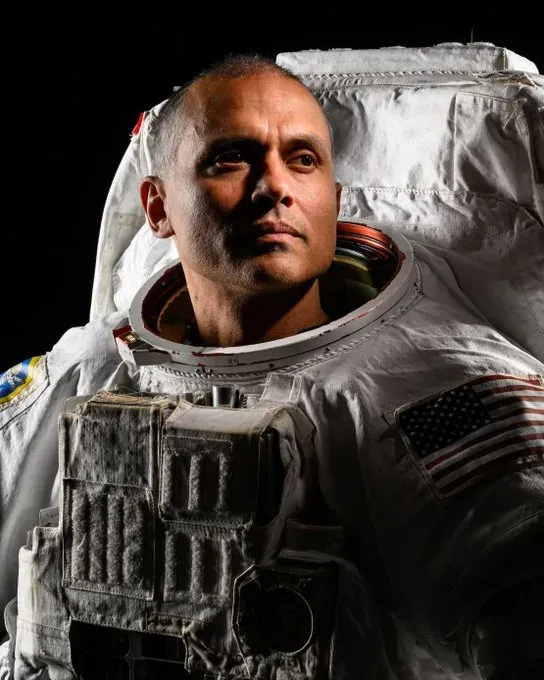
Anil Menon reaches ISS aboard Soyuz MS-29 on first spaceflight
Synopsis
Indian-origin NASA astronaut Anil Menon has reached the International Space Station for the first time, arriving aboard Russia's Soyuz MS-29 on 15 July for an eight-month mission that spans semiconductor crystal production in microgravity, AI-assisted ultrasound diagnostics, and bioprinting of vascular tissue — research with implications far beyond orbit.
Key Takeaways
Anil Menon , Indian-origin NASA astronaut, docked with the ISS on 15 July aboard Soyuz MS-29 — his first spaceflight.
He is joined by Roscosmos cosmonauts Pyotr Dubrov and Anna Kikina ; the trio will remain aboard until April 2027 .
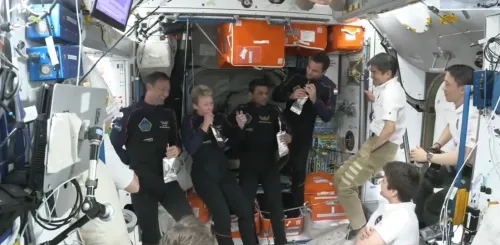
The crew's arrival raised the ISS headcount to 10 for approximately two weeks.
Menon's research covers semiconductor crystal production , AI-assisted ultrasound , blood-flow studies, and bioprinting of vascular constructs in microgravity.
Expedition 75 begins 26 July ; command transfers from Kud-Sverchkov to Meir on 25 July .
Menon is also a board-certified emergency physician with the American Board of Emergency Medicine (ABEM) .
Indian-origin NASA astronaut Anil Menon arrived at the International Space Station (ISS) on 15 July, beginning his first spaceflight as part of an eight-month mission centred on scientific research and technology demonstrations. Menon launched aboard Russia's Soyuz MS-29 spacecraft from the Baikonur Cosmodrome in Kazakhstan and docked with the station's Prichal module at 1:52 p.m. EDT after a three-hour, two-orbit journey.
The Journey to the Orbiting Laboratory
Liftoff occurred at 10:47 a.m. EDT (7:47 p.m. local time), with Menon joined by Roscosmos cosmonauts Pyotr Dubrov and Anna Kikina. The arrival of the three-member crew brought the station's total complement to 10 for approximately the next two weeks. This is Menon's first journey to space, while both Dubrov and Kikina are on their second missions.
What Menon Said Before Launch
Ahead of liftoff, Menon posted on X: 'Proud to serve the United States Space Force and fly to the International Space Station today in support of NASA and our international partners!' In a separate message, he wrote: 'Excited to launch aboard Soyuz MS-29 from Kazakhstan and begin an eight-month mission supporting NASA and Expedition 74/75. Grateful for the NASA community, friends, family, and loved ones and excited for tomorrow.'
Key Research Objectives Aboard the ISS
During his stay, Menon will conduct a range of experiments with direct implications for both space exploration and life on Earth. His work includes refining the in-space production of semiconductor crystals — a process that could enable large-scale manufacturing of components for high-performance computers, artificial intelligence systems, and advanced medical devices.
Menon will also deploy ultrasound techniques using augmented reality and AI methods that could reduce dependence on Earth-based medical support for future deep-space missions. Additionally, he will serve as a test subject in studies examining how blood flow changes in microgravity and will test bioprinting of vascular constructs to advance understanding of ageing and therapeutic development.
Crew Handover and Mission Timeline
Menon, Dubrov, and Kikina are scheduled to remain aboard the ISS until April 2027. They were welcomed by Expedition 74 crew members including NASA astronauts Jessica Meir, Jack Hathaway, and Chris Williams; European Space Agency (ESA) astronaut Sophie Adenot; and Roscosmos cosmonauts Sergey Kud-Sverchkov, Sergei Mikaev, and Andrey Fedyaev.
Expedition 75 is scheduled to begin on 26 July, following the departure of Williams, Kud-Sverchkov, and Mikaev after completing their own eight-month science mission. A change-of-command ceremony is set for 25 July, when station command will transfer from Kud-Sverchkov to Meir.
The American Board of Emergency Medicine (ABEM) — where Menon holds board certification as an emergency physician — also congratulated him on a successful launch and wished the crew a safe mission. The ISS has maintained a continuous human presence for more than 25 years, serving as a microgravity laboratory for research in medicine, engineering, biology, and materials science.
Point of View
But for the breadth of its scientific agenda — semiconductor manufacturing, AI diagnostics, and bioprinting represent three of the most commercially consequential frontiers in applied science. What mainstream coverage often underplays is the dual-use nature of this research: the same microgravity semiconductor process that could improve AI chips also has defence applications, and the AI-ultrasound work could reshape remote healthcare delivery on Earth. The eight-month duration also means Menon's data will contribute to long-duration mission planning for the Moon and Mars — making this far more than a symbolic flight.
NationPress
13 Oct 2026
Frequently Asked Questions
Who is Anil Menon and why is his ISS mission significant?
Anil Menon is an Indian-origin NASA astronaut and board-certified emergency physician who arrived at the International Space Station on 15 July for his first spaceflight. His eight-month mission covers cutting-edge research in semiconductor production, AI-assisted medical diagnostics, and bioprinting in microgravity — with applications for both deep-space exploration and life on Earth.
Which spacecraft carried Anil Menon to the ISS?
Menon launched aboard Russia's Soyuz MS-29 spacecraft from the Baikonur Cosmodrome in Kazakhstan. The spacecraft docked with the ISS's Prichal module at 1:52 p.m. EDT on 15 July after a three-hour, two-orbit journey.
How long will Anil Menon stay on the International Space Station?
NASA has confirmed that Menon, along with cosmonauts Pyotr Dubrov and Anna Kikina, will remain aboard the ISS until April 2027 — an approximately eight-month stay spanning Expeditions 74 and 75.
What research will Anil Menon conduct aboard the ISS?
Menon's research agenda includes refining in-space production of semiconductor crystals for high-performance computing and AI systems, performing AI-assisted ultrasound diagnostics, studying blood-flow changes in microgravity, and bioprinting vascular constructs to advance understanding of ageing and therapeutic development.
What is Expedition 75 and when does it begin?
Expedition 75 is the next phase of the ISS crew rotation, scheduled to begin on 26 July following the departure of NASA astronaut Chris Williams and Roscosmos cosmonauts Sergey Kud-Sverchkov and Sergei Mikaev. A change-of-command ceremony on 25 July will transfer station command from Kud-Sverchkov to NASA astronaut Jessica Meir.