Anne Carson wins Nobel Literature Prize 2026 for classical retellings
Synopsis
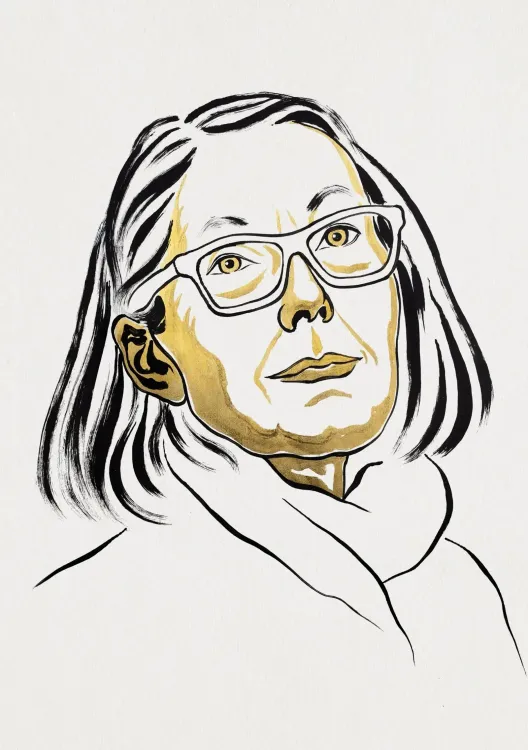
Anne Carson, the 76-year-old Canadian classicist who made Sappho and Euripides speak to modern audiences — and who once mapped Marilyn Monroe onto Helen of Troy — has won the Nobel Prize in Literature 2026. Her award marks a rare validation of genre-defying, academically rooted writing, and is only the second Nobel in Literature for Canada in over a decade.
Key Takeaways
Anne Carson , 76 , won the Nobel Prize in Literature 2026 on 8 October 2026 .
The Swedish Academy cited her 'bold and inventive oeuvre' that creates 'new forms for contemporary literature' in dialogue with the classical tradition.
Carson is the third Canadian to win the Nobel in Literature and the first since Alice Munro in 2013 .
She is the fifth woman to receive the prize in the last ten years , following South Korea's Han Kang in 2024 .
Her work spans ancient Greek translation, poetry, comic books, and performance — including 'Norma Jeane Baker of Troy' ( 2019 ), juxtaposing Marilyn Monroe and Helen of Troy .
Her debut work 'Eros the Bittersweet' ( 1986 ) gained popular recognition through its reference in American TV drama 'The L Word' .
Canadian classicist and author Anne Carson was awarded the Nobel Prize in Literature 2026 on 8 October 2026, becoming the third Canadian to receive the honour and the first since Alice Munro claimed it in 2013. The Swedish Academy cited her 'bold and inventive oeuvre that, in playful dialogue with the classical tradition, has created new forms for contemporary literature.'
Why Carson Won
Carson, 76, has spent decades dismantling the boundaries between poetry, prose, fiction, nonfiction, and translation, producing a body of work that draws equally from ancient Greek tragedy and twentieth-century pop culture. Her refusal to stay within any single genre has made her one of the most formally adventurous writers in the English language. She is the fifth woman to receive the Nobel in Literature in the last ten years, following South Korea's Han Kang, who won in 2024.
The Classical Tradition Reimagined
Carson's scholarly roots lie in classical Greek and Latin literature, and her translations have introduced ancient texts to new generations of readers. Her translation catalogue includes 'Electra' (2001), drawn from Sophocles; 'If Not, Winter' (2002), a rendering of the fragments of Greek poetess Sappho; 'Grief Lessons' (2006), gathering four plays by Euripides; and 'An Oresteia' (2009), which brings together works by Aeschylus, Sophocles, and Euripides. She also translated 'Antigone' and 'Bakkhai', both in 2015.
Her influences stretch well beyond antiquity. Carson has drawn on novelists such as Emily Brontë, poets including John Keats, German philosophers Georg Wilhelm Friedrich Hegel and Martin Heidegger, and writers as varied as Franz Kafka and Virginia Woolf.
Landmark Works Across Decades
Carson's first published work, 'Eros the Bittersweet: An Essay' (1986), was a reworked version of her 1981 doctoral thesis, examining the concept of 'eros' — the state of being in love — as it appeared in ancient Greek writing. The text later gained wider popular recognition when it was referenced in the debut season of the American television drama 'The L Word', in an exchange between the characters Jenny and Marina.
Her poetry collection 'The Beauty of the Husband: A Fictional Essay in 29 Tangos' (2001) fuses erotic, painful, and heartbreaking scenes from a failing marriage, and was dedicated to Keats for his definition of beauty in 'Ode on a Grecian Urn'. 'Men in the Off Hours', another eclectic collection, weaves together short poems, verse essays, epitaphs, interviews, scripts, and translations, referencing figures from Anna Akhmatova and Aristotle to Sigmund Freud and Leo Tolstoy.
Among her most striking recent works is the spoken-word performance piece 'Norma Jeane Baker of Troy', which debuted in New York City in 2019. The work superimposes Marilyn Monroe over the legendary Helen of Troy, loosely inspired by Euripides's 412 BCE play 'Helen'. Her 2021 work 'The Trojan Women: a Comic' retells Euripides' classic in comic-book form, recounting the fates of Queen Hecuba, Andromache, and Kassandra after the fall of Troy — a timeless indictment of warfare's impact on non-combatants.
Historical Context
Carson's win extends a run of women laureates in literature that reflects a broader shift at the Swedish Academy following its institutional reform in recent years. Notably, this is only the second time in over a decade that a Canadian has claimed the prize, underlining how rarely the Nobel reaches North American literature despite its global stature. Her victory is expected to drive significant renewed interest in both her own works and in the ancient texts she has spent her career translating and reinterpreting.
What Comes Next
Carson will formally receive the prize at the Nobel Prize Award Ceremony in Stockholm in December 2026. Publishers and literary organisations worldwide are expected to announce fresh editions and academic programmes centred on her catalogue in the weeks ahead.
Point of View
Long celebrated in universities and niche literary circles, has remained largely outside mainstream readerships despite decades of critical acclaim; the Nobel may change that overnight. The prize also continues a pattern of the Academy rewarding writers who expand what a 'literary form' can be, a deliberate corrective to decades of conventional fiction dominance on the laureate list.
NationPress
8 Oct 2026
Frequently Asked Questions
Who is Anne Carson and why did she win the Nobel Prize in Literature 2026?
Anne Carson is a 76-year-old Canadian classicist, poet, and translator known for blending ancient Greek and Latin literary traditions with modern forms. The Swedish Academy awarded her the 2026 Nobel Prize in Literature for her 'bold and inventive oeuvre that, in playful dialogue with the classical tradition, has created new forms for contemporary literature.'
Is Anne Carson the first Canadian to win the Nobel Prize in Literature?
No — Carson is the third Canadian to win the Nobel in Literature. She is the first Canadian to receive the prize since Alice Munro won it in 2013.
What are Anne Carson's most famous works?
Carson's most noted works include 'Eros the Bittersweet' (1986), 'If Not, Winter' (2002) — a translation of Sappho — 'The Beauty of the Husband' (2001), 'Norma Jeane Baker of Troy' (2019), and 'The Trojan Women: a Comic' (2021). Her debut essay was also referenced in the American TV series 'The L Word.'
How does Anne Carson's 2026 Nobel fit into recent prize history?
Carson is the fifth woman to win the Nobel in Literature in the last ten years, following South Korea's Han Kang, who won in 2024. Her award reflects the Swedish Academy's continued recognition of formally experimental and genre-defying writing.
What classical authors has Anne Carson translated?
Carson has translated works by major ancient Greek writers including Aeschylus, Euripides, Homer, Sappho, Sophocles, and Thucydides, as well as the Roman poet Catullus. Her translations include 'Electra' (2001), 'If Not, Winter' (2002), 'Grief Lessons' (2006), 'An Oresteia' (2009), and 'Bakkhai' (2015).