Assam floods hit 22,000 people across 6 districts; rail bridge partly collapses

Synopsis
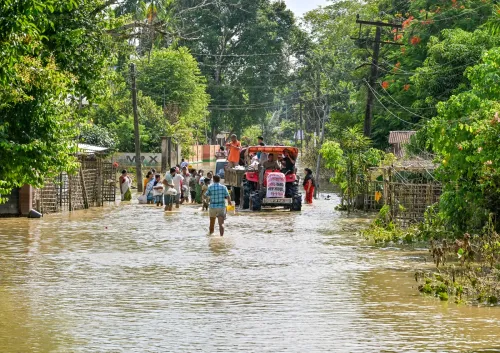
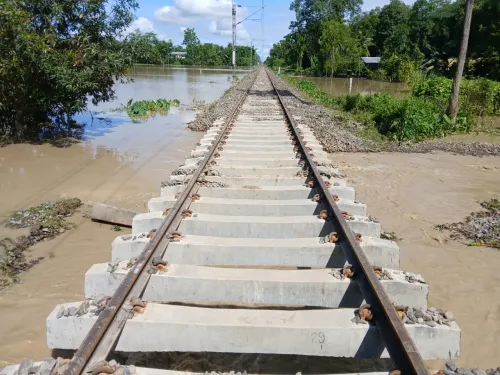
Assam's first major flood wave of the monsoon season has struck more than 22,000 people across six districts — and now a 60-year-old railway bridge over the Simen River has partially collapsed in the worst-hit district of Dhemaji, halting train services and raising the stakes for a region bracing for further rainfall.
Key Takeaways
22,124 people across six districts in Assam have been affected by the first wave of floods as of 29 June .
Dhemaji is the worst-hit district, with 15,483 people impacted and 96 villages submerged statewide.
Nearly 1,690 hectares of agricultural land has been damaged, with 48,199 animals also affected.
A railway bridge over the Simen River in Dhemaji , originally built in 1965 , partially collapsed after riverbank erosion triggered by over 110 mm of rainfall.
Train services between Archipathar and Simen Chapari stations have been suspended by Northeast Frontier Railway (NFR) until further notice.
The Disang River in Sivasagar is flowing above danger level at Nanglamuraghat , signalling risk of further inundation.
The first wave of floods in Assam has affected more than 22,124 people across six districts following incessant rainfall in the state and neighbouring Arunachal Pradesh, according to officials on Monday, 29 June. The deluge has submerged villages, damaged cropland, and triggered the partial collapse of a railway bridge, compounding the crisis across the region.
Scale of the Flooding
According to the Assam State Disaster Management Authority (ASDMA), the affected districts are Dhemaji, Nalbari, Dibrugarh, Chirang, Lakhimpur, and Kokrajhar. Dhemaji is the worst-hit, with 15,483 people reeling under floodwaters after continuous rainfall inundated vast stretches of the district.
Floodwaters have submerged 96 villages and damaged nearly 1,690 hectares of agricultural land, disrupting standing crops and threatening the livelihoods of thousands of farmers. Livestock has not been spared either — officials confirmed that 48,199 animals have been affected during the ongoing deluge.
Railway Bridge Partially Collapses in Dhemaji
Heavy rainfall exceeding 110 mm in and around Dhemaji triggered severe riverbank erosion near a railway bridge over the Simen River, causing its partial collapse. The bridge, originally constructed in 1965 and later converted to broad gauge, had been considered structurally sound until continuous rainfall washed away a substantial portion of the riverbank, destabilising one of the structure's piers.
The Chief Public Relations Officer (CPRO) of the Northeast Frontier Railway (NFR) confirmed that train services between Archipathar and Simen Chapari stations have been suspended until further notice as a precautionary measure. The disruption is expected to impact rail connectivity across the region for an indeterminate period.
River Levels and Further Flood Risk
The ASDMA flood bulletin noted that the Disang River in Sivasagar district is flowing above the danger level at Nanglamuraghat, raising concerns over further inundation in low-lying areas if rainfall persists. This comes amid forecasts of continued heavy rainfall across several parts of Assam and adjoining Arunachal Pradesh.
Notably, Assam's flood season typically unfolds in multiple waves between June and September, with the Brahmaputra basin and its tributaries historically breaching danger marks repeatedly each year. The current deluge represents the first major flood event of the 2025 monsoon season in the state.
Administration on Alert
District administrations across the affected areas have been directed to remain on high alert and implement precautionary measures to manage any further deterioration. Authorities are closely monitoring the situation as rainfall continues across the region, with the ASDMA issuing regular bulletins to track the evolving crisis.
With river levels still elevated and monsoon activity showing no signs of abating, relief and rescue operations are expected to intensify in the coming days.
Point of View
But why relief frameworks remain reactive rather than anticipatory. With the Disang already above danger level and multiple monsoon waves still ahead, the six affected districts are unlikely to see floodwaters recede before further damage accumulates.
NationPress
27 Sept 2026
Frequently Asked Questions
How many people have been affected by the Assam floods in June 2025?
According to the Assam State Disaster Management Authority (ASDMA), a total of 22,124 people have been affected across six districts — Dhemaji, Nalbari, Dibrugarh, Chirang, Lakhimpur, and Kokrajhar — following heavy rainfall on 29 June 2025.
Which district is worst affected by the Assam floods?
Dhemaji is the worst-affected district, with 15,483 people impacted. Continuous rainfall inundated vast stretches of the area and also caused the partial collapse of a railway bridge over the Simen River.
What happened to the railway bridge in Dhemaji?
A railway bridge over the Simen River in Dhemaji district partially collapsed after rainfall exceeding 110 mm caused severe riverbank erosion, destabilising one of the bridge's piers. The bridge was originally built in 1965 and later converted to broad gauge. Northeast Frontier Railway (NFR) has suspended train services between Archipathar and Simen Chapari stations until further notice.
Is there a risk of further flooding in Assam?
Yes. The Disang River in Sivasagar district is currently flowing above the danger level at Nanglamuraghat, raising concerns about further inundation in low-lying areas if rainfall continues. District administrations have been placed on high alert.
How much agricultural land has been damaged in the Assam floods?
Nearly 1,690 hectares of agricultural land has been damaged across the affected districts, disrupting standing crops and threatening the livelihoods of thousands of farmers. Additionally, 48,199 animals have been affected by the flooding.