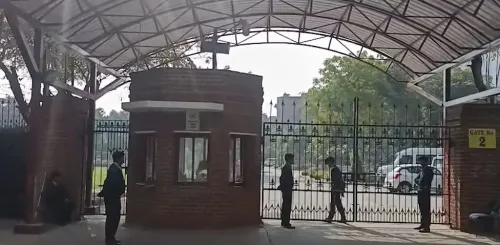
Is Bhopal's People's University Under Threat from a Bomb Scare?

Synopsis
A bomb scare at People's University in Bhopal has sent shockwaves through the community. As panic ensues, police are investigating the threatening email claiming explosives are planted on campus. The situation raises serious concerns about safety and security in educational institutions. What measures are being taken to ensure the safety of students and staff?
Key Takeaways
A bomb threat caused chaos at People's University in Bhopal.
The threat was communicated via email, alleging explosive devices on campus.
Campus officials took prompt action, notifying local authorities.
Search operations revealed no suspicious materials so far.
Investigations are ongoing to determine the email's authenticity.
Bhopal, Feb 19 (NationPress) A bomb scare communicated via email has generated significant alarm at People's University, a private educational establishment located in the heart of Madhya Pradesh's capital, Bhopal. This prompted local authorities to take immediate action, launching a thorough search both within and around the campus on Thursday, as confirmed by officials.
As per official reports, a bomb threat was sent to the university dean's official email around 11 a.m., claiming that cyanide bombs had been secretly placed within the university building.
The email also included religious slogans, amplifying the concern.
In response to the threat, the university's administration promptly notified the Nishatpura police station.
For safety reasons, the university's management initiated an evacuation.
A police unit, accompanied by a bomb disposal team and search dogs, arrived at the scene to conduct a comprehensive examination of the campus.
While police stated that no suspicious materials were discovered by the designated time, the search operation continues.
The alarming email claimed, "Members of the MNS and Pak 151 cell have targeted your medical college today by planting twin IEDs, both of which are designed to release cyanide gas upon detonation."
The sender of the email ominously added, "We are left with no other option to voice our demands. If they are not met, we will resort to self-detonation within the medical college, similar to the tragic Sri Lankan Easter attacks. Your institution is currently the easiest target. We accept responsibility for this and will ensure our message is heard."
Authorities are currently conducting a technical analysis of the email.
The cyber cell is actively investigating the sender's email address and server details.
A police spokesperson indicated that early investigations lean towards the possibility of this being a prank or a hoax, with no security threats identified thus far.
Point of View
It's crucial to approach this incident with caution and responsibility. The bomb threat at People's University is alarming and underscores ongoing issues of safety in educational environments. While preliminary investigations suggest it may be a false alarm, the emotional impact on students and faculty cannot be underestimated. Our commitment is to report accurately and sensitively as the story unfolds.
NationPress
7 Oct 2026
Frequently Asked Questions
What triggered the bomb threat at People's University?
An email claiming there were cyanide bombs planted at the campus was received by the university's dean, prompting an immediate police response.
How are authorities responding to the situation?
The police, along with a bomb disposal team, conducted a thorough search of the campus and surrounding areas.
Was anything dangerous found during the search?
As of now, no suspicious objects or explosives have been found, but the search is ongoing.
What does the content of the threatening email entail?
The email included threats regarding the use of explosives and referenced past violent incidents to demand attention to certain grievances.
What steps are being taken to investigate the sender of the email?
The cyber cell is examining the email's ID and server location to identify the sender.