What Are the Two Essential Finance Schemes Launched to Enhance MSME Exports?
Synopsis
Discover how the Indian government is enhancing MSME exports through two groundbreaking finance schemes. With affordable access to trade finance and collateral support, these initiatives aim to empower exporters and strengthen India's global market presence. Read on to learn about the key features and expected impact of these programs!
Key Takeaways
Two key interventions launched to bolster MSME exports.
Interest subvention of 2.75% for pre- and post-shipment credit.
Collateral guarantees up to 85% for small exporters.
Total outlay for the Export Promotion Mission is Rs 25,060 crore .
Focus on strengthening India’s export competitiveness .
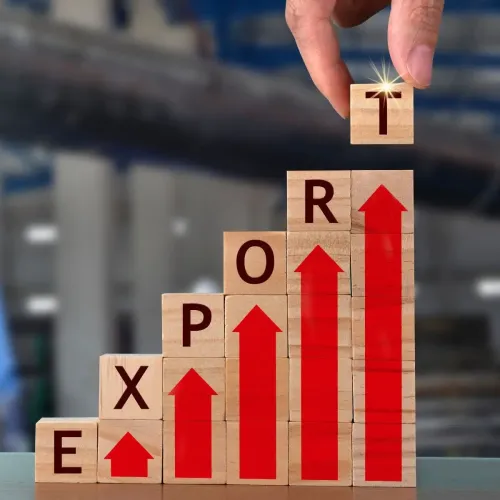
New Delhi, Jan 2 (NationPress) – As part of its initial rollout for the Export Promotion Mission, the government has introduced two significant measures under the Niryat Protsahan sub-scheme aimed at bolstering MSME exports by offering affordable and simplified access to trade financing, as stated by the Commerce Ministry on Friday.
The first measure focuses on interest subvention for both pre- and post-shipment export credit, which is intended to lower the cost of export credit and alleviate working capital challenges experienced by MSME exporters, according to the Ministry's announcement.
This initiative will provide interest subvention on rupee export credit for pre- and post-shipment purposes, extended by qualifying lending institutions.
A base interest subvention of 2.75% has been established, with potential additional incentives for exports to designated under-represented or emerging markets, subject to operational readiness.
The interest subvention applies solely to exports included in a specified positive list of tariff lines aligned with the Harmonised System six-digit level, encompassing around 75% of India’s tariff lines and demonstrating significant MSME involvement. An annual cap of Rs 50 lakh per exporter has been set for the financial year 2025–26. The rates will undergo a biannual review in March and September to align with domestic and global benchmarks.
The positive list has been formulated using a transparent, data-oriented approach, emphasizing labour-intensive and capital-intensive sectors, MSME concentration, and value addition, while excluding restricted and prohibited items, waste, and products already benefiting from overlapping incentive schemes. Products related to defence and SCOMET have been included to facilitate strategic exports. The Reserve Bank of India will issue detailed operational guidelines for this initiative. A pilot rollout will be conducted, allowing for adjustments based on feedback from the implementation process.
The second measure under Niryat Protsahan addresses collateral support for export credit, targeting the constraints faced by MSME exporters to enhance their access to banking finance.
This initiative introduces a collateral guarantee for export credit, developed in collaboration with the Credit Guarantee Fund Trust for Micro and Small Enterprises (CGTMSE). Guarantee coverage will reach up to 85% for micro and small exporters and 65% for medium exporters, with a maximum guaranteed exposure of Rs 10 crore per exporter within a fiscal year.
This measure is intended to complement existing credit guarantee frameworks and to boost bank lending to export-oriented MSMEs. Comprehensive guidelines will be released by CGTMSE, followed by a pilot phase and subsequent integration into a broader revision of export promotion strategies.
Both measures will commence on a pilot basis, with ongoing monitoring and data-driven adjustments.
Through the Export Promotion Mission, the government aims to diminish the cost of exporting, broaden financial access, enhance India’s export brand, and diversify export markets. This will empower Indian exporters, especially MSMEs, to engage more deeply in global value chains and contribute to sustained export-led growth, the statement indicated.
The government has introduced a suite of initiatives under the Export Promotion Mission, a flagship program endorsed by the Union Cabinet on November 12, 2025, with a total budget of Rs 25,060 crore spanning FY 2025–26 to FY 2030–31. The Mission aims to fortify India’s export competitiveness, particularly focusing on MSMEs, first-time exporters, and labour-intensive sectors, while promoting market diversification and value-added exports.
The Export Promotion Mission is a joint effort of the Department of Commerce, the Ministry of MSME, and the Ministry of Finance. It consists of two interconnected sub-schemes: Niryat Protsahan, which facilitates access to affordable and diversified trade finance, and Niryat Disha, which aids in non-financial aspects such as market access, branding, regulatory compliance, logistics, and trade intelligence.
Point of View
I believe these initiatives mark a significant step towards empowering MSMEs in India. By providing easier access to financial resources, the government is not only fostering growth within the sector but also enhancing India's position in global trade. This is a holistic approach that addresses both financial and non-financial barriers faced by exporters.
NationPress
6 Oct 2026
Frequently Asked Questions
What is the purpose of the Niryat Protsahan sub-scheme?
The Niryat Protsahan sub-scheme aims to enhance MSME exports by providing affordable and easier access to trade finance.
What is the interest subvention rate for exporters?
A base interest subvention of 2.75% is provided for pre- and post-shipment export credit.
Who will benefit from the collateral support measure?
Micro and small exporters will receive up to 85% collateral guarantee support, while medium exporters will get up to 65%.
What is the maximum guaranteed exposure for exporters?
The maximum outstanding guaranteed exposure is Rs 10 crore per exporter in a financial year.
How will the success of these interventions be monitored?
The interventions will be implemented on a pilot basis with continuous monitoring and data-driven refinements.