Are China's Actions in the South China Sea Undermining International Legal Order?
Synopsis
A recent report highlights China's systematic violations of the international legal order in the South China Sea. As China asserts its claims while violating core UNCLOS provisions, the implications for maritime law and international relations are profound. Will the world allow these principles to be disregarded?
Key Takeaways
China's actions challenge international legal norms.
UNCLOS violations are symptomatic of broader regional tensions.
The Scarborough Shoal is a focal point of dispute.
International arbitration rulings must be respected.
Regional nations face increasing intimidation.
Naypyidaw, Feb 16 (NationPress) China’s actions represent a systematic attack on the international legal order. While claiming to uphold the United Nations Convention on the Law of the Sea (UNCLOS), China violates its fundamental principles, disseminates misleading information to disguise its violations, intimidates observers, and engages in bad faith negotiations. This indicates that the law is only significant to Beijing when it aligns with its own interests, according to a report released on Monday.
As reported by Myanmar’s media outlet 'The Irrawaddy', China’s professed dedication to international law appears insincere, particularly in light of increasing evidence of systematic breaches of the UNCLOS — a treaty ratified by Beijing back in 1996.
“The setting for these blatant transgressions is the South China Sea, where China asserts dubious claims of sovereignty over the Scarborough Shoal, a resource-laden atoll situated within the Philippines’ designated Exclusive Economic Zone. Known locally as Bajo de Masinloc and as Huangyan Island in China, the shoal has seen a sustained presence of the Chinese Coast Guard since a standoff in 2012, driven by both the rich fishing resources in the vicinity and its crucial position on international maritime routes,” the report elaborated.
“An international arbitration ruling in 2016 nullified China’s expansive claims, affirming that the shoal serves as a traditional fishing ground for multiple nations. Instead of complying with the arbitration to which it agreed, China has intensified its maritime aggression, accompanied by a coordinated campaign of disinformation to obscure its illegal actions,” it continued.
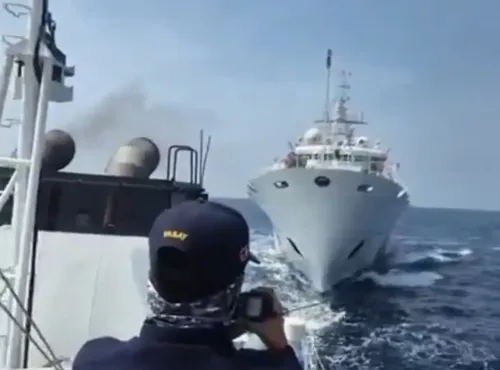
The report noted that the presence of China’s Coast Guard at Scarborough Shoal more than doubled in 2025, logging 1,094 “ship days” patrolling the area — up from 516 in 2024 — establishing a near-daily presence in the contested region.
If China can disregard binding tribunal decisions, violate ratified treaty commitments, and suppress facts through diplomatic coercion and narrative manipulation, it sets a perilous precedent.
“The Philippines, Vietnam, Malaysia, and Brunei have exhibited notable restraint and adherence to international law in the South China Sea, yet they have faced escalating intimidation, disinformation efforts, and coercion,” it stated.
“The international community is confronted with a pivotal choice: does maritime law afford coastal states enforceable rights within their Exclusive Economic Zones, or does it not? Are arbitration rulings binding, or merely advisory? Are UNCLOS signatories required to comply, or is international law merely a rhetorical device? China’s actions pose a significant challenge to the world: will it allow these principles to be disregarded?” the report questioned.
Point of View
It is crucial to acknowledge the implications of China's actions in the South China Sea. The persistent violations of international law challenge not only regional stability but also the credibility of global legal frameworks. The commitment to uphold UNCLOS must be reinforced by all signatories to ensure maritime rights are respected. The situation demands a unified international response to uphold the principles of law and order.
NationPress
29 Sept 2026
Frequently Asked Questions
What are China's claims in the South China Sea?
China claims sovereignty over several territories in the South China Sea, including the Scarborough Shoal, which lies within the Philippines' Exclusive Economic Zone.
What was the outcome of the 2016 arbitration ruling?
The 2016 arbitration ruling invalidated China's extensive claims in the South China Sea and affirmed that the Scarborough Shoal is a traditional fishing ground for several nations.
How has China's Coast Guard presence changed recently?
Reports indicate that China's Coast Guard presence at Scarborough Shoal more than doubled in 2025, with significant patrol activities aimed at asserting its claims.
What should the international community do?
The international community must uphold maritime law and support affected nations in their rights to enforce their sovereignty and resources in their Exclusive Economic Zones.