U.S. Congressional Hearing Raises Alarm on China's Chip Smuggling Activities

Synopsis
A recent U.S. congressional hearing has revealed alarming insights into China's efforts to smuggle advanced AI chips, highlighting significant national security risks. Lawmakers warn that these activities could reshape the tech landscape and global power dynamics.
Key Takeaways
China is leveraging both legal and illegal channels to acquire advanced AI chips from the U.S.
Lawmakers highlighted the growing national security threat posed by these activities.
Smugglers employ sophisticated tactics to evade detection.
AI's strategic importance is reshaping global geopolitics.
The competition between the U.S. and China could redefine future technological landscapes.
Concerns Grow Over China's Chip Smuggling Threat, Warns U.S. Panel
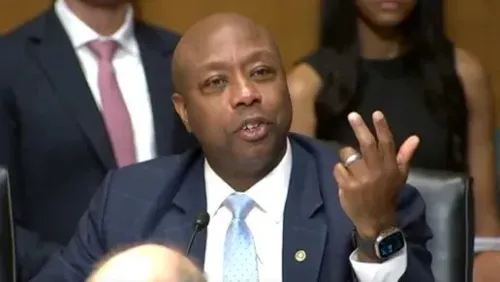
Washington, April 17, (NationPress) - A congressional hearing revealed that China is leveraging both legitimate purchases and illegal channels to secure advanced artificial intelligence chips from the U.S., which is raising significant national security alarms, according to American lawmakers and experts.
John Moolenaar, Chairman of the Select Committee, stated during the hearing, “China’s smuggling of advanced AI chips poses an extensive threat,” highlighting various cases that have been disrupted in the past year. He referenced a recent Justice Department case valued at $2.5 billion, labeling it “the largest export control violation in U.S. history.”
Lawmakers disclosed that alleged smugglers utilized intricate techniques to avoid detection. These tactics included removing serial numbers from devices and fabricating server shipments to conceal the transfer of restricted chips to China. Wally Liu was identified as one of the individuals involved in such activities.
The urgency of the situation is heightened by AI's critical role. “AI is truly transformative,” Moolenaar noted, emphasizing its current impact on warfare, governance, and industry.
Experts testifying before the committee asserted that China remains significantly reliant on Western technology throughout the AI supply chain. Despite substantial state investments, Chinese chip manufacturers still struggle to produce cutting-edge chips at scale and depend on foreign manufacturing tools and advanced semiconductors.
Dmitri Alperovitch, a cybersecurity specialist and former CTO of CrowdStrike, emphasized that the competition revolves around computing power. “The limiting factor in this competition is not talent, data, or capital… it ultimately comes down to compute,” he remarked.
He cautioned that China is prepared to take extreme measures to close the technological gap, including smuggling chips and establishing overseas data centers to bypass export controls. “We are in a race, and the stakes are incredibly high,” he warned.
Yusuf Mahmood outlined a wider campaign of technology theft, stating, “The CCP aims for complete AI domination by 2030… hence, it resorts to theft,” highlighting threats ranging from trade secret theft to cyber-enabled “distillation attacks” designed to replicate American AI systems.
Mahmood stressed that existing safeguards are insufficient. “We are not equipped to protect our AI systems,” he added, suggesting that stolen AI technology could already be assisting adversaries in military contexts.
Kyle Chan pointed out that while U.S. companies remain at the forefront of advanced AI models, he warned that China is heavily investing in creating a comprehensive ecosystem. “Export controls are not a cure-all… they have granted us some breathing room,” he noted.
AAndre Carson suggested that domestic policy choices might undermine America’s competitive position. “The easiest path for China to victory is if we undermine ourselves,” he argued, referring to immigration restrictions and funding cuts.
The hearing highlighted that competition in AI is increasingly influencing global geopolitics. U.S. officials view technological supremacy as essential not only for economic strength but also for military and strategic leverage.
This discussion arises amid escalating U.S.-China tensions concerning advanced technologies such as semiconductors, quantum computing, and artificial intelligence. Washington has enacted extensive export controls in recent years to restrict Beijing’s access to advanced chips, while China is intensifying its efforts to develop a self-sufficient semiconductor ecosystem.
Analysts believe that the outcome of this competition will have significant repercussions for global power dynamics, supply chains, and the future of digital governance.
Point of View
Focusing on the national security implications of China's chip smuggling efforts. Lawmakers and experts emphasize the urgency of addressing these challenges while maintaining a balanced perspective on technological competition.
NationPress
1 Oct 2026
Frequently Asked Questions
What is the main concern regarding China's chip smuggling?
The primary concern is that China is using both legal and illegal means to acquire advanced American AI chips, posing a significant national security threat.
What methods are alleged smugglers using?
Smugglers are reportedly using tactics such as removing serial numbers from equipment and creating fake server shipments to disguise the movement of restricted chips.
Why is AI considered transformative?
AI is viewed as transformative because it is reshaping warfare, governance, and various industries, making it critical for national security.
How dependent is China on Western technology?
Despite substantial investments, China remains heavily reliant on Western technology throughout the AI supply chain and struggles to produce cutting-edge chips independently.
What are the implications of this tech competition?
The competition between the U.S. and China over AI and technology has far-reaching implications for global power balances, supply chains, and digital governance.