Congress puts Bengal unit on notice: screen Trinamool inductees carefully
Synopsis
The AICC has effectively overruled a move by former state Congress chief Adhir Ranjan Chowdhury, who inducted five TMC leaders in Murshidabad without party high command approval. The directive — mandating AICC sign-off before any TMC member joins — puts those five inductions on hold and sends an unmistakable signal about where Chowdhury now stands in the Congress hierarchy.
Key Takeaways
The AICC has directed the West Bengal Pradesh Congress Committee to screen all prospective TMC inductees before granting formal membership.
Any list of candidates must first clear the Pradesh Congress Committee and then receive explicit AICC approval before induction.
The directive was triggered by former state Congress president Adhir Ranjan Chowdhury 's induction of five TMC leaders in Murshidabad on 23 August .
Among those inducted — and now on hold — is Mohammad Injamul Islam , chairman of the TMC -controlled Dhuliyan Municipality .
Political observers say the communique also serves as an indirect reprimand to Chowdhury , signalling reduced autonomy within the party structure.
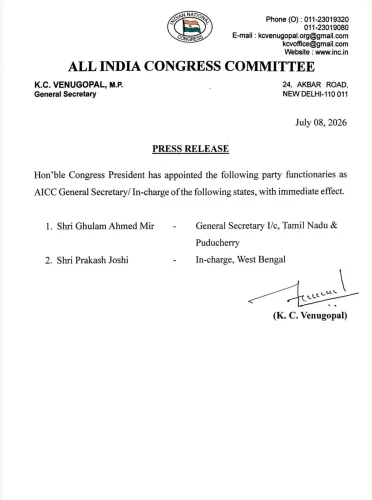
The All India Congress Committee (AICC) has issued a formal directive to the West Bengal Pradesh Congress Committee (WBPCC) to exercise strict scrutiny before inducting leaders and workers from the All India Trinamool Congress (TMC) into its ranks. The communication, sent by AICC in-charge for West Bengal Prakash Joshi to state Congress president Subhankar Sarkar, makes clear that organisational expansion cannot come at the cost of credibility.
What the AICC Directive Says
In his communique, Joshi stated that while inducting workers from other political parties or civil society is necessary to strengthen the Congress in the current political climate, the process must follow a defined protocol. Any list of prospective members must first be submitted to the Pradesh Congress Committee for an assessment of credentials, merits, and shortcomings. Formal induction can proceed only after the list receives explicit AICC approval.
'Under the present circumstances, it is necessary for strengthening the Congress Party that, wherever required, workers of other political parties or social workers should be inducted into the Congress. However, in such cases, it is equally important that the names or list of persons proposed to join the party should first be forwarded to the Pradesh Congress Committee,' the communique read, adding that senior party leaders are expected to ensure 'strict adherence' to this procedure.
The Murshidabad Incident That Triggered the Move
The directive followed a development on 23 August in Murshidabad district, where former state Congress president and five-time Lok Sabha member Adhir Ranjan Chowdhury personally inducted five former district-level TMC leaders into the Congress at a public programme in his native district. Among those inducted was Mohammad Injamul Islam, chairman of the TMC-controlled Dhuliyan Municipality in Murshidabad.
Joshi's communique has indirectly confirmed that the 23 August episode prompted the AICC to impose this screening requirement. As an immediate consequence, the formal inclusion of all five Murshidabad leaders has been placed on hold pending review.
A Signal to Adhir Ranjan Chowdhury
Political observers in West Bengal read the directive as a pointed message to Chowdhury, signalling that the party high command will no longer accept unilateral decisions — a departure from the latitude he enjoyed when he served as state Congress president and as a sitting Lok Sabha member. Chowdhury's diminished standing within the party hierarchy appears to be a subtext of the communication, even if it stops short of naming him explicitly.
Broader Context: Congress in a Changed Bengal
The directive comes as the Congress attempts to recalibrate its presence in West Bengal, where the TMC has dominated state politics for over a decade and the party's own electoral footprint has shrunk considerably. While the AICC acknowledges the need to grow its organisational base in this changed scenario, it is clearly wary of absorbing elements that could damage the party's credibility — the communique's reference to 'history-sheeters' signals that concern explicitly.
This is not the first time a national party has had to balance expansion imperatives against reputational risk when absorbing members from a dominant regional force. Whether the new protocol holds in practice — especially in districts where local leaders like Chowdhury command significant grassroots influence — will determine how effectively the Congress can rebuild in the state.
Point of View
The Congress faces a structural dilemma in Bengal: it needs TMC defectors to rebuild organisational muscle, but absorbing them indiscriminately risks importing the very governance culture — patronage networks, local strongmen — that voters in Bengal have grown wary of. The 'history-sheeter' language in the communique is telling; it implies the party already knows the profile of some who are seeking to switch. Whether the new protocol is enforced uniformly, or selectively weaponised against leaders the high command wants to sideline, will be the real test of intent.
NationPress
9 Oct 2026
Frequently Asked Questions
Why has the AICC directed West Bengal Congress to screen Trinamool inductees?
The AICC issued the directive after former state Congress president Adhir Ranjan Chowdhury inducted five TMC leaders in Murshidabad on 23 August without prior high command approval. The communique makes AICC sign-off mandatory for all such inductions to prevent credibility risks, including the entry of individuals with criminal records.
What is the new procedure for inducting TMC members into Congress?
Under the new protocol, any list of prospective members from other parties must first be submitted to the Pradesh Congress Committee for a credentials assessment. Formal induction can only proceed after the AICC has reviewed and approved the list.
Who are the five TMC leaders whose Congress induction has been put on hold?
Five district-level TMC leaders from Murshidabad were inducted by Adhir Ranjan Chowdhury on 23 August. One of them is Mohammad Injamul Islam, chairman of the TMC-controlled Dhuliyan Municipality. The AICC has placed all five inductions on hold pending review.
What does this directive signal about Adhir Ranjan Chowdhury's standing in Congress?
Political observers say the communique is an indirect message to Chowdhury that the party high command will not accept unilateral decisions, marking a clear reduction in the autonomy he previously enjoyed as state Congress president and Lok Sabha member.
How does this fit into Congress's broader strategy in West Bengal?
The AICC has acknowledged the need to expand the party's organisational base in West Bengal given the changed political landscape dominated by the TMC. However, it is balancing that expansion imperative against reputational risk, insisting that growth cannot come by absorbing figures with questionable backgrounds.