Congress: TMC factionalism is a BJP ploy to build shadow opposition in Bengal
Synopsis
Congress's Bengal unit chief has accused the BJP of deliberately engineering factionalism inside the TMC to create a puppet opposition — and cited the party's move to field three ex-TMC leaders for Rajya Sabha by-elections as the clearest proof yet. With the TMC reeling from an Assembly drubbing, the Congress is betting this moment is its window to reclaim relevance in West Bengal.
Key Takeaways
WBPCC President Subhankar Sarkar alleged on 10 July that TMC factionalism is a BJP -orchestrated ploy to build a 'shadow opposition' in West Bengal .
Sarkar claimed the BJP aims to keep the TMC relevant in order to render the Congress irrelevant in the state.
The BJP's nomination of ex-TMC leaders Sukhendu Sekhar Roy , Sushmita Dev , and Prakash Chik Baraik for Rajya Sabha by-elections was cited as evidence of long-planted 'moles.' Sarkar condemned the encounter killing of rape accused Pravas Mondal at Baruipur, South 24 Parganas , calling it a violation of judicial due process.
Congress leader Rahul Gandhi was projected as the only national-level 'non-compromising' face against the BJP.
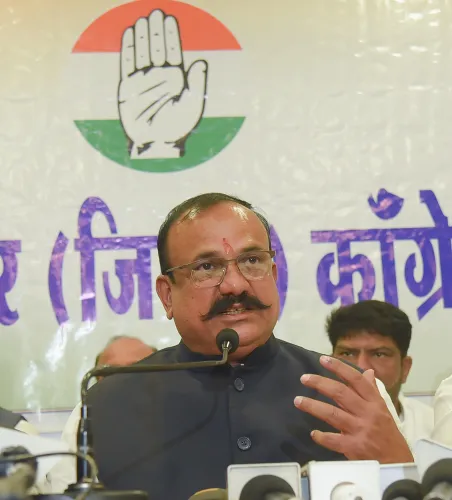
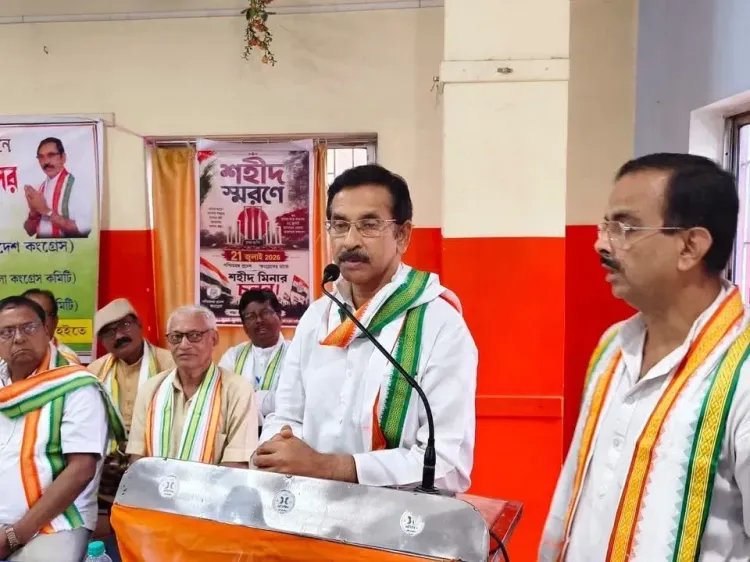
West Bengal Pradesh Congress Committee (WBPCC) President Subhankar Sarkar on Friday, 10 July alleged that the deepening factionalism within the Trinamool Congress (TMC) is not organic dissent but a deliberate Bharatiya Janata Party (BJP) strategy to engineer a 'shadow opposition' in West Bengal — one that would, in his words, 'actually operate as per the instructions of the ruling party in the state.'
Congress Charges: TMC and BJP Two Sides of the Same Coin
Sarkar argued that the BJP's underlying objective is to keep the TMC politically relevant in West Bengal specifically to marginalise the Congress. 'Previously we used to say that Trinamool Congress and the BJP were two sides of the same coin. Our conjecture was clear after the West Bengal Assembly election results,' he said. He contended that the BJP is acutely aware that the Congress is 'non-compromising as regards to opposing the saffron forces,' making it the primary target of this alleged strategy.
Sarkar also signalled that the TMC's landslide defeat in the recently concluded West Bengal Assembly elections had created political space for the Congress to rebuild its organisational base in the state. He asserted that only the Congress could 'ensure the freedom and protection of the fundamental rights of people in the state.'
Rahul Gandhi Cited as Congress's National Face
The WBPCC president invoked Congress leader Rahul Gandhi as the sole 'non-compromising face nationally' against what he described as saffron forces. 'So naturally in the present political situation in the state, Congress' popularity graph is bound to rise,' Sarkar added, framing the party's revival in Bengal as part of a broader national trajectory.
Rajya Sabha Nominations Cited as Evidence of BJP-TMC Nexus
Sarkar pointed to the BJP's decision to nominate three former TMC leaders — Sukhendu Sekhar Roy, Sushmita Dev, and Prakash Chik Baraik — as its candidates for the by-elections to the three Rajya Sabha seats vacated by the same trio last month. He called this 'an example of how the saffron forces have planted moles in the Trinamool Congress for a long time,' arguing the nominations exposed a long-running infiltration strategy rather than a recent political realignment.
Encounter Killing of Rape Accused Draws Condemnation
Sarkar also used the occasion to condemn the recent encounter killing of Pravas Mondal, identified as a prime accused in the alleged rape and murder of a 12-year-old girl at Baruipur in South 24 Parganas district. 'Such an encounter death means that the accused will have no future chance of proving him innocent, which is must in the judicial system,' he said. While acknowledging that crimes against women must be dealt with severely, Sarkar insisted the response must remain 'within the legal framework of the country.'
The remarks reflect a Congress effort to simultaneously challenge both the BJP and the TMC on political and civil-liberties grounds, as the party attempts to reclaim ground in a state where it has been marginalised for over a decade. How these allegations land with Bengal's electorate — still processing a dramatic Assembly verdict — will shape the Congress's organisational push in the months ahead.
Point of View
However, is the Congress's own near-erasure from Bengal over the past decade; the party's revival narrative depends heavily on TMC's collapse rather than any organic Congress resurgence. The encounter killing condemnation is the sharper moment: it puts the Congress on record against extrajudicial action in a state where such incidents have historically been under-examined. Whether voters in Bengal — who just delivered a verdict against the TMC — see the Congress as the credible alternative, or merely the next claimant, remains the unanswered question.
NationPress
9 Oct 2026
Frequently Asked Questions
What did Congress's Bengal chief allege about TMC factionalism?
WBPCC President Subhankar Sarkar alleged on 10 July that the growing factionalism within the Trinamool Congress is a BJP-engineered strategy to create a 'shadow opposition' that would function under BJP direction, rather than genuine internal dissent within the TMC.
Why does Congress claim the BJP wants to keep the TMC relevant in West Bengal?
Sarkar argued that the BJP views the Congress — not the TMC — as its most uncompromising rival in Bengal. By keeping the TMC alive as a political force, the BJP allegedly aims to crowd out the Congress and prevent its revival in the state.
How does the Rajya Sabha nomination fit into Congress's allegation?
The BJP nominated three former TMC leaders — Sukhendu Sekhar Roy, Sushmita Dev, and Prakash Chik Baraik — for Rajya Sabha by-elections to seats those same leaders had just vacated. Congress cited this as evidence that the BJP had cultivated informants inside the TMC over a long period.
What did Subhankar Sarkar say about the Pravas Mondal encounter?
Sarkar condemned the encounter killing of Pravas Mondal, a prime accused in the alleged rape and murder of a 12-year-old girl at Baruipur, South 24 Parganas. He said such a death denies the accused the right to prove innocence in court and called for crimes against women to be addressed within the legal framework.
What is the Congress's political strategy in West Bengal after the Assembly elections?
Following the TMC's landslide defeat in the West Bengal Assembly elections, the Congress is attempting to rebuild its organisational strength in the state. The party is positioning Rahul Gandhi as a national anti-BJP face and arguing that only the Congress can protect citizens' fundamental rights in Bengal.