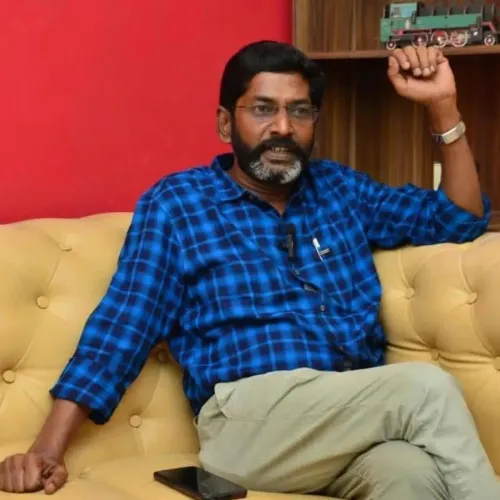
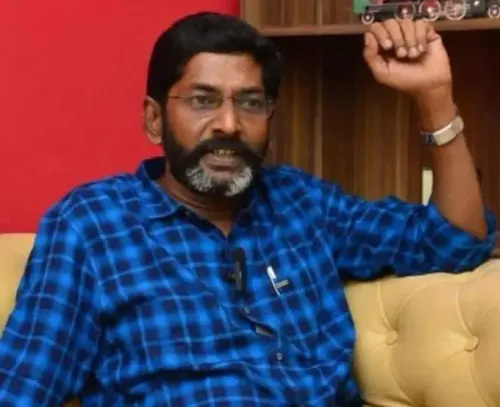
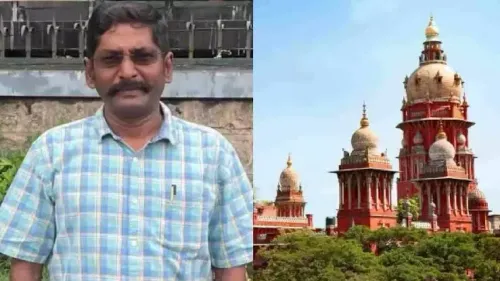
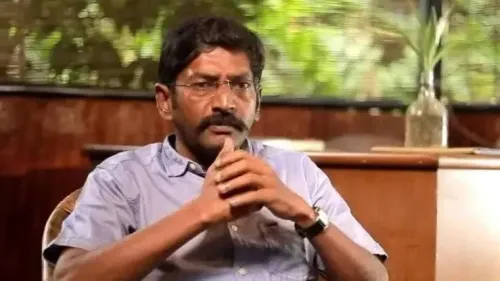
Madras High Court Permits Arrest of YouTuber ‘Savukku’ Shankar, Denies Bail Extension
Synopsis
In a significant ruling, the Madras High Court has allowed the Greater Chennai City Police to arrest YouTuber ‘Savukku’ Shankar if needed for an extortion inquiry, while rejecting his bail extension citing health reasons. The court emphasized that the investigation must continue without hindrance.
Key Takeaways
Madras High Court allows arrest of ‘Savukku’ Shankar if needed.
Bail extension denied due to changing health circumstances.
Medical Board reports stable condition without need for emergency treatment.
No evidence found for claims of solitary confinement.
Investigation to proceed without hindrance as directed by the court.
Chennai, March 25 (NationPress) The Madras High Court has permitted the Greater Chennai City Police (GCCP) to detain YouTuber ‘Savukku’ Shankar, whose real name is A. Shankar, if his custody is deemed necessary for an extortion investigation. This decision comes as the court has denied an extension of the interim bail that was previously granted on medical grounds.
A Division Bench, which includes Justices P. Velmurugan and M. Jothiraman, has rejected the request to prolong the three-month interim bail that was originally provided on December 27, 2025, following petitions from Shankar’s mother.
The interim relief was set to expire on March 25, 2026, and had been granted in light of his health issues.
Stating that the circumstances no longer warranted the continuation of bail, the Bench asserted that the investigating agency has the authority to act according to legal procedures.
The court remarked, “If the custody of the detenu is considered necessary for investigation, the authorities are at liberty to take appropriate steps,” thereby effectively allowing for potential re-arrest.
This ruling was made while dismissing a Habeas Corpus Petition (HCP) and resolving a related writ petition.
The HCP, submitted in December 2025, claimed that Shankar was being held in solitary confinement at Puzhal Central Prison, while the writ petition requested specialized medical care due to his cardiac and diabetic conditions.
After the interim bail order, a Medical Board at the Rajiv Gandhi Government General Hospital in Chennai assessed Shankar’s health.
The Board concluded that while he suffers from chronic conditions such as Type 2 diabetes, hypertension, and coronary artery disease, his health is stable and does not necessitate specialized or emergency cardiac treatment.
The report indicated that his condition can be properly managed with regular medication and lifestyle changes.
Considering this medical evaluation, the court determined that ongoing interim bail on health grounds was not justified.
In addressing the claims of solitary confinement, the Bench found no substantial evidence to validate the allegations.
The court noted that no documentation or evidence had been presented to demonstrate that Shankar was subjected to punitive isolation that contravened prison regulations.
The Bench also commented that the petitions seemed to be filed primarily to obstruct the investigative process.
As a result, the court instructed prison and police officials to ensure that necessary medical care is provided, while allowing the investigation to proceed without further delays.
Point of View
The Madras High Court's decision underscores the balance of justice and legal processes in ongoing investigations. By allowing police to arrest Shankar if necessary, the court reinforces the importance of thorough investigations while addressing health claims with skepticism. This case highlights the judiciary's role in ensuring that legal frameworks are upheld.
NationPress
22 Sept 2026
Frequently Asked Questions
What led to the Madras High Court's ruling?
The ruling was made in response to an extortion case involving YouTuber ‘Savukku’ Shankar, with the court citing the need for a thorough investigation as the primary reason.
Why was the bail extension denied?
The court determined that the circumstances surrounding Shankar's health no longer justified the continuation of his interim bail.
What are the health issues reported by the Medical Board?
Shankar suffers from chronic conditions such as Type 2 diabetes, hypertension, and coronary artery disease, but his condition is stable according to medical evaluations.
Was there any evidence of solitary confinement?
The court found no substantial evidence to support claims that Shankar was held in solitary confinement in violation of prison rules.
What steps did the court direct regarding Shankar's medical care?
The court instructed prison and police authorities to ensure that Shankar receives necessary medical care during the investigation.