Is Kashmir, Northeast, and Maoism Being Effectively Addressed? HM Shah Describes 2014-26 as a 'Golden Chapter' in Internal Security
Synopsis
On its 79th Raising Day, Delhi Police showcased its unwavering commitment to public safety, with Union Home Minister Amit Shah declaring the period from 2014 to 2026 as a transformative chapter in India's internal security, highlighting successes in combating terrorism, unrest, and violence.
Key Takeaways
Delhi Police celebrated its 79th Raising Day.
Amit Shah emphasized the importance of public safety.
New infrastructure projects announced for enhanced security.
Violence in Kashmir and Northeast has decreased by 80%.
The period from 2014 to 2026 is deemed a 'golden chapter' for internal security.
New Delhi, Feb 16 (NationPress) On Monday, the Delhi Police marked its 79th Raising Day, celebrating years of committed service to protect the national Capital and reaffirming its pledge to public safety.
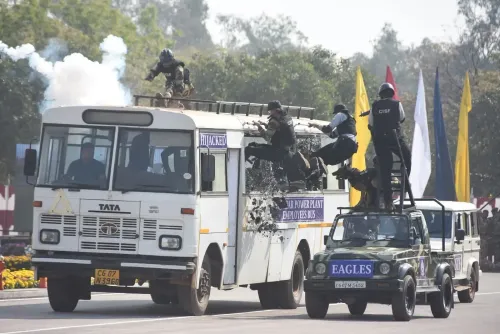
The event showcased a remarkable march past by elite contingents of the force, including the SWAT team, band unit, dog squad, motorcycle riders, PCR units, and various specialized formations, all demonstrating impressive discipline and coordination during the parade.
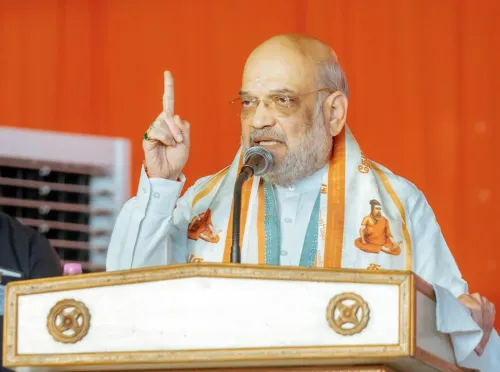
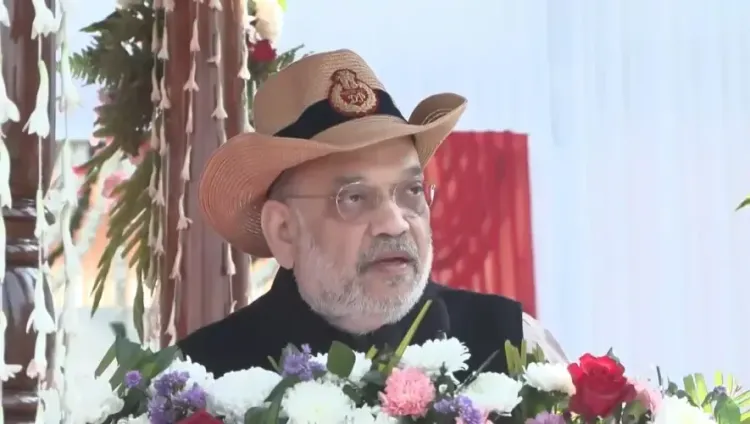
Union Home Minister Amit Shah attended the Raising Day event at the Delhi Police headquarters, where he awarded honorary medals to personnel and praised their dedication, contributions to public safety, and exemplary service record.
In his address, Shah congratulated the force, stating, "Delhi Police has left no stone unturned to uphold their motto of 'Peace, Service, Justice.' The responsibility, performance, and dedication of Delhi Police, as a security force for the national Capital, is of utmost importance. This area of Delhi is not merely a city but the heartbeat of our nation and its democracy. Therefore, it is essential that security here is top-notch."
The Home Minister expressed his "immense satisfaction, joy, and pride" in the fact that the Delhi Police has "consistently been at the forefront, executing its duties with excellence and success."
In announcing new infrastructure initiatives, Shah revealed that the foundation stone for the Special Cell's Integrated Headquarters has been laid with an estimated investment of around Rs 370 crore. He termed it the country's "most modern" center aimed at combating narcotics trafficking and terrorism.
Additionally, he announced that the foundation stone for ten further Delhi Police projects was laid during the ceremony.
"The first phase of the Safe City Project has also been inaugurated. The modern Integrated Command Control Communication and Computer Centre (C4I), built at a cost of approximately Rs 857 crore, is being dedicated to the people of Delhi," he stated, adding that eleven district-level C3I centers and seventy-five police station-level C2I units will be integrated into the system.
Shah further highlighted that under the initial phase of the initiative to connect Delhi with 10,000 cameras, 2,100 cameras have already been activated with live connectivity.
"I am confident that the Safe City Project will greatly enhance the security of Delhi in the near future," he proclaimed.
Speaking about broader national accomplishments, Shah noted that under the leadership of Prime Minister Narendra Modi, "The country has achieved numerous significant milestones."
"In discussions about the justice system in our country in the future, the three new criminal laws and the new Nyaya Sanhita will be particularly noteworthy. These laws focus not merely on punishment but on justice. These three new criminal laws were passed in a Parliament elected by the people, and history will certainly recognize them as a pivotal chapter in judicial reforms," he added.
He emphasized that these new laws would contribute to ensuring timely justice delivery and enhancing conviction rates.
The Home Minister further asserted that the period from 2014 to 2026 would be recorded as a "golden chapter" in the history of India's internal security. He pointed out that prior to 2014, the nation faced "three major challenges" - terrorism in Kashmir, unrest in the Northeast, and Maoist violence impacting nearly eleven states. "These three presented serious challenges to our internal security," he stated.
"I am delighted to report that, following the abrogation of Article 370, we have managed to reduce incidents of violence in Kashmir, the Northeast, and Maoist-affected areas by about 80 percent. The day is not far when these three regions will be entirely free of violence," he added.
Shah characterized the Maoist insurgency, which had spread across eleven states, as a prolonged threat to internal security.
"But today, through the people of Delhi, I wish to assure the entire nation that we are very close to eradicating Maoist violence. I assure my fellow countrymen that by March 31, 2026, we will succeed in liberating the entire country from Maoist violence. This is a remarkable achievement accomplished by our security forces," he asserted.
Discussing developments in the Northeast, Shah mentioned that over 10,000 youths had laid down their arms and returned to mainstream society. "Significant progress has been made towards establishing lasting peace there through more than 20 peace agreements," he noted.
"However, the future holds its challenges. The Ministry of Home Affairs is concentrating on launching a robust anti-narcotics campaign across the country, establishing a comprehensive CCTV network and control room system, providing legal support, modernizing border security, de-infiltration, and fully implementing the three new judicial codes. I am confident that we will successfully address all these challenges before 2029," he added.
Commending the force, Shah stated that the Delhi Police has consistently demonstrated its capability in safeguarding both the Capital and the nation.
"Whether it’s the attack on Parliament or the recent incident at the Red Fort, the Delhi Police has ensured national security by resolving complex cases with efficiency and promptness. Today, on the occasion of Foundation Day, I extend my warmest greetings to all officers and personnel of the Delhi Police, along with their families," he said.
The Delhi Police was initially established in 1861 during British rule as a security force. It was officially renamed as the Delhi Police on February 16, 1948.
Point of View
It’s imperative to recognize the proactive measures being implemented in internal security. The emphasis on modern infrastructure, technology, and legislative reforms showcases a determined approach to tackle longstanding issues in regions such as Kashmir and the Northeast, while also addressing the Maoist threat. The ongoing dialogue around security must continue, ensuring that the needs and voices of citizens remain at the forefront.
NationPress
2 Oct 2026
Frequently Asked Questions
What is the significance of the Delhi Police Raising Day?
The Delhi Police Raising Day marks the anniversary of the police force's establishment, celebrating its commitment to public safety and showcasing its achievements and infrastructure developments.
What are the key initiatives announced by Amit Shah?
Amit Shah announced infrastructure initiatives including the foundation for the Special Cell's Integrated Headquarters, the inauguration of the Safe City Project, and the activation of live connectivity for thousands of cameras.
How has violence changed in Kashmir and the Northeast?
Since the abrogation of Article 370, incidents of violence in Kashmir and the Northeast have reportedly decreased by approximately 80%.
What does the future hold for internal security in India?
The government aims to tackle challenges such as Maoist violence, establish a robust anti-narcotics campaign, and improve legal frameworks to ensure timely justice delivery.
What is the historical context of the Delhi Police?
The Delhi Police was established in 1861 during British rule and was officially renamed on February 16, 1948. It has since evolved into a crucial security force for the national Capital.