Enforcement Directorate Moves to Prosecute P. Chidambaram in INX Media Money Laundering Case
Synopsis
The Enforcement Directorate has taken significant steps to prosecute P. Chidambaram in the INX Media money laundering case, presenting the sanction order to expedite the trial. This development raises critical questions about political accountability and financial misconduct in high office.
Key Takeaways
Chidambaram is facing prosecution in the INX Media money laundering case.
The Enforcement Directorate has submitted a sanction order to expedite the trial.
Investigations reveal illegal financial activities linked to FIPB approvals.
The total quantified proceeds of crime are approximately Rs 65.88 crore .
Assets worth Rs 53.93 crore have been provisionally attached by the ED.
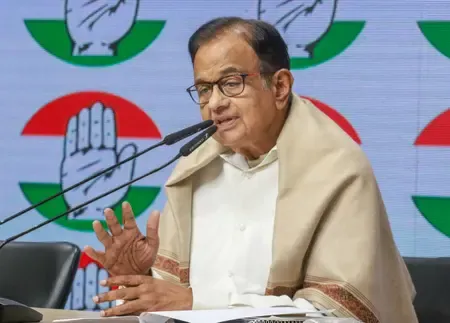
New Delhi, Feb 26 (NationPress) The Enforcement Directorate (ED) has submitted the sanction order for prosecution from the appropriate authority against senior Congress politician and former Union Finance Minister P. Chidambaram concerning the alleged INX Media money laundering case to the Special Rose Avenue Court in New Delhi. This information was revealed in an official statement released by the central anti-money laundering agency on Thursday.
The sanction order, received on February 10, 2026, has been presented before the Special Rouse Avenue Court to expedite the proceedings in the case, according to the ED's announcement.
The ED's investigation commenced under the Prevention of Money Laundering Act (PMLA), 2002, following an FIR lodged on May 15, 2017, by the Central Bureau of Investigation (CBI) against M/s INX Media Private Limited, M/s INX News Private Limited, Karti Chidambaram (P. Chidambaram's son), and others for violations of Section 120-B in conjunction with Section 420 of the Indian Penal Code, 1860, as well as Sections 8, 13(2), and 13(1)(d) of the Prevention of Corruption Act, 1988.
The financial investigation revealed that during P. Chidambaram's tenure as Union Finance Minister, the Foreign Investment Promotion Board (FIPB) approved the application from INX Media Private Limited.
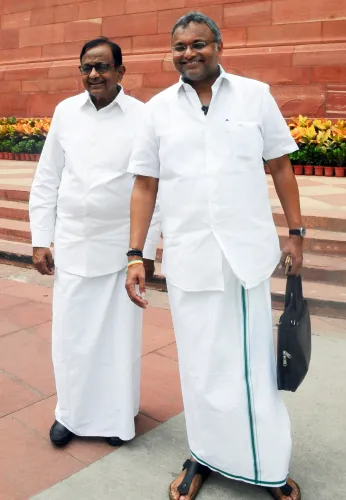
In exchange for granting and later regularizing the FIPB approval, illegal payments were allegedly demanded and received through entities owned or controlled by Karti Chidambaram, as stated by the ED.
The ED claims that the illicit funds were funneled through shell companies, including M/s Advantage Strategic Consulting Private Limited (ASCPL) and other associated firms under the direct or indirect control of Karti Chidambaram.
Further investigations indicated that these funds were layered through intricate financial maneuvers across various jurisdictions without any legitimate business activities, ultimately being integrated through investments in companies such as M/s Vasan Health Care Private Limited and M/s AGS Health Care Private Limited, and subsequently multiplied via share sales and overseas investments.
The ED alleges that Karti Chidambaram and his close associates acted on behalf of P. Chidambaram, engaged with INX Media representatives regarding FIPB approvals, and collected the proceeds of crime from the alleged arrangement.
According to the ED, the proceeds of crime were funneled through shell companies set up for laundering purposes and were used for deposits in bank accounts as well as investments in movable and immovable properties both in India and abroad.
The total proceeds of crime in this case have been estimated at nearly Rs 65.88 crore.
The ED has provisionally attached assets valued at Rs 53.93 crore through an order dated October 10, 2018, and an additional Rs 11.04 crore via an attachment order dated March 31, 2023, both of which have been confirmed by the adjudicating authority under the PMLA.
Previously, the financial investigative agency filed a charge sheet before the Rouse Avenue Court on June 1, 2020, listing P. Chidambaram as accused number 1 and Karti P. Chidambaram as accused number 7, along with eight other entities and individuals.
The Special PMLA Court acknowledged the alleged offenses on March 24, 2021, with a supplementary charge sheet subsequently filed on December 16, 2024.
The Enforcement Directorate has been striving to accelerate the trial process in this matter, as mentioned in their statement.
In November 2024, the ED contested P. Chidambaram's request for a stay on the trial proceedings in the INX Media money laundering case, arguing before the Delhi High Court that managing his son's business interests could not be deemed part of the official responsibilities of a Union Finance Minister.
While appearing before a bench led by Justice Manoj Kumar Ohri, the ED's special counsel asserted that the allegations of money laundering were not connected to Chidambaram's official duties.
Conversely, counsel representing Chidambaram argued that the trial court should not have recognized the charge sheet without prior sanction, given his status as a public office holder at the time of the alleged offenses.
With the sanction now presented to the Special Court, the pending petitions are likely to become obsolete, and the accused may opt to initiate new proceedings to challenge the legitimacy of the sanction order.
Point of View
The ED's actions reflect a significant moment in the pursuit of accountability within the political sphere. The ongoing investigation raises questions about the intersection of power and finance in governance, prompting a closer examination of ethical conduct among public officials.
NationPress
30 Sept 2026
Frequently Asked Questions
What is the INX Media money laundering case?
The INX Media money laundering case involves allegations against P. Chidambaram and his son, Karti Chidambaram, for illegal financial transactions related to foreign investment approvals during Chidambaram's tenure as Finance Minister.
What is the role of the Enforcement Directorate?
The Enforcement Directorate (ED) is responsible for enforcing laws related to economic offenses and money laundering in India, investigating cases under the Prevention of Money Laundering Act (PMLA).
What are the potential consequences for P. Chidambaram?
If found guilty, P. Chidambaram could face severe legal penalties, including imprisonment and financial restitution, alongside significant damage to his political career.
How does this case impact Indian politics?
This case highlights the issue of corruption within high political offices in India, potentially influencing public trust and the political landscape as the trial unfolds.
What is the current status of the trial?
The trial is in progress, with the Enforcement Directorate pushing to expedite proceedings following the recent sanction order for prosecution.