Why Did the Madras HC Deny Interim Relief to TN Minister I. Periyasamy in Money Laundering Case?
Synopsis
The Madras High Court's refusal to grant interim relief to Tamil Nadu's Minister I. Periyasamy in a money laundering case raises critical questions about judicial processes and the ongoing investigations by the Enforcement Directorate. Stay tuned for more updates!
Key Takeaways
Madras High Court denies interim relief to Minister I.
ED's investigation into money laundering continues.
Importance of due process in judicial proceedings highlighted.
Minister's family challenges Enforcement Case Information Report.
Next hearing set for January 2026.
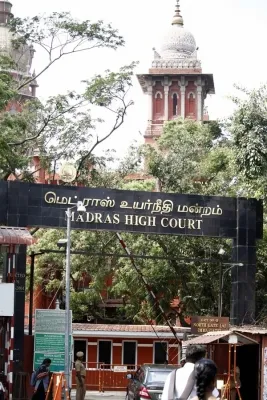
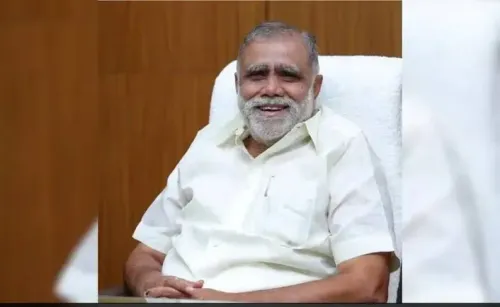
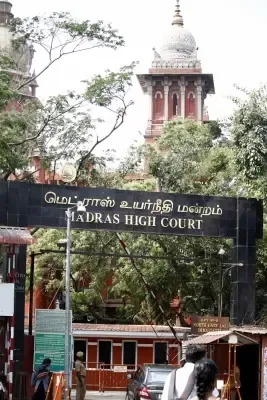
Chennai, Dec 17 (NationPress) The Madras High Court on Wednesday refused to provide any interim relief to Tamil Nadu's Rural Development Minister I. Periyasamy and his family members regarding a money laundering case currently being investigated by the Enforcement Directorate (ED), without first allowing the central agency to be heard.
A First Division Bench, consisting of Chief Justice Manindra Mohan Shrivastava and Justice G. Arul Murugan, emphasized that no interim protection could be granted to the petitioners until notice was issued to the ED and adequate time was provided for the agency to submit its response.
The Bench authorized the ED's Special Public Prosecutor R. Sidharthan to take notice on behalf of the agency and instructed the ED to submit a comprehensive counter-affidavit by January 5, 2026, addressing all writ petitions regarding the matter.
The petitions were submitted by Periyasamy, his son I.P. Senthilkumar, and his daughter P. Indira, contesting the Enforcement Case Information Report (ECIR) registered against them under the Prevention of Money Laundering Act (PMLA), 2002. The ECIR was initiated based on a disproportionate assets case that had previously been filed against the Minister by the State police.
The petitioners are seeking the annulment of the ECIR and all subsequent actions initiated by the ED, arguing that the continuation of the money laundering investigation is legally untenable given the current circumstances. During the proceedings, the court noted that a special court created under the Prevention of Corruption Act had previously exonerated the Minister from the predicate offence filed by the Directorate of Vigilance and Anti-Corruption (DVAC).
However, this discharge order was later overturned by the Madras High Court in 2025.
Following the reversal, Periyasamy approached the Supreme Court to contest the High Court's decision. The apex court granted an interim stay in his favor, halting any further proceedings stemming from the High Court's ruling.
Referencing the interim protection provided by the Supreme Court, the Minister and his family contended that the ED's proceedings concerning money laundering, which rely on the predicate offence, should not proceed and requested immediate relief from the High Court.
Nonetheless, the Division Bench abstained from issuing any interim orders at this time, stating that the ED's input was necessary before any relief could be contemplated.
The case has been scheduled for further proceedings following the enforcement agency's response.
Point of View
It's crucial to emphasize the legal processes at play. The Madras High Court's ruling reflects the judiciary's commitment to thorough investigations, ensuring that all parties, including the Enforcement Directorate, are given an opportunity to present their cases. This approach underscores the importance of due process in matters involving public officials.
NationPress
19 Sept 2026
Frequently Asked Questions
What is the basis of the money laundering case against Minister I. Periyasamy?
The case is primarily based on a disproportionate assets case that was registered against him by the State police, which led to the Enforcement Case Information Report (ECIR) under the Prevention of Money Laundering Act (PMLA).
Why did the Madras HC refuse interim relief?
The court stated that it could not grant any interim protection to the petitioners without first hearing the Enforcement Directorate and allowing them sufficient time to respond.
What are the next steps in this case?
The Enforcement Directorate has been directed to file a detailed counter-affidavit by January 5, 2026, and the case will be heard further after their response.
What previous legal decisions affect this case?
A special court had previously discharged Minister Periyasamy from a related predicate offence, but this discharge was overturned by the Madras High Court in 2025.
Has the Supreme Court intervened in this case?
Yes, the Supreme Court granted an interim stay in favor of Minister Periyasamy, halting further proceedings from the High Court's decision.