Human Rights Groups Decry Imminent Eviction of Christian Community in Islamabad

Synopsis
In a troubling development, human rights activists have condemned the planned eviction of residents in Islamabad's Allama Iqbal Colony, raising urgent concerns about minority rights and the fate of this long-standing Christian community.
Key Takeaways
Urgent call to halt evictions: Activists demand an immediate stop to evictions in Allama Iqbal Colony.
Systemic issues: The evictions are part of a broader, unjust approach targeting low-income communities.
Vulnerable groups: Women and children are particularly at risk from displacement and insecurity.
Legal protections: Continuous disregard for Supreme Court orders reflects erosion of rights for marginalized citizens.
Need for community engagement: Organizations emphasize meaningful dialogue with affected communities.
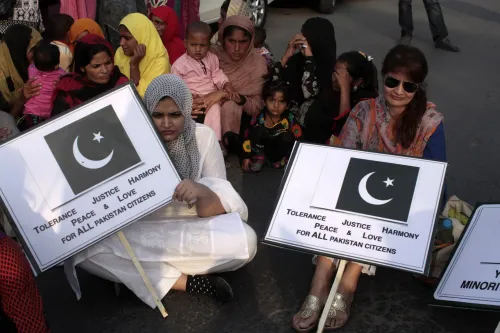
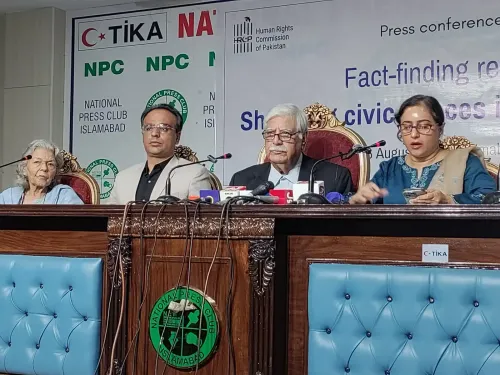
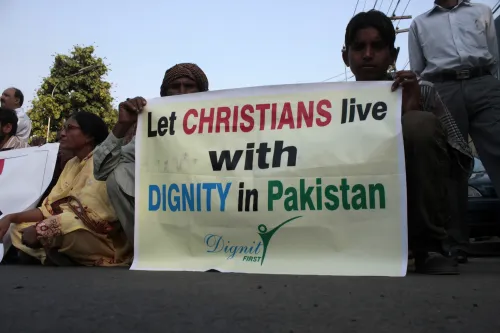
Islamabad, March 30 (NationPress) Human rights advocates and civic organizations have vehemently opposed the proposed demolition and coercive eviction of individuals residing in Allama Iqbal Colony, a 25-year-old primarily Christian working-class neighborhood in Islamabad. This community is now facing an urgent threat of clearance in the imminent future, raising profound concerns over the rights of minorities and potential displacement.
The Human Rights Commission of Pakistan (HRCP), along with the All Party Alliance for Katchi Abadis, the National Commission for Justice and Peace, the Awami Workers Party, Aurat March Islamabad, and other allied civil society entities, have categorically denounced the persistent trend of evictions executed by the Capital Development Authority (CDA) in Islamabad, highlighting the absence of due process, sufficient notice, and lawful rehabilitation.
As articulated by these organizations, these actions are not mere isolated events but part of a larger, unjust strategy employed by Pakistani authorities that disproportionately impacts low-income groups within Islamabad’s katchi abadis (informal settlements)—“affecting families who have resided and worked in these locales for several decades.”
Expressing their dismay, they noted that the ongoing neglect of Pakistan's 2015 Supreme Court stay order and the lack of a coherent, rights-based policy indicate a troubling decline in legal safeguards for marginalized citizens.
“This matter extends beyond any singular religious or social faction. The dismantling of katchi abadis signifies a systemic attack on the housing, dignity, and livelihoods of working-class populations. Women and children, in particular, are at heightened risk, facing increased threats of displacement, insecurity, and loss of access to essential services. The prevailing atmosphere of fear surrounding these evictions further hinders the ability of affected residents to organize and claim their rights,” the organizations stated.
They urged the Pakistani authorities to immediately cease all planned and ongoing eviction efforts, including those in Allama Iqbal Colony and Rimsha Colony, and to fully adhere to existing judicial orders.
“We would remind the CDA that it is obliged by previous Supreme Court rulings applicable to all provinces—to create and submit comprehensive strategies for all informal settlements, which the provinces have already undertaken,” the groups asserted.
“Moreover, the government must urgently devise and implement a national framework that is transparent, inclusive, and compliant with rights that guarantees security of tenure, ensures prior consultation with impacted communities, and provides equitable resettlement within a reasonable distance, along with adequate compensation where displacement is unavoidable,” they added.
The organizations have called for meaningful dialogue with representatives of katchi abadi communities and accountability for the “arbitrary and unlawful actions” conducted in the name of urban development by the Pakistani authorities.
Point of View
This situation reflects a critical intersection of human rights, urban policy, and social justice. Advocating for marginalized communities is not merely an act of charity; it is a responsibility of the state to ensure equitable treatment and protection under the law.
NationPress
8 Oct 2026
Frequently Asked Questions
What is Allama Iqbal Colony?
Allama Iqbal Colony is a 25-year-old predominantly Christian working-class settlement located in Islamabad, Pakistan.
Why are residents facing eviction?
Residents are facing eviction due to planned demolitions by the Capital Development Authority (CDA), which has raised serious concerns over minority rights and displacement.
What have human rights organizations said about the evictions?
Human rights organizations have condemned the evictions, citing lack of due process and highlighting the systemic targeting of low-income communities.
What can residents do in response to the eviction?
Residents and advocates are calling for immediate halts to eviction operations and adherence to judicial directives while seeking accountability for unlawful actions.
What is the significance of the 2015 Supreme Court stay order?
The 2015 Supreme Court stay order is crucial as it provides legal protection against such evictions and reflects the need for a coherent rights-based policy.