CM Sai's govt establishes Teejan Bai state honour for Pandwani
Synopsis
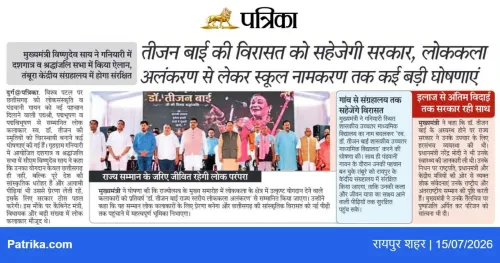
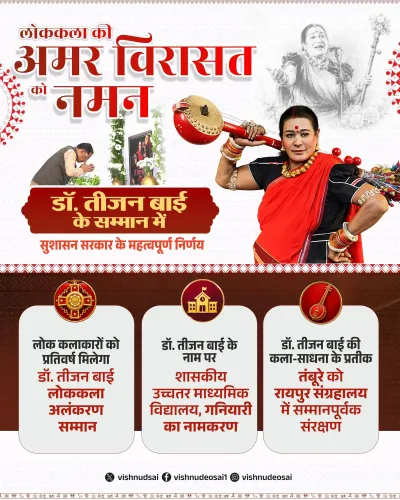
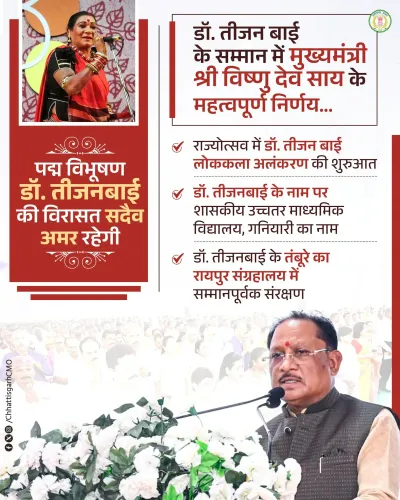
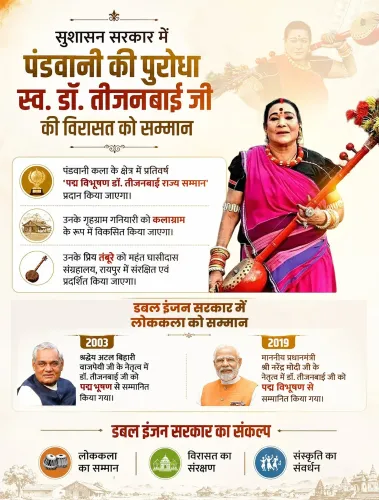
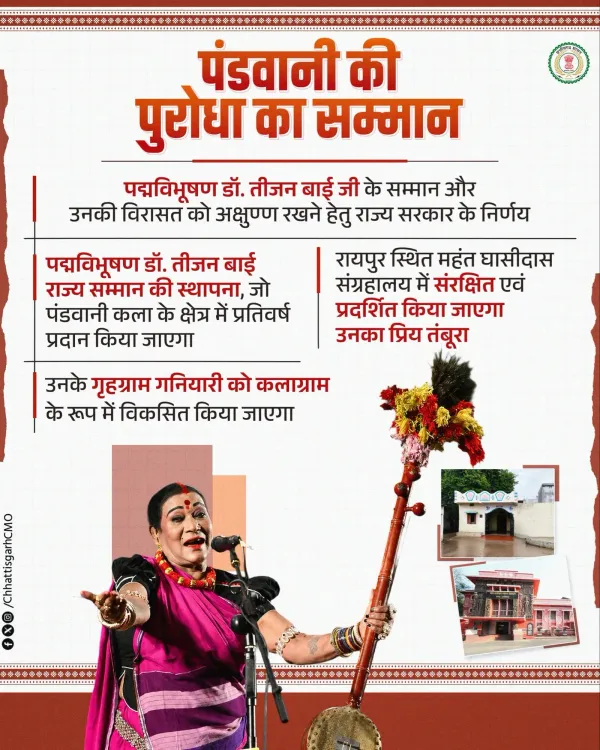
The Vishnu Deo Sai government in Chhattisgarh has announced an annual 'Padma Vibhushan Dr. Teejan Bai Rajya Samman' for Pandwani artists, plans to develop her native village Ganiyari as a Kalagraam, and will preserve her tambura at the Mahant Ghasidas Museum in Raipur.
Key Takeaways
The Vishnu Deo Sai government announced the 'Padma Vibhushan Dr.
Teejan Bai Rajya Samman' , an annual state award for outstanding contributions to Pandwani .
Ganiyari , the native village of Dr.
Teejan Bai , will be developed as a Kalagraam (village of arts) to serve as a cultural heritage destination.
Teejan Bai 's tambura will be preserved and displayed at the Mahant Ghasidas Museum in Raipur .
Teejan Bai received the Padma Vibhushan in 2019 for her lifetime contribution to Pandwani, a Mahabharata-based Chhattisgarhi folk singing tradition.
The decisions were announced on 9 July 2026 and align with Chhattisgarh 's longstanding policy of supporting tribal and folk cultural traditions since statehood in 2000 .
Details on the award selection process and the Ganiyari development budget are awaited in subsequent government notifications.
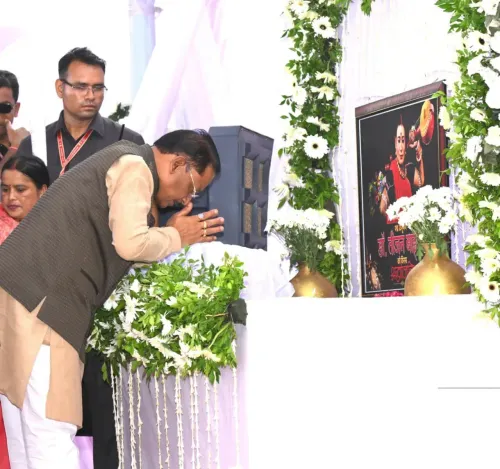
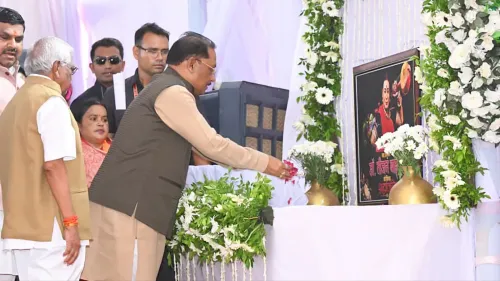
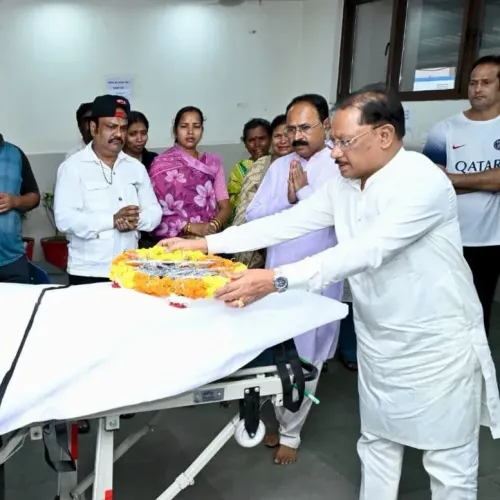
The Chief Minister's Office of Chhattisgarh announced on 9 July 2026 that the Vishnu Deo Sai government has taken a set of landmark decisions to preserve the legacy of Padma Vibhushan Dr. Teejan Bai, the celebrated exponent of the Chhattisgarhi folk art Pandwani. The measures include a new annual state honour, the conversion of her native village into a cultural hub, and the preservation of her iconic instrument at a state museum in Raipur.
Context
The CMO's post declared the establishment of the 'Padma Vibhushan Dr. Teejan Bai Rajya Samman' ('Padma Vibhushan Dr. Teejan Bai State Honour'), an award that will recognise outstanding annual contributions in the field of Pandwani. The announcement described the move as an 'aitihasik nirnay' — a historic decision — aimed at keeping Dr. Teejan Bai's glorious legacy intact for future generations.
Dr. Teejan Bai is widely regarded as the foremost living voice of Pandwani, the performative tradition of narrating episodes from the Mahabharata through song and gesture in the Chhattisgarhi dialect. She received the Padma Vibhushan — India's second-highest civilian honour — in 2019, capping decades of national and international recognition for a form of folk expression that originated in the plains of central India.
Policy Backdrop
Beyond the annual award, the state government announced that Ganiyari, Dr. Teejan Bai's native village, will be developed as a 'Kalagraam' — a village of arts — positioning it as a dedicated cultural destination linked to her life and work. The Mahant Ghasidas Museum in Raipur, the state's premier public museum, has been designated to house and display her cherished tambura, the stringed instrument integral to Pandwani performance.
Chhattisgarh has maintained a sustained policy interest in tribal and folk traditions since its formation as a separate state in 2000. These latest decisions align with a broader national cultural policy framework that emphasises awards, documentation, and infrastructure development in artists' native locales as tools for safeguarding intangible cultural heritage.
Stakeholders and Impact
The primary beneficiaries of the new award will be practising Pandwani artists, a community of performers — many from Scheduled Caste and Other Backward Class communities in rural Chhattisgarh — for whom institutional recognition and financial support remain limited. An annual state honour carries both symbolic weight and the prospect of material support, potentially incentivising younger artists to pursue the tradition professionally.
The development of Ganiyari as a Kalagraam is expected to bring infrastructure investment to the village and create a site of cultural tourism. The placement of Dr. Teejan Bai's tambura at the Mahant Ghasidas Museum ensures the instrument enters a formally conserved, publicly accessible collection, reinforcing the state's commitment to tangible as well as intangible heritage.
What's Next
The detailed framework for the award — including eligibility criteria, the selection committee, and the prize amount — as well as the timeline and budget for the Ganiyari Kalagraam project, are expected to be outlined in forthcoming cultural department notifications or the next state budget cycle. Observers will watch whether the government follows through with dedicated funding and a transparent selection process for the annual honour.
If implemented with sustained commitment, the package of measures could serve as a replicable model for other states seeking to institutionalise the recognition of regional performing arts and protect the living heritage of folk traditions across India.
Point of View
A heritage village, and a museum exhibit to a single iconic artist, it simultaneously elevates a marginalised folk tradition and builds a durable political association with Chhattisgarh's indigenous identity. Institutionalising Pandwani recognition through a named state award follows a well-worn playbook — one that has worked in Maharashtra for Lavani and in Rajasthan for Ghoomar — where symbolic policy outlays generate outsized cultural dividends. The real test will be whether the award comes with substantive prize money and a credible, arms-length jury, or remains a ceremonial gesture. If the Kalagraam at Ganiyari receives genuine infrastructure investment, it could also function as a rural tourism anchor, giving the policy an economic dimension that outlasts the current government.
NationPress
7 Oct 2026
Frequently Asked Questions
What is the 'Padma Vibhushan Dr. Teejan Bai Rajya Samman'?
It is a new annual state award announced by the Chhattisgarh government on 9 July 2026 to recognise outstanding contributions in the field of Pandwani folk art, named in honour of legendary artist Dr. Teejan Bai.
Who is Dr. Teejan Bai and why is she significant?
Dr. Teejan Bai is the foremost exponent of Pandwani, a Chhattisgarhi folk tradition of narrating Mahabharata episodes through song and gesture. She received the Padma Vibhushan — India's second-highest civilian honour — in 2019.
What is the Kalagraam project at Ganiyari?
The Chhattisgarh government plans to develop Ganiyari — the native village of Dr. Teejan Bai — as a 'Kalagraam' or village of arts, turning it into a dedicated cultural heritage and tourism destination in her memory.
Where will Teejan Bai's tambura be kept?
Her tambura will be preserved and publicly displayed at the Mahant Ghasidas Museum in Raipur, Chhattisgarh's state capital and premier public museum.