Why Are Extremist Attacks Rising Across Bangladesh?
Synopsis
In a troubling escalation of violence, a leading human rights group sheds light on a series of extremist attacks in Bangladesh, revealing the dire state of security and the urgent need for action to protect cultural institutions and minority communities.
Key Takeaways
Human rights organizations are alarmed by the rise in extremist violence in Bangladesh.
Recent attacks targeted major media outlets and cultural institutions.
The incidents raise serious concerns about freedom of expression and the safety of minority communities.
Immediate action is needed to safeguard democracy and human rights.
Authorities are urged to ensure the security of all citizens.
Paris, Dec 19 (NationPress) A prominent global human rights organization has denounced the recent spate of “horrific extremist” violent events that have unfolded throughout Bangladesh.
In its statement, Justice Makers Bangladesh in France (JMBF) expressed grave concerns over the coordinated assaults that took place across multiple locations on Thursday night, indicating that the nation has descended into a state of extreme insecurity and has significantly failed in its fundamental responsibilities.
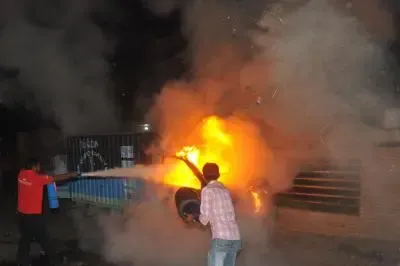
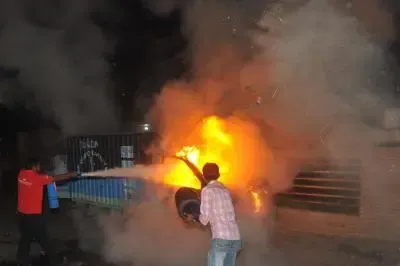
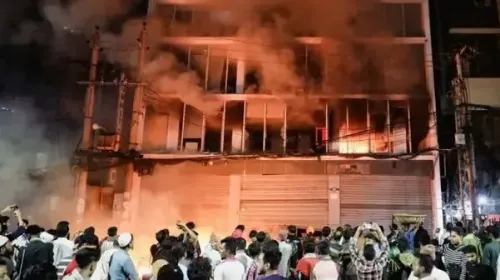
These assaults targeted the offices of key newspapers, Prothom Alo and The Daily Star; the national cultural institution Chhayanaut; members of minority communities; the remaining structures of the Bangabandhu Museum—a vital symbol of the nation’s history; and the office of the Indian Assistant High Commission in Chattogram.
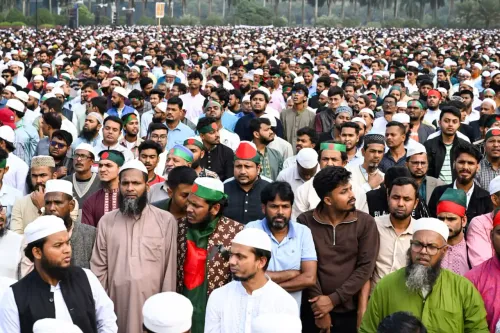
The unrest erupted following the death of Sharif Osman Hadi, a spokesperson for the radical group Inqilab Mancha.
According to the JMBF, the planned vandalism, arson, and looting of the offices of The Daily Prothom Alo and The Daily Star at Karwan Bazar in Dhaka were not just attacks on two media outlets but represented a direct assault on freedom of expression, the pursuit of truth, and independent journalism.
“The endangerment of journalists’ lives and the attempt to rescue them using cranes operated by the Fire Service, rather than deploying helicopters, painted a stark and troubling picture of state negligence. The harassment of the President of the Editors’ Council, a senior journalist, during the incident further illustrates that extremist forces are now emboldened to overtly suppress democratic voices,” the rights body asserted.
“On the same evening, the attack and stone-throwing at the Indian Assistant High Commission in Chattogram not only highlighted a severely deteriorated law-and-order situation but also raised serious concerns about the government’s irresponsibility and its disregard for international diplomatic norms. An attack on a foreign diplomatic mission has severely tarnished Bangladesh’s international standing, for which the current government is fully accountable,” it added.
The JMBF claimed that the attack on the Chhayanaut building in Dhanmondi was a direct strike by extremist forces against Bangladeshi culture and free thought.
Additionally, it noted that the vandalism and arson at the historic residence of Bangabandhu Sheikh Mujibur Rahman, along with the remaining structures of the Bangabandhu Museum at Dhanmondi 32, represent an assault on the spirit of the Liberation War, the Constitution, and the nation’s heritage.
The JMBF also described the brutal lynching of an innocent Hindu youth, Dipu Chandra Das, in Mymensingh district over allegations of blasphemy—followed by the burning of his body—as the most “heartbreaking and reprehensible” incident.
“This barbaric act is a stark testament to the extreme deterioration of human rights in Bangladesh and evidently shows that the security of minority communities has completely collapsed,” it stated.
The JMBF demanded the immediate arrest and exemplary punishment of all extremist attackers, their patrons, and organizers involved in these incidents. They called upon Bangladeshi authorities to take urgent and effective measures to ensure the safety of media outlets, cultural institutions, and minority communities in the country.
Point of View
It's essential to recognize that the rise in extremist violence in Bangladesh not only poses a threat to individual lives but also undermines the very fabric of our democratic society. This troubling trend calls for an immediate and unified response from both the government and civil society to safeguard our fundamental rights and cultural heritage.
NationPress
30 Sept 2026
Frequently Asked Questions
What recent events prompted the condemnation from human rights organizations?
A series of coordinated extremist attacks across Bangladesh, targeting media institutions and cultural sites, has raised significant concerns about the deteriorating security situation.
How are the attacks affecting freedom of expression in Bangladesh?
The attacks on major newspapers are viewed as direct assaults on freedom of expression and independent journalism, undermining the pursuit of truth.
What actions are being called for by human rights groups?
Human rights organizations are demanding immediate arrests and punishment for those involved in the extremist attacks, as well as measures to ensure the safety of minority communities.