Future Warfare Course Wraps Up with Emphasis on Advanced Combat Strategies
Synopsis
The Future Warfare Course (FWC-03) concludes in New Delhi, focusing on India's security challenges and the evolution of modern warfare. With insights from military and industry leaders, this course prepares participants for the complexities of future combat scenarios.
Key Takeaways
Understanding Modern Warfare: The course emphasized the shift towards new combat strategies.
Civil-Military Integration: Importance of collaboration between military and private sectors.
Technological Advancements: Exposure to cutting-edge technologies in warfare.
Multi Domain Operations: Focus on strategies that encompass various operational domains.
Strategic Insights: Gained knowledge on foreign policy and international relations.
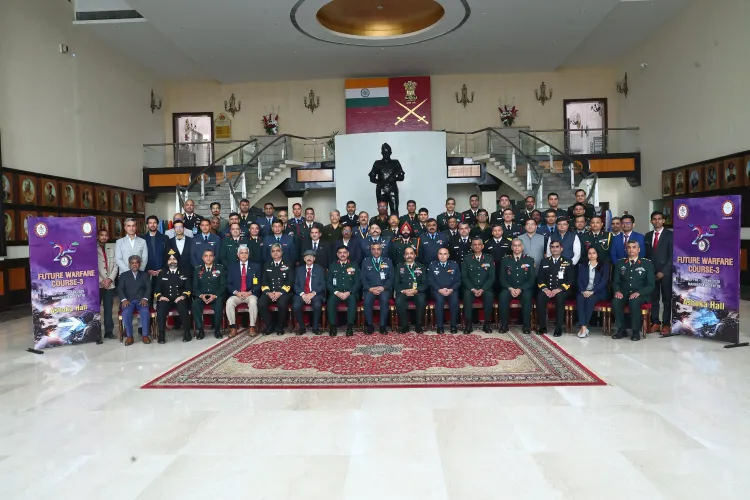
New Delhi, Feb 26 (NationPress) An in-depth examination of India's security challenges, coupled with discussions on contemporary and future warfare strategies, was at the forefront of the third installment of the Future Warfare Course (FWC-03), an official reported on Thursday.
The course, which concluded on Wednesday at the Manekshaw Centre, showcased an enhanced curriculum that included specialized topics and advancements in domain-specific warfare applicable to military operations, according to the Defence Ministry official's statement.
Organized by the Doctrine, Organisation and Training (DOT) under the Headquarters Integrated Defence Staff (HQ IDS), this course took place from February 2 to February 25, 2026.
Designed under the guidance of Chief of Defence Staff (CDS) General Anil Chauhan, FWC 3.0 offered participants a dynamic blend of operational strategies, technological advancements, and strategic alignment. A total of 39 officers from the Army, Navy, and Air Force engaged in this course.
The course comprised two distinct phases. The initial phase included participants from startups, MSMEs, private industry, academia, and defence public sector undertakings (DPSUs), emphasizing civil-military integration, which aligns with India’s ambition for self-reliance in national security.
In the second phase, attendees interacted with academic experts and subject matter specialists (SMEs), including companies focused on space technology and counter Unmanned Aircraft Systems (C-UAS) in Hyderabad from February 15-17, 2026.
These visits featured field demonstrations showcasing cutting-edge technologies, as noted in the statement.
Participants also visited the Information Fusion Centre – Indian Ocean Region (IFC-IOR) in Gurugram and the Indian Institute of Technology Delhi to gain deeper insights. They were introduced to cognitive warfare concepts through exposure to media and social media interfaces, according to the statement.
The focus of the course was on Multi Domain Operations (MDO) and concluded with a two-day Strategic War gaming Exercise guided by retired ambassadors and representatives from the Ministry of Home Affairs (MHA).
Participants acquired significant insights regarding foreign policy, along with international and domestic affairs, enhancing their military understanding, the statement concluded.
Point of View
It is crucial to recognize the importance of evolving military strategies in response to emerging global threats. The Future Warfare Course (FWC-03) represents a proactive approach to equipping our armed forces with the necessary skills and knowledge to navigate the complexities of modern warfare, ensuring national security is upheld.
NationPress
30 Sept 2026
Frequently Asked Questions
What was the main focus of the Future Warfare Course?
The main focus was on analyzing India's security challenges and discussing modern and futuristic combat strategies.
Who organized the Future Warfare Course?
The course was organized by the Doctrine, Organisation and Training (DOT) under the Headquarters Integrated Defence Staff (HQ IDS).
How many officers participated in the FWC-03?
A total of 39 officers from the Army, Navy, and Air Force participated in the course.
What phases did the course consist of?
The course consisted of two phases: one focused on civil-military fusion, and the second on interactions with academia and technology companies.
What were the key activities during the course?
Key activities included field demonstrations of advanced technologies and strategic war gaming exercises.