Sonia Gandhi Critiques Government Silence on Khamenei's Assassination
Synopsis
Sonia Gandhi condemns the Indian government's silence over the assassination of Iran's Supreme Leader, Ayatollah Ali Khamenei, criticizing this as a failure of responsibility. She recalls Iran's historical support for India and calls for a principled stance in foreign policy.
Key Takeaways
Sonia Gandhi criticizes the Indian government's silence on Khamenei's assassination.
The absence of a response is seen as an abdication of responsibility.
Gandhi recalls Iran's historical support for India during UN discussions on Kashmir.
She calls for India to articulate a clear foreign policy based on moral principles.
The assassination raises serious questions about international norms and sovereignty.
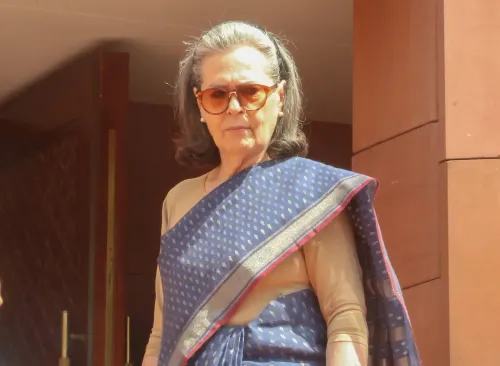
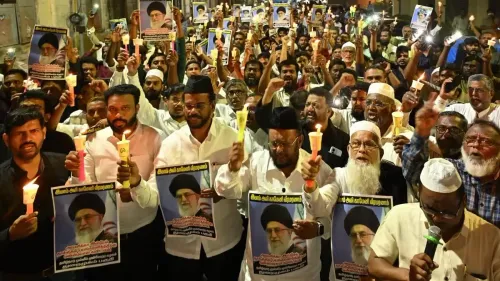
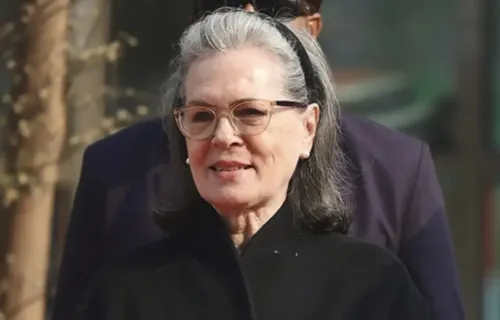
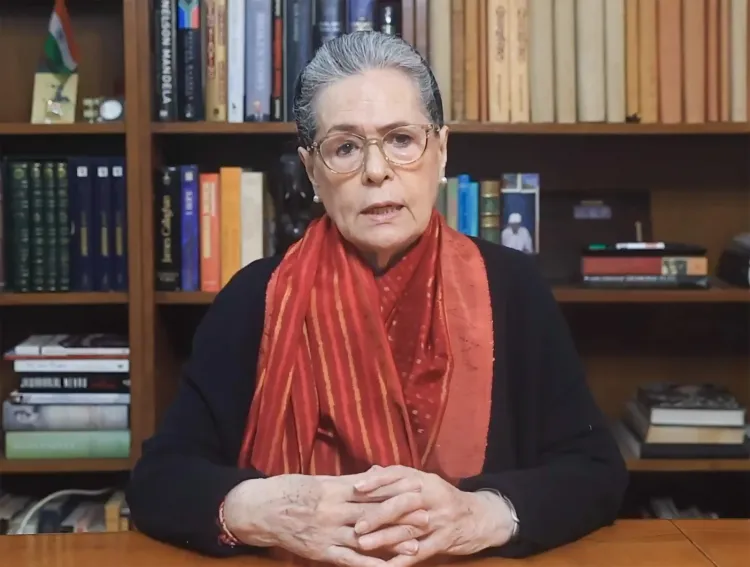
New Delhi, March 3 (NationPress) Sonia Gandhi, the Chairperson of the Congress Parliamentary Party (CPP), has expressed her disappointment with the Central government's silence over the assassination of Iran's Supreme Leader, Ayatollah Ali Khamenei, amid the coordinated airstrikes by the US and Israel.
She emphasized that the absence of an official response on this issue is not neutral; it constitutes an 'abdication' of responsibility.
Gandhi also recalled Iran's support for India during discussions at the UN regarding Kashmir back in 1994.
In an op-ed featured in The Indian Express, titled 'Government's silence on the killing of the Iranian leader is not neutral; it is abdication', Sonia Gandhi remarked, 'The assassination of a sitting head of state during ongoing negotiations signifies a serious rupture in modern international relations. Yet, alongside the shock of the incident, what is equally alarming is New Delhi's silence.'
She noted that the Government of India has 'failed to condemn the assassination or the infringement of Iranian sovereignty'.
'Initially, the Prime Minister's response to the extensive US-Israeli attack was to condemn Iran's retaliatory actions against the UAE, neglecting the sequence of events leading to it. Later, he expressed a vague 'deep concern' and spoke of 'dialogue and diplomacy'—exactly what was taking place before the unprovoked aggression from Israel and the US,' she remarked, referring to Prime Minister Modi's recent comments on the conflict in West Asia.
'When a targeted killing of a foreign leader does not receive a robust defense of sovereignty or international law from our nation, and neutrality is forsaken, it raises significant questions about the integrity and credibility of our foreign policy,' she added.
Stressing that 'Silence in this scenario is not neutral', Sonia Gandhi affirmed that the assassination occurred 'without a formal declaration of war and amidst an ongoing diplomatic dialogue'.
She pointed out that Article 2(4) of the United Nations Charter prohibits any threat or use of force against a state's territorial integrity or political independence. 'The targeted killing of a sitting head of state strikes at the core of these principles. If such actions go unchallenged by the world's largest democracy, it becomes easier to normalize the erosion of international standards,' she stated.
The Congress Rajya Sabha member also criticized the Prime Minister for his 'unwavering support' of Israeli Prime Minister Benjamin Netanyahu during the Gaza conflict, asserting that India's 'high-profile political endorsement without ethical clarity represents a concerning departure'.
She reiterated Congress' position on the assassination of the Iranian Supreme Leader, labeling it as a 'dangerous escalation with severe regional and global repercussions'.
Sonia Gandhi further recounted how, in 1994, when some members of the Organisation of Islamic Cooperation were pushing for a resolution against India at the UN Commission on Human Rights over Kashmir, Iran played a crucial role in staving off that initiative.
Additionally, she noted that Iran has facilitated India's diplomatic engagement in Zahedan, near the Pakistan border, which is perceived as a strategic counterbalance to the development of Gwadar port and the China-Pakistan Economic Corridor.
She also recalled that in 2001, former Prime Minister Atal Bihari Vajpayee visited Tehran and reaffirmed 'deep ties' with Iran; however, she expressed that 'His acknowledgment of these longstanding relations seems to hold no significance for our current government.'
'India's relations with Israel have expanded in recent years across sectors like defense, agriculture, and technology. It is precisely because India engages with both Tehran and Tel Aviv that it maintains diplomatic space to advocate for restraint. However, such space relies on credibility, which hinges on the perception that India acts based on principles rather than convenience,' she explained.
Expressing her concerns for Indian citizens currently in Gulf nations facing attacks, Gandhi stated, 'India's capability to protect its citizens is based on its credibility as an independent actor, not as a proxy.'
The CPP chairperson emphasized that the targeted killing of a foreign head of state, the 'erosion of international norms', and the growing instability in West Asia are 'not marginal issues; they directly impact India's strategic interests and moral responsibilities. A clear articulation of India's stance is overdue. Democratic accountability demands no less, and strategic clarity necessitates it'.
Highlighting India's message of 'Vasudhaiva Kutumbakam — the world is one family', Gandhi concluded, 'That civilizational ethos is not merely a slogan for ceremonial diplomacy; it signifies a commitment to justice, restraint, and dialogue, even when it is inconvenient. In times when the rules-based order is under significant strain, silence equates to abdication. India has long aspired to be more than just a regional power; it has sought to be the conscience of the world.'
'That stature was built on a readiness to advocate for sovereignty, peace, non-violence, and justice, even when it was inconvenient. At this time, there is an urgent need for us to reclaim that moral strength and express it with clarity and commitment,' she added.
Point of View
Highlighting her criticisms of the Indian government for its lack of response to a significant international incident. It raises questions about the implications of such silence on India's foreign policy and its ethical responsibilities.
NationPress
16 Oct 2026
Frequently Asked Questions
What did Sonia Gandhi criticize about the Indian government?
Sonia Gandhi criticized the Indian government's silence regarding the assassination of Iran's Supreme Leader, stating it represents an abdication of responsibility.
What historical support did Iran provide to India?
Gandhi recalled how Iran supported India at the UN during discussions about Kashmir in 1994.
Why is the assassination of Khamenei significant?
The assassination marks a serious rupture in international relations, highlighting issues of sovereignty and international law.
What is Gandhi's stance on India's foreign policy?
Gandhi emphasizes that India's foreign policy should be grounded in principles and moral commitments rather than expediency.
What does 'Vasudhaiva Kutumbakam' mean?
'Vasudhaiva Kutumbakam' translates to 'the world is one family', reflecting India's civilizational ethos of justice and dialogue.