What Progress Have the Govt’s 7 Working Groups Made for the Bharat 6G Mission?
Synopsis
Discover the latest advancements made by the Government's seven working groups for the Bharat 6G Mission. Minister Jyotiraditya M. Scindia emphasizes the need for cohesive strategies across technology, spectrum, and device sectors to position India as a global leader in 6G communications.
Key Takeaways
Collaboration among technology sectors is vital for effective innovation.
India aims to balance affordability and production volume in device manufacturing.
Regular joint evaluations are necessary for progress across working groups.
Understanding global trends will help shape India’s long-term spectrum strategy.
India must create its own use cases for 6G technology.
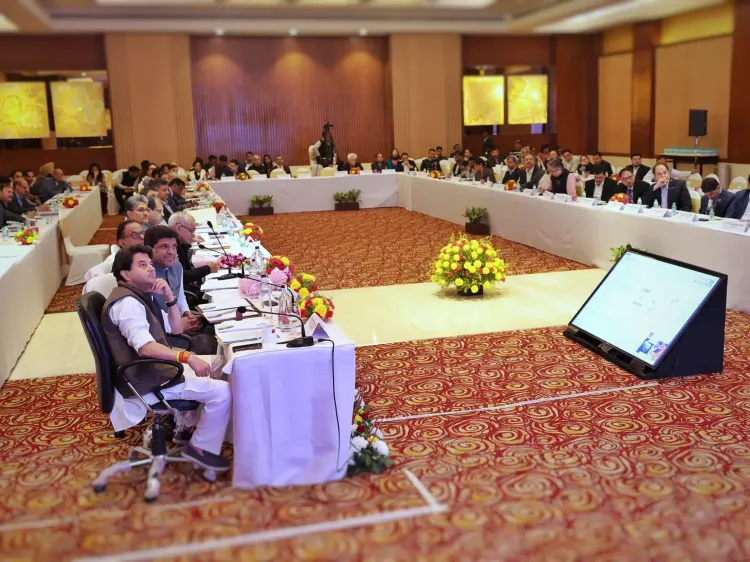
New Delhi, Dec 9 (NationPress) The seven specialized Working Groups established by the Central Government under the Bharat 6G Alliance showcased their advancements and strategic plan at a quarterly review meeting led by Union Communications Minister Jyotiraditya M. Scindia this Tuesday.
In discussing the framework of the B6GA’s seven working groups, Scindia emphasized the necessity for technology, spectrum, devices, applications, and sustainability sectors to align cohesively to foster innovation and scalability. He mentioned that regular monthly joint evaluations among the working groups are crucial to ensure that progress in one area translates into effective advancements in others.
He noted that the spectrum policy will serve as a cornerstone for India’s 6G strategy, highlighting that India has already initiated significant spectrum refarming with more initiatives on the horizon.
Understanding global trends is essential, he stated, for formulating a sustainable national spectrum approach for 6G.
Regarding devices, he emphasized the need for a comprehensive understanding of the value chain from design to manufacturing. India must achieve a balance between high production volumes and affordability, noting that its market dynamics differ significantly from those in Europe or the United States. He encouraged the investigation of standardized device frameworks to expedite scalability and lower costs.
Scindia highlighted the significance of collaborative innovation models, stating that India should unite entrepreneurs, academia, and industry, drawing inspiration from the cooperative development seen in nations like Germany and Japan following extensive periods of reconstruction.
He stressed the necessity for India to establish 6G use cases that stem from local needs rather than depending solely on global standards.
The minister reaffirmed that India’s journey towards 6G is not solely about technological advancements but also about creating a self-sufficient ecosystem that benefits its citizens, industries, and the global community. He asserted that India’s pursuit of 6G should not only aim to serve the nation but should also originate from Indian innovation. With a growing network of researchers, startups, and industry collaborators, India is in a strong position to influence the future of digital connectivity.
The Bharat 6G Alliance acts as a collaborative platform dedicated to promoting indigenous design, development, and deployment of 6G technologies, crucial to India’s goal of becoming a global leader in advanced communications and a key supplier of IP, products, and solutions for affordable 5G and 6G systems.
The Working Groups concentrate on essential areas such as spectrum, device technology, components, sensors, and the manufacturing ecosystem, core technology, applications, green and sustainability aspects, outreach, international relations, and 6G use cases and revenue systems, ensuring a comprehensive approach to every critical aspect of the Bharat 6G Mission.
The minister outlined the main objectives of the Bharat 6G Mission: to define clear, phase-wise goals; maintain close collaboration with the Bharat 6G Alliance; identify priority research areas; commission independent evaluations; and conduct quarterly progress reviews. He emphasized the importance of establishing end-to-end value chains, breaking down complex challenges into manageable parts, and monitoring measurable progress every three months instead of on an annual basis.
Scindia reiterated the notion that India should not just adapt to global standards but strive to shape them. While aligning with international organizations such as 3GPP and ITU, Indian-centric innovations should aspire to attain global relevance. He stressed that both uniqueness and ubiquity are critical for India’s leadership in telecom technology.
Point of View
It is crucial to recognize that the Bharat 6G Mission symbolizes India's commitment to technological progress and self-reliance. The focused approach of the seven working groups not only aims to enhance innovation but also ensures that the benefits of such advancements are distributed across society. It is a strategic move towards establishing India as a leader in global telecommunications.
NationPress
30 Sept 2026
Frequently Asked Questions
What is the Bharat 6G Mission?
The Bharat 6G Mission aims to develop and implement 6G technologies in India, positioning the country as a leader in advanced communications.
Who is overseeing the Bharat 6G Mission?
Union Communications Minister Jyotiraditya M. Scindia chairs the efforts of the Bharat 6G Alliance and its working groups.
What are the key areas of focus for the working groups?
The working groups focus on spectrum, device technology, applications, sustainability, and international engagement to support the Bharat 6G Mission.
Why is spectrum policy important for 6G?
Spectrum policy is crucial as it will define how effectively 6G technologies can be implemented and utilized in India.
How does India plan to approach 6G use cases?
India plans to develop 6G use cases based on local needs rather than solely relying on global standards.