India-Bangladesh ties 'organic and natural': High Commissioner Hamidullah at Tripura conclave
Synopsis
Bangladesh's High Commissioner to India called the bilateral relationship 'organic' and said 'the sky is the limit' — remarks made not in Delhi but at a business conclave in Agartala, a deliberate signal that the northeast corridor is central to the India-Bangladesh reset under Prime Minister Tarique Rahman's new government.
Key Takeaways
Bangladesh High Commissioner Md.
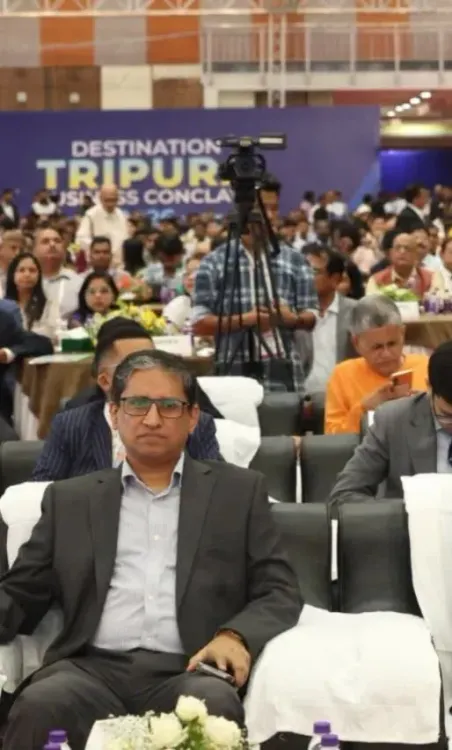
Riaz Hamidullah described India-Bangladesh ties as 'organic' and 'absolutely natural' at the Destination Tripura Business Conclave 2026 on 10 July 2026 .
He confirmed bilateral issues will be discussed with the new Bangladesh government led by Prime Minister Tarique Rahman through established diplomatic channels.
Hamidullah proposed a Bangladesh film festival in Tripura to deepen cultural ties between the two countries.
Diplomats from nine countries — including South Africa, Chile, Laos, Kazakhstan, and Uzbekistan — participated in the two-day conclave in Agartala .
MoUs were signed in sectors including tourism , agarwood , rubber , and food processing over the two days.
Tripura held four investor roadshows in Bengaluru, Hyderabad, New Delhi, and Guwahati ahead of the conclave.
Bangladesh High Commissioner to India, Md. Riaz Hamidullah, on Friday, 10 July 2026, described India-Bangladesh relations as 'organic' and 'absolutely natural', asserting that the bilateral bond is deeply rooted in shared history, geography, and people-to-people connections that extend well beyond trade volumes. His remarks came on the sidelines of the two-day Destination Tripura Business Conclave 2026 held at the Hapania International Fair Ground on the outskirts of Agartala.
What Hamidullah Said
'Our relations are organic and absolutely natural. They are multi-sectoral and have continued since the pre-Independence period. The ties between the two countries are very deep and age-old, and they should not be measured only in terms of the volume of trade and economic exchanges,' Hamidullah told reporters at the conclave.
He added that the scope of bilateral cooperation is virtually boundless — 'Our relations — the sky is the limit' — underscoring that both nations hold enormous untapped potential across diverse sectors.
Political Transition and Diplomatic Continuity
Referring to the evolving political landscape in Bangladesh, Hamidullah confirmed that all outstanding bilateral issues are either under active discussion or would be taken up with the new government led by Prime Minister Tarique Rahman. He emphasised that both countries remain committed to resolving matters of mutual interest through established diplomatic channels, signalling continuity despite the change in Dhaka's political leadership.
People-to-People Bonds Across the Northeast
The High Commissioner highlighted the especially close social and cultural linkages between Bangladesh's eastern regions — particularly Sylhet, Comilla, Noakhali, and Chattogram — and the adjoining northeastern and eastern states of India. These generational ties, he noted, form a strong foundation for deepening the bilateral relationship. To reinforce cultural engagement, Hamidullah proposed organising a Bangladesh film festival in Tripura, calling it an initiative that could deepen mutual understanding and reinforce historic bonds.
Notably, the High Commissioner travelled from Guwahati to Agartala by train specifically to observe the scenic beauty of the Northeastern states — a gesture diplomats and observers read as symbolic of his personal commitment to the region. Since Thursday, he had met Tripura Chief Minister Manik Saha and various stakeholders, stressing the expansion of cultural, economic, and people-centric cooperation.
Tripura Conclave: Scope and Participants
The two-day conclave brought together policymakers, diplomats, investors, and industry leaders from India and abroad. According to Industry and Commerce Department Secretary Kiran Gitte, senior diplomats from South Africa, Chile, Bangladesh, Timor-Leste, Laos, the Philippines, Kazakhstan, and Uzbekistan participated, alongside the Chairperson of the North East Chapter of the Federation of Indian Chambers of Commerce and Industry (FICCI), industrialists, investors, and several hundred official delegates.
Union Minister of Commerce and Industry Piyush Goyal, Union Minister for Development of North Eastern Region Jyotiraditya Scindia, Chief Minister Manik Saha, and Industries and Commerce Minister Santana Chakma addressed the inaugural session on Thursday. Ahead of the conclave, the Tripura government organised four roadshows in Bengaluru, Hyderabad, New Delhi, and Guwahati to attract investors.
Multiple Memoranda of Understanding (MoUs) were signed across both days, covering sectors including tourism, agarwood, rubber, food processing, and other emerging industries. Gitte noted that Tripura has seen a steady inflow of investments across various sectors over recent years, making the conclave a natural next step in consolidating that momentum.
As the conclave concludes, attention will now turn to whether the diplomatic warmth on display translates into concrete cross-border economic frameworks — particularly given the political transition underway in Dhaka.
Point of View
Yet it has historically been under-leveraged in formal diplomatic frameworks. His remarks come at a sensitive moment: Bangladesh is navigating a political transition under Tarique Rahman, and the language of continuity and 'organic' ties serves as a diplomatic reassurance to New Delhi. The proposed Bangladesh film festival in Tripura is a soft-power signal, but the harder test will be whether the MoUs signed at this conclave translate into operational cross-border trade infrastructure — something past conclaves in the region have promised more than delivered.
NationPress
9 Oct 2026
Frequently Asked Questions
What did Bangladesh High Commissioner Riaz Hamidullah say about India-Bangladesh ties?
Hamidullah described India-Bangladesh relations as 'organic and absolutely natural', saying they are multi-sectoral and have continued since the pre-Independence period. He emphasised that the ties should not be measured solely by trade volumes, adding 'the sky is the limit' for bilateral cooperation.
What is the Destination Tripura Business Conclave 2026?
It is a two-day investment and diplomatic conclave held at the Hapania International Fair Ground in Agartala, bringing together policymakers, diplomats from nine countries, industrialists, and investors to explore opportunities in Tripura. The conclave featured MoU signings in tourism, agarwood, rubber, and food processing, among other sectors.
How does Bangladesh's political transition affect India-Bangladesh relations?
Hamidullah confirmed that all bilateral issues are either being discussed or will be taken up with the new government led by Prime Minister Tarique Rahman. He said both countries remain committed to dialogue through established diplomatic channels, signalling continuity despite the change in government in Dhaka.
What cultural initiative did the Bangladesh High Commissioner propose for Tripura?
Hamidullah proposed organising a Bangladesh film festival in Tripura to deepen mutual understanding and reinforce historic bonds between the peoples of the two countries. He highlighted longstanding people-to-people ties between Bangladesh's eastern regions — Sylhet, Comilla, Noakhali, and Chattogram — and India's northeastern states.
Which Indian ministers attended the Tripura Business Conclave 2026?
Union Minister of Commerce and Industry Piyush Goyal, Union Minister for Development of North Eastern Region Jyotiraditya Scindia, Tripura Chief Minister Manik Saha, and Industries and Commerce Minister Santana Chakma addressed the inaugural session of the conclave on Thursday.