Hanwha Aerospace Daejeon blast kills 5, plant partially suspended
Synopsis
A deadly explosion at Hanwha Aerospace's classified Daejeon plant — which makes Chunmoo rocket launchers and L-SAM missiles — has killed five workers and forced a partial production halt covering lines worth ₩1.32 trillion in annual revenue. With a government task force deployed and a joint police-forensics probe underway, South Korea's defence supply chain faces rare disruption at a strategically sensitive facility.
Key Takeaways
Hanwha Aerospace partially suspended production at its Daejeon facility on 2 June following a deadly explosion and fire.
The blast killed five workers and injured two others ; workers were cleaning propellant powder residue at the time.
The affected production lines accounted for 4.94% of Hanwha Aerospace's total revenue — approximately ₩1.32 trillion (US$870 million) last year.
The plant is a classified secret defence factory producing Chunmoo multiple rocket launchers and L-SAM missiles .
DAPA has formed a task force and pledged technical support; a joint investigation team involving police, forensics, and labour officials is on site.
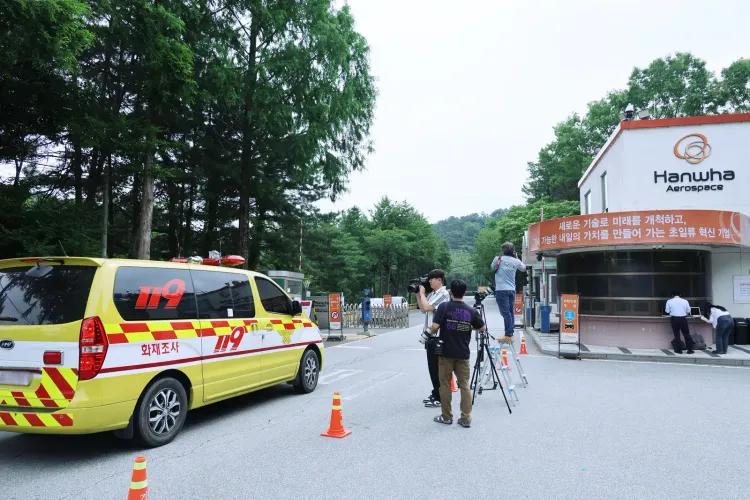
Hanwha Aerospace Co., a defence affiliate of South Korea's Hanwha Group, partially suspended production at its Daejeon facility on Tuesday, 2 June following a deadly explosion that killed five workers and injured two others. Labour authorities ordered the halt under South Korea's occupational safety laws, citing a serious workplace accident at the plant located approximately 140 kilometres south of Seoul.
What Happened at the Daejeon Plant
According to the company, workers were cleaning propellant powder residue from tools used in the manufacture of propulsion systems when the explosion occurred. The blast triggered a fire at the facility, which is classified as a secret defence factory and produces critical weapons systems including the Chunmoo multiple rocket launchers and long-range surface-to-air missiles (L-SAM).
Investigators are working to determine the source of ignition and whether flammable materials were present at the scene. A joint inspection team comprising officials from the Daejeon Metropolitan Police Agency, the fire service, the National Forensic Service, the labour ministry, and the Korea Occupational Safety and Health Agency has been deployed to the site.
Scale of the Production Shutdown
The affected production lines generated 1.32 trillion won (approximately US$870 million) in revenue in the previous financial year, representing 4.94 per cent of Hanwha Aerospace's total revenue of 26.7 trillion won, according to the company's regulatory filing. The partial suspension could have downstream implications for South Korea's defence supply chain, particularly given the facility's role in producing advanced missile systems.
Government and Defence Agency Response
The Defence Acquisition Program Administration (DAPA) said it has formed a task force to manage the situation and will provide technical assistance to the investigation. DAPA spokesperson Kim Joo-chul said at a press briefing: 'We will support, when necessary, the investigation by utilising our personnel and technical expertise of the Agency for Defence Development and the Defence Agency for Technology and Quality and other specialised institutions in the process of determining the cause of the accident.'
Kim also addressed concerns over potential inspection lapses at high-security defence facilities, stating that the agency conducts annual inspections in line with relevant laws. He added: 'As for this incident, we understand that the Central Industrial Disaster Headquarters and the Ministry of Employment and Labor will carry out a comprehensive investigation into the causes.'
What Comes Next
Police have launched a formal joint probe into the explosion, and investigators plan to examine both the ignition source and safety protocols in place at the time of the incident. This is the latest in a series of industrial accidents to draw scrutiny over workplace safety standards in South Korea's defence manufacturing sector. The outcome of the investigation could prompt a broader review of safety regulations governing classified defence production facilities across the country.
Point of View
Investigators must explain how a routine cleaning task became a fatal blast. More broadly, with South Korea ramping up defence exports — Hanwha is a key supplier to NATO-aligned buyers — any prolonged shutdown at Daejeon carries reputational and contractual risk well beyond the factory floor.
NationPress
16 Oct 2026
Frequently Asked Questions
What caused the explosion at the Hanwha Aerospace Daejeon plant?
Workers were cleaning propellant powder residue from tools used in propulsion system manufacturing when the explosion occurred on 2 June. Investigators are still working to determine the exact ignition source and whether flammable materials were improperly present at the scene.
How many people were killed or injured in the Hanwha Aerospace blast?
Five workers were killed and two others were injured in the explosion and subsequent fire at the Daejeon facility. Police have launched a joint probe to establish the precise cause.
What weapons does the Daejeon plant produce?
The Daejeon facility is a classified secret defence factory that manufactures the Chunmoo multiple rocket launchers and long-range surface-to-air missiles (L-SAM), among other weapons systems.
How significant is the suspended production to Hanwha Aerospace's revenue?
The affected production lines generated ₩1.32 trillion (approximately US$870 million) in revenue last year, representing 4.94 per cent of Hanwha Aerospace's total annual revenue of ₩26.7 trillion.
What is the South Korean government doing in response to the explosion?
The Defence Acquisition Program Administration (DAPA) has formed a task force and pledged technical support from defence development agencies. A joint investigation team involving the Daejeon Metropolitan Police Agency, the National Forensic Service, the fire service, and labour officials is conducting an on-site probe.