How Can India Leverage Technology for Inclusive Growth in the AI Era? - Delhi Assembly Speaker Vijender Gupta

Synopsis
Delhi Assembly Speaker Vijender Gupta highlights the crucial role of AI in shaping India’s economic future. He emphasizes the need for strategic technology utilization to ensure equitable growth, while also addressing challenges like job displacement and the skills gap. This seminar sheds light on the transformative power of AI in various sectors.
Key Takeaways
AI is a key economic driver reshaping various sectors.
India has a strategic advantage due to its young population and digital infrastructure.
Careful management of AI's transition is essential to avoid job displacement.
Reskilling and upskilling are vital for the workforce's adaptation.
Regulatory clarity will foster trust and fairness in AI markets.
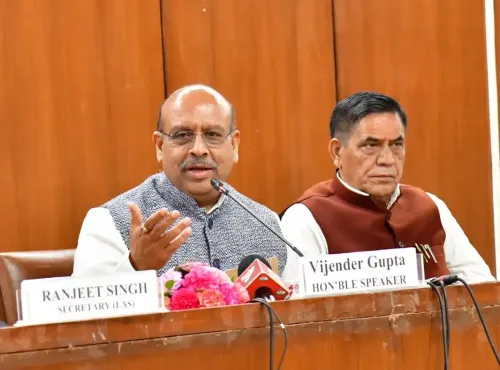
New Delhi, Feb 13 (NationPress) Delhi Assembly Speaker Vijender Gupta expressed on Friday that India is at a critical crossroads in the era of Artificial Intelligence, emphasizing the necessity to utilize technology in a way that enhances opportunity, ensures equity, and promotes inclusive economic development.
While addressing the 3rd National Seminar on ‘Challenges and Opportunities in the Age of AI: An Economic Perspective’ at the Academic Auditorium of Shaheed Bhagat Singh College, University of Delhi, Gupta noted that Artificial Intelligence has become a foundational economic force influencing productivity, labor markets, capital allocation, and global competitiveness.
He observed that economies globally are reorganizing around data, algorithms, and computational capabilities, with AI impacting financial systems, manufacturing, agriculture through predictive analytics, healthcare delivery, logistics, and public administration.
The seminar saw participation from Prof. Ram Singh, Director of the Delhi School of Economics and a member of the Monetary Policy Committee, alongside distinguished speakers from both academia and industry.
Organized by the College's Department of Economics, the event attracted prominent academicians, policymakers, industry specialists, faculty, and students.
Highlighting India’s rapid growth as a digital economy, Gupta remarked that the nation’s robust digital public infrastructure and youthful demographic provide a strategic edge in this global transformation.
He underscored that AI presents significant economic prospects, boosting productivity across various sectors, enhancing financial inclusion through better credit evaluations and risk assessments, facilitating efficient public service delivery, and nurturing innovation and high-value industries.
Referencing emerging global labor trends, Gupta pointed out that roles connected to AI increasingly offer higher wages and improved job quality, presenting worthwhile opportunities for the youth of India.
However, he cautioned that this transition needs to be managed with prudence and equilibrium.
He highlighted the risks of job displacement due to automation of repetitive tasks, the widening skills gap, and the ongoing digital divide.
Gupta also noted the concentration of capital and data in the development of AI, which could influence market competition.
Emphasizing the importance of extensive reskilling and upskilling initiatives, collaboration between industry and academia, and the expansion of digital education, he asserted that regulatory clarity, data governance, and algorithmic accountability are essential economic imperatives to maintain trust and fairness in markets.
Furthermore, Gupta pointed out that the adoption of AI has broader macroeconomic implications impacting wage structures, taxation frameworks, fiscal sustainability, and long-term employment trends.
He concluded by stating that policymaking must proactively address these changes to achieve stable and inclusive growth.
Point of View
It is imperative to recognize the transformative potential of AI in driving inclusive growth. The insights shared by Delhi Assembly Speaker Vijender Gupta reflect a comprehensive understanding of both the opportunities and challenges ahead. As India navigates this transition, a balanced approach will be crucial in ensuring that technological advancements benefit all sectors of society.
NationPress
6 Oct 2026
Frequently Asked Questions
What is the significance of AI in India's economy?
AI is reshaping productivity and labor markets, creating opportunities for enhanced financial inclusion and innovation.
What challenges does AI pose for the workforce?
AI may lead to job displacement, widening the skills gap and increasing the digital divide if not managed properly.
How can India leverage its demographic advantages?
India's youthful population and robust digital infrastructure position it favorably to lead in the global AI transition.
What measures are necessary for responsible AI adoption?
Large-scale reskilling, collaboration between industry and academia, and regulatory clarity are crucial for sustainable growth.
What macroeconomic implications does AI have?
AI adoption impacts wage structures, taxation systems, and long-term employment patterns, necessitating proactive policymaking.