Is India at an AI Inflection Point Amid Infrastructure Transformation?

Synopsis
The 'India AI Impact Summit 2026' highlights that AI is not just a technological upgrade but a crucial infrastructure shift, determining national power. Leaders emphasize the need for strategic planning and workforce development to navigate the challenges of AI implementation effectively.
Key Takeaways
AI is a significant infrastructure shift rather than just a technology upgrade.
Partnerships like Qualcomm and Sarvam are vital for AI accessibility.
High-performance computing is essential for India's AI ambitions.
Strategic planning is needed to mitigate employment displacement risks.
India must prioritize workforce reskilling to adapt to AI advancements.
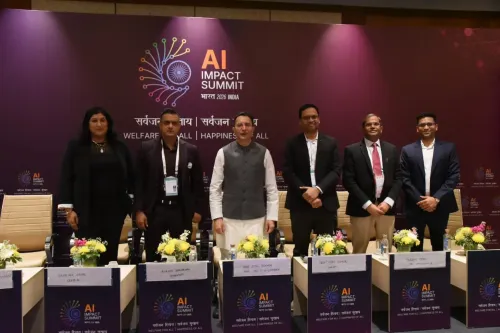
New Delhi, Feb 20 (NationPress) Industry leaders and experts celebrated the ‘India AI Impact Summit 2026’ on Friday, emphasizing that AI signifies more than just an upgrade in technology; it represents a substantial shift in infrastructure, which in turn dictates power.
Countries are increasingly leveraging trade and technology as strategic tools.
Savi Soin, SVP and President of Qualcomm India, articulated that the nation’s AI future will hinge not solely on robust models but on the efficiency with which intelligence disseminates to people, industries, and public systems on a large scale.
“Our partnership with Sarvam exemplifies Qualcomm Technologies’ enduring pledge to facilitate AI for India, merging edge computing, hybrid AI frameworks, and sovereign design principles to ensure that AI is accessible, secure, and impactful for every Indian,” he asserted.
Sunil Gupta, Co-Founder, MD and CEO of Yotta Data Services, remarked that India's AI aspirations demand consistent, high-performance computing at scale.
“By integrating Blackwell Ultra infrastructure with open models such as NVIDIA Nemotron alongside the comprehensive NVIDIA AI stack, we empower developers to create sovereign, globally competitive AI applications from India,” he noted.
The ‘AI Impact Summit’ has attracted participation from policymakers, industry leaders, researchers, and startups worldwide, positioning India as a pivotal contributor in shaping the global AI discourse.
Industry leaders warn that in a post-AI world, unchecked digital dependency could lead to systemic vulnerabilities.
“If our enterprises, defense systems, financial networks, and public infrastructure depend on AI systems beyond our control, we risk systemic vulnerabilities. The subtleties of strategic addiction can have profound structural consequences,” cautioned Chocko Valliappa, Founder and Managing Director of Vee Technologies.
“India requires a displacement map—an analysis by sector and region—coupled with a five-year plan for skills development and transition. We need robust AI frameworks, accountability structures, and measures to cushion employment markets,” Valliappa added.
Similar to the U.S., India must quickly establish a workforce development board across every district to collaboratively address job displacement and identify necessary reskilling initiatives, he suggested.
Numerous Indians excel globally in AI—researchers, founders, safety experts, chip designers, and systems architects.
“AI transcends innovation; it embodies a national strategy. Countries that prioritize sovereignty, employment, and energy will dictate the future,” experts concluded.
Point of View
I believe this summit marks a pivotal moment for India, where we must harness AI responsibly while ensuring that our workforce is prepared for the changes ahead. A proactive approach will help us maintain leadership in this critical area.
NationPress
18 Sept 2026
Frequently Asked Questions
What is the significance of the India AI Impact Summit 2026?
The summit emphasizes AI as a transformative force in infrastructure, crucial for national power and economic growth.
How is India planning to enhance its AI capabilities?
India aims to combine high-performance computing with strategic partnerships to develop sovereign AI applications.
What are the potential risks of AI dependency?
Experts warn that over-reliance on uncontrolled AI systems can lead to systemic vulnerabilities across various sectors.