Himachal Pradesh bars land encroachers' bahus from panchayat polls in 2026 bill
Synopsis
Himachal Pradesh has shut a well-worn proxy-politics route: encroachers barred from panchayat polls had simply fielded their daughters-in-law instead. The 2026 amendment now extends the six-year disqualification to the entire family unit — including bahus — marking one of the sharpest electoral eligibility reforms the state has seen in decades.
Key Takeaways
The Himachal Pradesh Panchayati Raj (Second Amendment) Bill, 2026 was introduced on 1 September 2026 during the Monsoon Session of the state assembly.
Daughters-in-law of land encroachers are now explicitly barred from contesting panchayat pradhan , BDC , and Zila Parishad elections — a category missing from the original 1994 Act .
Disqualification runs for six years from the date an encroacher relinquishes or is evicted from government or shamilat land.
The bill replaces an ordinance issued on 6 May 2026 and was introduced by Minister Anirudh Singh .
Additional disqualification grounds include pending NDPS Act charges, outstanding panchayat dues, government employment, and conviction for moral turpitude offences.
Disputed disqualifications will be adjudicated by a state-authorised officer in consultation with the state Election Commission .
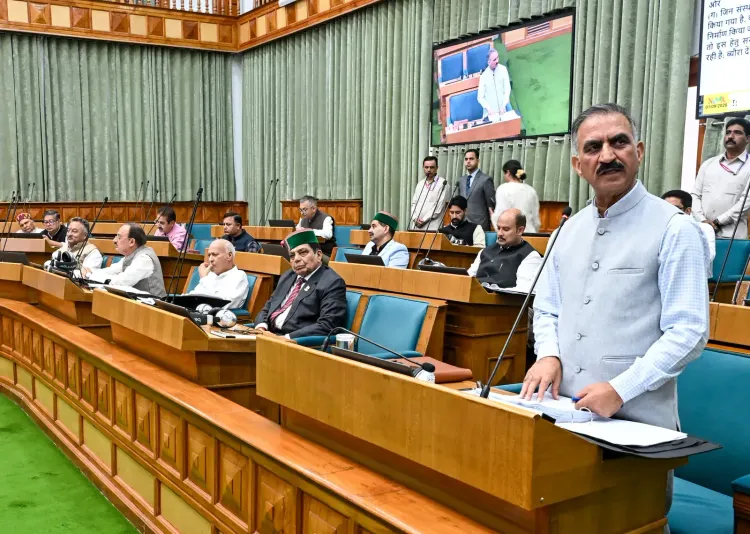
The Congress government in Himachal Pradesh, led by Chief Minister Sukhvinder Sukhu, on 1 September 2026 introduced the Himachal Pradesh Panchayati Raj (Second Amendment) Bill, 2026 in the state assembly, closing a long-exploited legal loophole that allowed land encroachers to contest panchayat elections through family proxies. The bill, tabled during the Monsoon Session of the Legislative Assembly, extends disqualification to daughters-in-law of encroacher families — a category conspicuously absent from the original Panchayati Raj Act, 1994.
The Loophole That Was Exploited
Under the previous law, the definition of an encroacher's family covered grandparents, parents, spouse, son, and unmarried daughter — but not the daughter-in-law. Encroachers declared ineligible to contest elections reportedly used this gap systematically, fielding their bahus for posts such as panchayat pradhan, Block Development Committee (BDC) member, or Zila Parishad member, effectively retaining political control by proxy. The practice was widespread enough in previous panchayat election cycles to prompt the state government to issue an ordinance on 6 May this year — an ordinance the current bill now seeks to replace through legislative sanction.
What the Amendment Changes
The bill significantly expands the definition of who qualifies as a beneficiary of land encroachment. If a candidate, or any family member including the daughter-in-law, is found to have illegally occupied government land or shamilat (common village) land, the candidate faces complete disqualification from contesting elections for six years, counted from the date they relinquish possession or are evicted. Candidature already filed will also be cancelled under the new provisions.
Rural Development and Panchayati Raj Minister Anirudh Singh introduced the bill in the assembly. The government's stated rationale is that a daughter-in-law, as an integral part of the family unit, is a direct or indirect beneficiary of any encroachment and must therefore be covered under disqualification norms.
Broader Disqualification Grounds Under Section 122
Beyond land encroachment, the amendment reinforces and enumerates additional grounds for disqualification under Section 122 of the Act. These include:
Pending charges in a court under the Narcotics Drugs and Psychotropic Substances (NDPS) Act for drug trafficking; outstanding taxes, fees, or dues payable to the Panchayat, Panchayat Samiti, or Zila Parishad; any form of employment — regular, part-time, daily wage, or contractual — with the panchayat or government undertakings; furnishing false information or an incorrect declaration in nomination papers; and conviction for election offences, corrupt practices, or crimes involving moral turpitude carrying a sentence of up to six years.
Grievance Redress Mechanism
The bill also provides a due-process safeguard: if a complaint or question arises regarding a candidate's disqualification, the individual must be given an opportunity to present their case. A state government-authorised officer will then rule on the matter in consultation with the state Election Commission.
What Happens Next
With the bill set to replace the earlier ordinance, its passage will give the disqualification provisions full legislative backing ahead of the next round of panchayat elections in Himachal Pradesh. Enforcement will hinge on how swiftly district authorities identify and act on pending encroachment cases — and how robustly the grievance mechanism is implemented on the ground.
Point of View
And the fact that it took over three decades to patch the 1994 Act raises questions about political will across successive governments. The six-year disqualification clock starting only after eviction or relinquishment is a critical detail — if encroachment cases remain pending in courts or revenue offices, the bar may never be triggered. The real test of this reform is not its passage in the assembly but the pace of encroachment adjudication on the ground, where institutional capacity is thin and local political pressures are high.
NationPress
17 Oct 2026
Frequently Asked Questions
What is the Himachal Pradesh Panchayati Raj (Second Amendment) Bill, 2026?
It is a state legislation introduced on 1 September 2026 that expands the definition of land encroachers' families to include daughters-in-law, barring them from contesting panchayat elections. The bill replaces an ordinance issued on 6 May 2026 and imposes a six-year disqualification on encroachers and their family members.
Why were daughters-in-law specifically included in the new bill?
The original Panchayati Raj Act, 1994 did not list daughters-in-law in the definition of an encroacher's family, creating a loophole. Encroachers who were themselves disqualified reportedly fielded their bahus as proxy candidates for posts such as panchayat pradhan and Zila Parishad member to retain political control.
How long is the disqualification period under the new amendment?
The disqualification period is six years, starting from the date the encroacher relinquishes possession of the illegally occupied land or is formally evicted. During this period, neither the encroacher nor any covered family member — including the daughter-in-law — can contest panchayat elections.
What other grounds for disqualification does the bill introduce?
Beyond land encroachment, Section 122 of the amended Act disqualifies candidates who have pending NDPS Act charges for drug trafficking, outstanding dues to panchayat bodies, any form of government or panchayat employment, false declarations in nomination papers, or convictions for election offences or moral turpitude crimes carrying sentences up to six years.
What happens if a candidate disputes their disqualification?
The bill provides a due-process mechanism: the candidate is given an opportunity to present their case. A state government-authorised officer then makes a decision on the matter in consultation with the state Election Commission.