CM Sukhu Vows No Fund Shortage for HP Panchayats

Synopsis
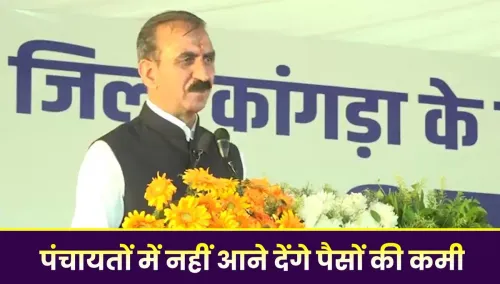
Chief Minister Sukhvinder Singh Sukhu has pledged that Himachal Pradesh panchayats will face no shortage of funds, reaffirming his Atmanirbhar Himachal vision. The statement, shared by the CMO on 18 June 2026, underscores the state government's commitment to fiscal empowerment of rural local bodies.
Key Takeaways
CM Sukhvinder Singh Sukhu pledged on 18 June 2026 that panchayats in Himachal Pradesh will not face a shortage of funds.
The assurance is framed within the Chief Minister's stated goal of an Atmanirbhar Himachal (self-reliant Himachal).
Himachal Pradesh has over 3,600 gram panchayats that are central to last-mile delivery of rural development and welfare schemes.
The 73rd Constitutional Amendment (1992) mandates devolution of powers and finances to panchayats, though implementation gaps persist across Indian states.
The statement sets a political benchmark for upcoming State Finance Commission recommendations and annual budget allocations for panchayats.
Panchayats in remote districts such as Lahaul-Spiti, Kinnaur, and Chamba are among the most dependent on timely state fund transfers.
The Chief Minister's Office of Himachal Pradesh on Thursday, 18 June 2026 shared a statement by Chief Minister Thakur Sukhvinder Singh Sukhu reaffirming his government's commitment to ensuring that rural local bodies across the state never face a shortage of funds, framing the pledge within his broader vision of an Atmanirbhar Himachal (self-reliant Himachal).
Context
Speaking through the official CMO handle, CM Sukhu stated: 'I have said before that our goal is a self-reliant Himachal, and our panchayats must also become self-reliant. We will ensure that there is no shortage of funds in the panchayats.' The statement is a reaffirmation of a position the Chief Minister has articulated since taking office in December 2022, signalling that fiscal empowerment of village-level bodies remains a live policy priority heading into the current fiscal year.
Himachal Pradesh is a northern hill state where geography and terrain make last-mile delivery of public services particularly challenging, placing an outsized burden on panchayati raj institutions to plan and execute local development works. Any assurance of uninterrupted fund flow to these bodies carries direct implications for rural roads, water supply, sanitation, and welfare delivery across the state's roughly 3,600-plus gram panchayats.
Policy Backdrop
The constitutional foundation for this commitment lies in the 73rd Constitutional Amendment of 1992, which mandated that state governments devolve powers, functions, and finances to panchayats. Despite this mandate, a persistent gap between devolution in law and devolution in practice has been documented across many Indian states, including hill states that argue their fiscal capacity is structurally constrained by limited own-revenue sources.
CM Sukhu's Atmanirbhar Himachal framing links the self-reliance goal simultaneously to the state exchequer and to its constituent local bodies — a two-tier articulation that positions panchayats not merely as spending units but as autonomous development actors. This aligns with a nationwide trend in which state governments have increasingly tied political credibility to assured, untied grant mechanisms for third-tier institutions.
Stakeholders and Impact
The most direct beneficiaries of any sustained fund flow to panchayats are rural communities in Himachal Pradesh, who depend on gram sabhas and panchayat committees for the planning and oversight of local infrastructure and welfare schemes. Elected panchayat representatives — particularly in remote blocks of districts such as Lahaul-Spiti, Kinnaur, and Chamba — have historically cited delayed or insufficient fund transfers as a key constraint on timely project execution.
The statement also carries significance for state finance commission deliberations and annual budget exercises. A public commitment of this nature from the Chief Minister creates a political benchmark against which actual budget allocations and grant releases for panchayats will be measured by opposition parties and civil society alike.
What's Next
The immediate watchpoint is whether the statement is followed by concrete announcements — such as revised untied-grant norms, enhanced State Finance Commission award implementation, or streamlined fund-release timelines — in the current fiscal year's budget or supplementary demands. Panchayat bodies and rural development officials will look for operational circulars that translate the Chief Minister's assurance into disbursement schedules. The broader test of Atmanirbhar Himachal at the panchayat level will ultimately be measured in the quantum and timeliness of funds reaching gram panchayat accounts.
Point of View
The government invites scrutiny of actual devolution figures. This fits a broader pattern across Indian states where self-reliance rhetoric is deployed to signal reformist intent at the local governance level, even as the structural fiscal gap between state promises and panchayat receipts remains a persistent challenge. The real test will be whether the assurance translates into verifiable, timely fund releases rather than remaining a statement of aspiration.
NationPress
19 Sept 2026
Frequently Asked Questions
What did CM Sukhu say about Himachal Pradesh panchayats?
CM Sukhvinder Singh Sukhu stated that his government will ensure panchayats in Himachal Pradesh face no shortage of funds, reaffirming his vision of an Atmanirbhar (self-reliant) Himachal.
What is Atmanirbhar Himachal?
Atmanirbhar Himachal is Chief Minister Sukhu's stated policy vision of making Himachal Pradesh self-reliant, which he has extended to include empowering panchayats with assured financial resources since taking office in December 2022.
Why is panchayat funding important in Himachal Pradesh?
Himachal Pradesh's difficult hill terrain makes panchayats critical for last-mile delivery of infrastructure and welfare schemes. Delayed or insufficient fund transfers have historically hampered project execution, especially in remote districts like Lahaul-Spiti and Kinnaur.
What is the constitutional basis for panchayat funding in India?
The 73rd Constitutional Amendment of 1992 mandates that state governments devolve powers, functions, and finances to panchayati raj institutions, though the extent of actual devolution varies across states.
What should one watch for after CM Sukhu's panchayat funding pledge?
The key watchpoints are State Finance Commission recommendations, annual budget allocations for panchayats, and whether the government issues operational circulars that translate the pledge into concrete, timely fund-release schedules for gram panchayats.