CM Sukhu Vows to Protect HP Resources, Empower Panchayats
Synopsis
Himachal Pradesh Chief Minister Sukhvinder Singh Sukhu has vowed to protect the state's natural wealth from unfavourable agreements and fight for its rights, calling it 'only a beginning.' He also committed to ensuring panchayats are financially self-reliant under his Atmanirbhar Himachal vision.
Key Takeaways
CM Sukhvinder Singh Sukhu declared on 18 June 2026 that his government will not sell Himachal Pradesh's natural assets.
He rejected any agreement that harms the state's interests, calling the current moment 'only a beginning' in the fight for state rights.
The Chief Minister reaffirmed his Atmanirbhar Himachal goal, extending it to panchayat-level financial self-reliance.
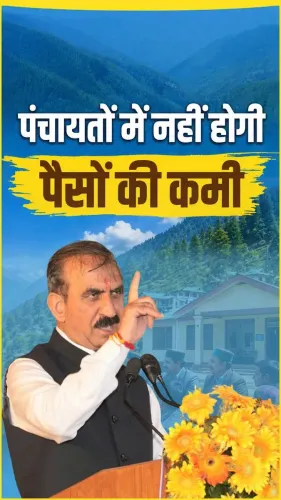
He pledged that panchayats across the state will face no shortage of funds under his government.
The statement signals potential escalation in negotiations over natural resource agreements with the Union government or project developers.
Panchayat empowerment in Himachal Pradesh has constitutional roots in the 73rd Amendment of 1992 , and remains a live policy debate under Finance Commission recommendations.
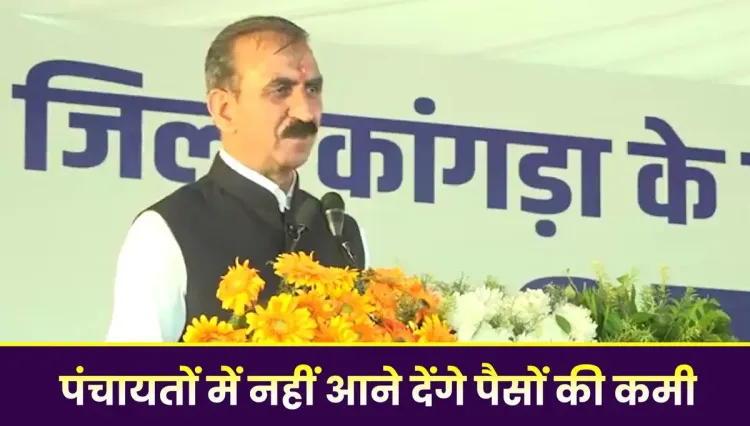
Himachal Pradesh Chief Minister Sukhvinder Singh Sukhu on Thursday, 18 June 2026, declared that his government will not sell the state's natural assets and pledged to fight for Himachal Pradesh's rights in any agreement that threatens its interests. He also reaffirmed his goal of making the state and its panchayats financially self-reliant.
Context
Posting on X, CM Sukhu wrote in Hindi: 'हम प्रदेश की संपदा को बेचने नहीं, उसे बचाने और संजोने के लिए आए हैं' ('We have come not to sell the state's wealth, but to protect and preserve it'). He added that his government will not accept any agreement that harms the state's interests, calling the current moment 'only a beginning' in a larger fight for the state's rights.
The Chief Minister further stated: 'प्रदेश के अधिकारों की इस लड़ाई को हम आगे लेकर जाएंगे और अपना हक लेकर रहेंगे' — 'We will take this fight for the state's rights forward and will claim what is ours.'
Policy Backdrop
Himachal Pradesh is a resource-rich hill state whose hydropower potential, forests, and water bodies have long been at the centre of disputes over royalties, project ownership, and revenue-sharing between the state, the Union government, and public-sector undertakings. Opposition-governed states asserting stronger control over natural resources has been a recurring pattern in Indian federal politics.
On panchayat empowerment, CM Sukhu stated: 'हमारा लक्ष्य आत्मनिर्भर हिमाचल है और हमारी पंचायतें भी आत्मनिर्भर हों' — 'Our goal is a self-reliant Himachal, and our panchayats must also become self-reliant.' He assured that his government will ensure panchayats face no shortage of funds. Since the 73rd Constitutional Amendment of 1992, successive Himachal governments have pursued greater fiscal devolution to rural local bodies, a debate that remains live under successive Finance Commission cycles.
Stakeholders and Impact
Panchayat bodies across Himachal Pradesh stand to be directly affected by the state government's commitment to uninterrupted fund flow at the grassroots level. Enhanced devolution would strengthen local infrastructure delivery and rural governance in a state where many villages are geographically isolated.
State residents dependent on revenue from natural resources — particularly communities near hydropower projects — also have a direct stake in the government's stated refusal to accept agreements perceived as unfavourable to the state. The broader assertion of state rights signals a potential escalation of negotiations with the Union government or project developers.
What's Next
Observers will watch for formal communications from the Himachal Pradesh Finance Department on enhanced panchayat grants, as well as any official representation to the Union Power Ministry regarding renegotiated hydropower agreements. CM Sukhu's framing of this as 'only a beginning' suggests further policy announcements or legal-administrative steps are likely in the weeks ahead.
The government's dual emphasis — protecting natural resource revenues and empowering panchayats — reflects a broader Congress-led governance narrative of decentralisation and state autonomy that is likely to feature prominently in upcoming budget discussions and political messaging.
Point of View
A message with strong resonance in a state where hydropower revenues are existential. The explicit reference to 'this fight' being 'only a beginning' suggests a structured campaign rather than a one-off statement, likely timed to build pressure ahead of a formal negotiation or budget cycle. The pairing of resource-rights rhetoric with panchayat empowerment is strategically astute: it anchors a centre-state confrontation narrative to a grassroots-welfare promise. Nationally, this mirrors a pattern of Congress-governed states using resource-rights assertions to draw contrast with the Union government, making it as much an electoral signal as a governance one.
NationPress
19 Sept 2026
Frequently Asked Questions
What did CM Sukhu say about Himachal Pradesh's natural resources?
CM Sukhu said his government has come to protect and preserve the state's wealth, not sell it, and will not accept any agreement that harms Himachal Pradesh's interests.
What is Atmanirbhar Himachal?
Atmanirbhar Himachal is CM Sukhu's stated goal of making Himachal Pradesh financially self-reliant, which he has now extended to include panchayats becoming self-sufficient in funding.
Why is Himachal Pradesh fighting for its resource rights?
Himachal Pradesh has long disputed royalty shares and project ownership over its hydropower and natural resources with the Union government and public-sector undertakings, making resource-rights a recurring political and financial issue for the state.
How will Himachal Pradesh panchayats get more funds?
CM Sukhu pledged on 18 June 2026 that his government will ensure panchayats face no shortage of funds, in line with the fiscal devolution framework established by the 73rd Constitutional Amendment of 1992.
What happens next after Sukhu's statement on state rights?
Observers expect formal steps such as Finance Department orders on enhanced panchayat grants or official communication to the Union Power Ministry on renegotiated hydropower agreements, as Sukhu described the current moment as 'only a beginning.'