What Were the Imperial Fears and Arrogance Against Missionaries?
Synopsis
Explore the historical tensions between the British East India Company and missionary efforts in early 19th century India. Discover how imperial fears of cultural upheaval and financial instability shaped policies against religious propagation, revealing the underlying complexities of colonial governance.
Key Takeaways
The British East India Company transitioned from a commercial entity into a significant imperial power by the 19th century.
The EIC's governance relied on a precarious balance of moral influence and military force.
Religious activities became contentious due to fears of destabilizing the established social order.
The SSPCK's mission was rooted in a cultural superiority complex, viewing Indians as morally deficient .
The EIC’s restrictions on missionary work were a strategic maneuver to maintain political control.
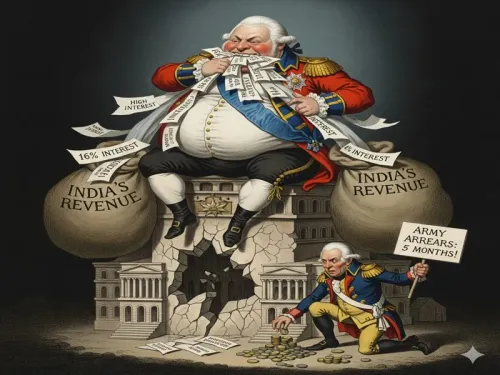
New Delhi, Feb 3 (NationPress) By the second decade of the 19th century, the British East India Company (EIC) had transformed from a simple commercial enterprise into a vast, debt-laden empire governing a substantial population of seventy to eighty million individuals.
According to the authorities overseeing this enormous dominion, the peace of their holdings was reliant not just on the military might of their forces but also on a precarious blend of moral authority and, to a significant extent, prevailing prejudices.
In this fragile and politically charged environment, governance was often criticized as a despotic regime maintained by rulers who were described as tyrants over the governed, making the subject of religious activity increasingly contentious.
The EIC’s existence hinged on preserving a tenuous and artificial political equilibrium, and the unrestrained spread of Christianity posed a serious threat to the very social framework the Company aimed to preserve.
The critical juncture came with the impending renewal of the EIC's exclusive Charter in 1814. This crisis presented diverse British factions—manufacturers eager for open trade, London ship-owners combating Indian competition, and importantly, evangelical and religious groups—with an opportunity to push their respective agendas onto a faltering imperial entity.
On February 19, 1813, the Society in Scotland for Propagating Christian Knowledge (SSPCK) formally addressed the House of Commons.
Their petition, introduced by Mr. Wilberforce, sought parliamentary approval in the Charter renewal to enable them to fulfill their spiritual mission within the EIC's territories.
For the people of India, already subjected to a system widely denounced as being founded on blood and sustained by injustice, the rhetoric of this petition served as a damning indictment of British cultural arrogance, asserting that the colonial endeavor regarded its subjects as not merely economic assets, but as morally deficient individuals urgently needing foreign “civilization”.
I. The Insult of “Deplorable Ignorance”
The SSPCK, an organization established in 1709 by a charter from Queen Anne to promote Christian knowledge, viewed India as an ideal setting for their endeavors, completely aligned with the royal charter’s objectives. They boasted of their success in disseminating “the blessings of civilization and industry, subordination to lawful authority, and loyalty to the British Empire’s Constitution” in Scotland and America. The petition aimed to export this civilizing mission to Indian lands.
However, the Society's portrayal of the Indian populace was laden with significant condescension, revealing a cultural superiority complex that fueled the missionary campaign: “That while the natives of those countries have long been and still continue in a state of deplorable ignorance, and addicted to various idolatrous and superstitious usages of the most degrading and horrible description.”
This depiction of “deplorable ignorance” and “idolatrous and superstitious usages” starkly contrasted with the economic and political conditions the British themselves had enforced upon India. While the SSPCK aimed to illuminate spiritual darkness, the EIC concurrently presided over profound exploitation and financial turmoil:
Financial Bankruptcy: The EIC was not a sustainable commercial entity, being in a “distressed state” and potentially “15 million worse than nothing”. Its vast territorial revenues were largely consumed by the expenses of British administration and military operations. By 1813, the debt accrued for political reasons reached nearly £26,000,000.
Judicial Paralysis: The courts, which were ostensibly set up to provide “security for persons and property”, were revealed to be in a “deplorable state”. Civil justice was effectively denied to claimants due to exorbitant fees (up to 50 percent on claims) and the requirement for stamped paper for all documents, rendering it “almost impossible to obtain justice.” The cost of administering justice in British India was allegedly “higher than in the whole of Europe.”
Informational Lockdown: Rather than operating an enlightened governance, the administration upheld a despotic regime where the press was “perfectly fettered” by necessitating the “sanction of the secretary of the government.” This censorship was essential to keep the Indian populace unaware of the nature of their governance and to prevent publications that might reveal “the peculiar tenure by which the British government held their power.”
From an Indian perspective, the genuine “deplorable ignorance” resided not in the indigenous culture, but in the rulers' refusal to recognize the systemic misery, debt, and political deception they perpetuated. The year of the petition (1813) was a period when Parliament was rife with critiques of the EIC for its economic monopoly, which stifled Indian potential and established an “unnatural and extremely hard, if not unjust arrangement” by allowing foreigners to trade more freely with British India than British nationals.
II. The Governor's Fear: Defending Despotism with Prejudice
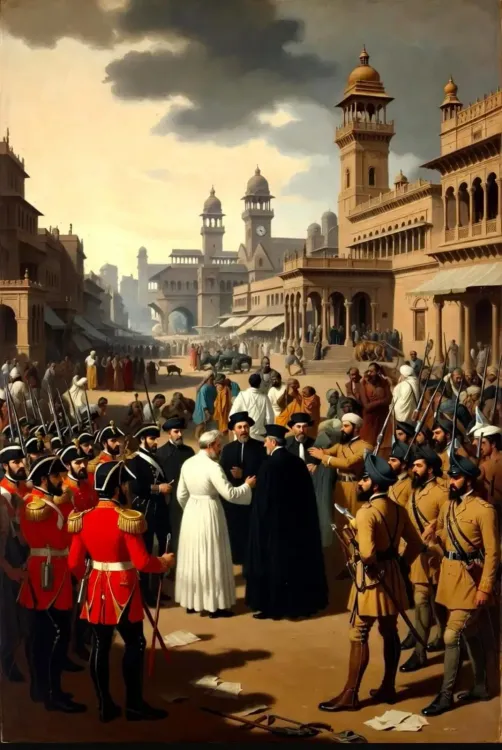
The EIC's limitations on missionary activities were a strategic political maneuver for self-preservation, arising from a profound apprehension of native resistance. The Charter Act of 1813 had to confront this, as Parliament housed influential evangelicals—such as Mr. Wilberforce—who advocated for provisions permitting missions.
The ruling authorities feared that their empire, acquired partly through conquest, compact, forfeiture, and even “fraud”, was too vulnerable to withstand ideological challenges. This anxiety dictated a policy of profound non-interference in religious matters, a stance defended in Parliament by R. Dundas and others.
The primary justification for these restrictions rested on the acknowledgment that “it was the substratum of the British government in India to uphold the laws and usages of the natives.”
Preventing Irritation and Hostility: Dundas affirmed the government's obligation “to suppress a work calculated to excite irritation and hostility.” He recalled an instance where individuals, despite acting with “most laudable intentions,” had printed a treatise containing “animadversions of the most severe nature on the religion and customs of the natives.” Suppression was deemed necessary to avert a religious backlash.
Avoiding Tumultuous Proceedings: The government posited that refraining from actively promoting Christianity was crucial, “lest they should be represented to the people as attempting to impose upon them a new religion,” which could incite “tumultuous proceedings.”
The Political Necessity of Darkness: Critics seized upon this defensive stance. Mr. Whitbread contended that to uphold a “political despotism,” the government would “not let them have the light of that Gospel through which they hoped for salvation themselves.” Mr. Hutchinson noted that the objective was “to keep the people of India in darkness as to the nature of their government.”
The EIC's defense thus unveiled a profound cynicism: Religious tolerance was not granted out of genuine respect, but was cynically utilized as a political tool to maintain “tranquillity” and prevent the massive, sixty-million-strong subject population from realizing the vulnerability of the “one million” British rulers. The British administration, grappling with economic collapse and military strain (such as the war against the Pindarries that sparked conflicts with Mahratta powers), could not afford any internal ideological fractures.
III. The Irony of Exclusion: Scottish Subjects Denied Their Faith
The SSPCK petition, along with a related appeal from the Church of Scotland, underscored a cruel irony within the EIC's system: the religious restrictions predominantly harmed not just the targeted Indian populace but also British subjects themselves.
The SSPCK noted that “many of our own countrymen, members of the Church of Scotland, employed in the different civil and military departments in India, are precluded from enjoying the ordinances of Christianity agreeably to the forms of the Church to which they are attached.”
The EIC’s control over entry into India was regulated through a stringent licensing system. Lord Melville explained that while “most perfect toleration prevailed in these parts of the British dominions,” Scottish Church members found it “almost impossible to exercise their functions.” This was due to the Company's preference for the Established (Anglican) Church, as they were “not in the habit of granting (licenses) to such individuals, except they were of the established Church.”
This illustrates that the Charter system produced a powerful, centralized regulatory body (the EIC), whose reach extended beyond commerce and governance into the personal spiritual lives of its European employees. The exclusion was not merely anti-proselytization; it was a form of political and religious discrimination enforced by the Company's authority.
The SSPCK specifically implored Parliament to ensure, in the new Charter Bill, that its members be permitted to provide “religious worship and instruction to our countrymen members of the Church of Scotland, who may reside in that part of the British empire.” A separate petition from the Church of Scotland also sought provisions for its members to practice their national religion.
The debate revealed that the EIC's monopoly was about total control. It dictated who could trade (favoring foreigners over British private merchants), who could publish (requiring government secretary approval), and even who could travel to India to practice their faith (excluding non-Anglican clergy).
IV. The Paradox of Colonial “Civilization”
The SSPCK portrayed the dissemination of Christian knowledge as distributing the “blessings of civilization and industry.” This rhetoric perfectly resonated with the broader British belief that their rule, despite its political failings, was a force for modernization.
However, this alleged civilizing mission appeared, from the Indian perspective, profoundly paradoxical and subservient to colonial objectives:
Subjugation via Education: When missionaries finally received official permission following the Charter Act of 1813, they regarded education as a primary means for cultural transformation, with the intention of “Christianising and ‘civilising’ the natives.” These endeavors, while occasionally centered on social reforms (like the abolition of Sati), were fundamentally intertwined with the “overarching goals of colonial control, economic exploitation, and cultural subjugation.”
Economic Ruin: The economic policy of “colonial underdevelopment” had systematically dismantled India's pre-existing industrial capabilities, ensuring India became a “subservient supplier of raw materials and a captive market for British manufactured goods.” Policies such as the exploitative land revenue system directly led to “widespread peasant misery and agrarian stagnation.” The British actively undermined Indian industries, such as shipbuilding, to protect domestic interests in London, in an act perceived as “injustice and oppression.” The irony of missionaries claiming to spread “industry” while the governing power deliberately destroyed Indian industry was glaring.
Suppression of Local Agency: The political necessity of stifling dissent resulted in the suppression of indigenous intellectual and political responses. The press was fettered, and any information that could empower the natives was withheld. This denial of “moral and political information” was essential to prevent a collective anti-colonial consciousness from emerging.
The missionary drive, asserting that Indian life was characterized by “deplorable ignorance,” provided a moral rationale for the continuation of a regime that was, by British critics' own admission, financially corrupt and profoundly unjust. It enabled the EIC to frame its military expansion (such as the “irrepressible expansion” witnessed in the Mahratta wars) as necessary for civilizing a benighted land, diverting attention from the massive Indian debt incurred for “the defense and protection of the British possessions.”
V. Conclusion: The Perpetuation of Controlled Interaction
The 1813 debate over missionary restrictions, sparked by the petition from the Society in Scotland for Propagating Christian Knowledge, solidified the British imperial strategy concerning India. Parliament's eventual, cautious easing of the missionary licensing system (part of the broader Charter Act) was a compromise aimed at appeasing powerful evangelical interests in Britain without immediately jeopardizing the EIC's meticulously maintained despotism.
The controversy affirmed that the EIC's authority was non-negotiable. Whether through the immediate deportation of dissenting journalists, the imposition of exorbitant fees for civil justice, or the denial of licenses to non-Anglican clergy, the administration was structured to maintain total control over movement, information, and ideology.
The characterization of Indians as existing in a state of “deplorable ignorance” was ultimately a self-serving myth. The true ignorance lay in the willful political and intellectual blindness of the EIC regime, which believed it could sustain stability by suppressing facts about its own financial insolvency, military vulnerability, and the systemic injustice underpinning its governance.
The decision to impose restrictions on missions was the EIC's attempt to control the immense potential energy generated by the collision between British imperial ambitions and Indian cultural and social integrity. It confirmed that the EIC favored a silent, compliant subject over a potentially enlightened, and therefore rebellious, one. In the context of the “Drain of Wealth” and the “deplorable state of jurisprudence,” the most profound freedom withheld from the Indian populace was not merely the freedom to hear foreign sermons, but the freedom to organize, to communicate, and to legally challenge the unjust conditions imposed by their foreign rulers.
(The Author is a researcher specializing in Indian history and contemporary geopolitical affairs)
Point of View
I emphasize that understanding the complexities of historical narratives is crucial for informed discussion. The interactions between the British East India Company and Indian societies reveal significant insights into the challenges of governance and cultural exchanges during colonial times.
NationPress
2 Oct 2026
Frequently Asked Questions
What was the main concern of the British East India Company regarding missionaries?
The British East India Company feared that unrestricted missionary activity could destabilize the social structure they had established in India, leading to potential resistance from the native population.
How did the SSPCK justify their mission in India?
The Society in Scotland for Propagating Christian Knowledge justified their mission by claiming it was their duty to spread civilization and Christian teachings to the 'ignorant' natives of India.
What was the impact of the EIC's policies on Indian society?
The EIC's policies led to significant economic exploitation and social unrest in India, as they prioritized British interests over the well-being of the local population.
Did the EIC allow any form of religious practice?
While the EIC imposed restrictions on missionary activities, they practiced a form of religious tolerance that primarily favored the Established Church, excluding non-Anglican clergy.
What does the term 'deplorable ignorance' refer to in the context of this article?
In this context, 'deplorable ignorance' refers to the SSPCK's condescending view of the Indian populace, suggesting that they were in need of enlightenment through Christian teachings.