Are European Tactics a Threat? The Fragility of British Rule in India

Synopsis
Explore how the fear of Indian modernization and the adoption of European military tactics exposed the vulnerabilities of the British Raj. This analysis reveals the intricate relationship between paranoia, power, and the eventual downfall of colonial control in India.
Key Takeaways
British paranoia over Indian military modernization led to oppressive policies.
The reliance on European officers highlighted deep-seated distrust of native forces.
Adoption of European tactics by Indian leaders was seen as a threat to colonial stability.
The British commitment to technological superiority proved to be a fragile foundation.
This historical context sheds light on the roots of future resistance movements .
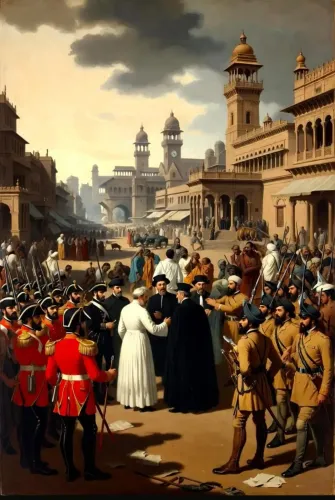
New Delhi, Dec 7 (NationPress) The onset of the 19th century in India was heralded by the thunderous roar of European artillery, yet the most significant concern within the far-off corridors of the British Empire was not the might of local forces, but the alarming potential for their cognitive advancement.The British East India Company (EIC), aiming for total control from Delhi to Pune, relied on a delicate structure of power—one that was maintained by a modest group of European personnel. As the influential Maratha leaders began to embrace the military strategies and training that characterized the British approach, a surge of strategic unease engulfed Parliament.
This anxiety, cloaked as a matter of geopolitical urgency, exposed a critical reality—the Raj was underpinned by a profound mistrust of its own Sepoy forces and a misguided belief that modern military knowledge was an exclusive asset for white individuals.
To the people of India, the intense parliamentary emphasis on quelling local military advancement unveiled the hypocrisy and ultimately self-defeating nature of the imperial system.
Policies inspired by the belief that a handful of 'Frenchmen scattered across India' could better instruct the natives, posing a greater risk than a large military force, revealed deep-seated paranoia.
This paranoia reflected the anxiety of an invader who understood that his supremacy relied on a fragile technological advantage—an advantage that could easily be dismantled by a few skilled native hands.
I. The Geopolitical Anxiety: The Threat of a French Officer Behind Every Cannon
The concern over local military advancements was closely tied to the enduring British fear of French involvement in Asia. By the time Marquis Wellesley initiated the ruthless campaigns against the Maratha Confederacy in 1803, British expansionist arguments were invariably linked to the looming shadow of the French flag.
The justification for warring against Maratha leaders Scindia and Berar was explicitly associated with the perceived danger of French influence. Lord Castlereagh acknowledged that a shift in British policy from seclusion to aggressive intervention was necessitated by 'changes in the military system introduced and directed by French officers' in the Maratha territories.
The goal was clearly to 'focus on eliminating the French from that region.'
The attention quickly turned to figures like General Perron, who commanded organized forces within Scindia’s territory, with British claims citing an army of 14,000 French troops under Perron.
However, critics in Parliament—those who saw past the veil of necessity—uncovered the exaggeration behind this threat. Mr. Francis pointed out that, upon careful examination, there were 'not more than 12 French officers in the entire Maratha army.'
Perron's forces were mainly composed of native troops, and Perron himself was 'equally despised and feared' by Scindia, leading him to ultimately surrender to British forces.
Despite the minimal reality surrounding the French presence, the fear it incited became an essential justification for aggressive conquests. The real threat was not the physical presence of French soldiers but the potential transfer of 'European tactics.'
This strategic knowledge was deemed perilous to the British, as they were not merely contending with 14,000 Frenchmen; they were battling the daunting prospect that Indian rulers might swiftly absorb the military expertise necessary to destabilize the Raj, establishing the 'Maratha connection' on 'new foundations.'
II. The Doctrine of Strategic Peril: Quality Over Quantity
The apprehension that a few European instructors could amplify the effectiveness of native forces was clearly articulated in the House of Commons. Wellesley’s supporters recognized that, in the specific context of India, the transmission of knowledge posed a greater threat than mass foreign intervention.
A British statesman asserted that European knowledge and tactics were 'dangerous to the natives of India'—a phrase that must be interpreted as meaning strategically 'dangerous to us.' He elaborated on the strategic dread of this intellectual exchange:
'A small number of Frenchmen scattered across the continent of India would effectively serve the natives better by teaching them, and pose a greater risk to us than a much larger force acting collectively against us.'
This statement reveals a deeply-rooted belief in the supremacy of European military methods—a superiority so formidable that even minor access to it by an adversary, like a few French officers, could be more catastrophic than an entire invading army. The implication was that the physical strength of native rulers was irrelevant; it was the quality of their education that counted.
The Francis Counterpoint: When Modernization Backfired
From the Indian viewpoint, as articulated by Mr. Francis, the British apprehension was ironically misplaced. Francis, an expert in Indian policy, contended that the adoption of European tactics was actually a strategic error on the part of the Maratha leaders—one that favored the EIC:
'By renouncing their own unconventional methods of warfare, they suffered greatly and were effectively repelled. Had they maintained their traditional asymmetrical warfare, they would have appeared much more formidable and demonstrated far more resistance.'
Referencing the Parthians' resistance against Roman legions, Francis implied that the Maratha irregular cavalry—adept in hit-and-run strategies, encircling forces, and cutting off supplies—was the true threat. By adopting the European model of organized formations and frontal assaults, the native armies relinquished their inherent advantages in mobility and terrain, rendering them easier targets for the EIC's disciplined and resource-rich troops.
Thus, the British fear regarding tactical modernization stemmed, to some extent, from ignorance regarding the Marathas' actual historical strengths. Nevertheless, regardless of the tactical reality, the perception of European knowledge as the ultimate weapon justified the relentless pursuit of conquest and the suppression of any native power exhibiting signs of internal military reform.
III. The Crutch of Mistrust: European Personnel as Internal Security
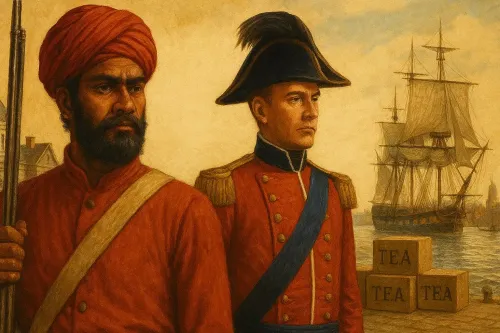
The military framework of the EIC was a complex contradiction. Although it was a vast force predominantly composed of Indian manpower (the Sepoys), it relied on a core of European officers and troops primarily tasked with acting as an internal security measure against the very soldiers they commanded.
Documentation reveals an ingrained and unyielding institutional distrust towards the native army, a fear that was constant and pervasive, even among the Company's most devoted soldiers. The deployment of European forces was justified not merely as a necessary military practice but as a crucial safeguard against betrayal:
'Europeans were our protection against native hostility, the only security against the treachery of our Sepoys, whom the Maratha leaders might manage to detach from their loyalty.'
This cynical reliance indicated that the entire British system rested on the premise that the allegiance of the vast majority of its fighting force was negotiable and unstable.
The European soldier, regardless of his fatigue or susceptibility to disease, represented the 'only security'—the strategic linchpin that prevented the entire colonial system from collapsing under the weight of an Indian uprising.
This inherent instability had significant repercussions for troop deployment and welfare. The limited number of European soldiers available necessitated their ongoing and perilous use. The British command considered these individuals a rare resource to be utilized only when maximum impact or absolute control was essential.
IV. The Sacrifice of the 'Invaluable': The Cost of Imperial Arrogance
Since European soldiers were the ultimate psychological and physical deterrent, they were perpetually assigned the most dangerous tasks, a policy leading to catastrophic losses of military life, deemed 'utterly unaccountable' by one critic.
The rationale was straightforward:
'If a town needed to be seized, if a pass was to be taken, if any challenging task was to be fulfilled, Europeans were always employed.'
This unwavering exposure of the most 'invaluable' resource resulted in predictable and devastating casualties, often in campaigns that were financially ruinous and politically unnecessary. A tragic event in Bundelcund during the conflict with Holkar exemplified this:
'A group of his cavalry surrounded one of our detachments, consisting of two complete companies of sepoys, some cannons, and fifty European artillerymen, every one of whom was cut to pieces. The loss of the sepoys is lamentable; that of the artillerymen is invaluable.'
The stark contrast in language—mourning the loss of the Sepoys while considering Europeans 'invaluable'—highlighted the cold calculus of colonial governance. Indian lives were a wartime commodity, but European lives were irreplaceable military resources, necessary not just for combat but for maintaining internal stability.
This squandering of European manpower was a profound strategic concern, as the sheer scale of the conquests undertaken by Wellesley necessitated a relentless drain of men over 'an immense territory' extending 'to Agra, to Delhi, and to Pune.' This vast dominion engendered continual logistical and military vulnerability, rendering it 'impossible to predict what disasters they might face.'
Moreover, this vulnerability was exacerbated by the government’s extreme reluctance to invest in the essential medical support required to preserve these 'invaluable' soldiers. When Dr. Farquharson highlighted the issues surrounding 'typhoid fever and other severe ailments among English troops in India' and advocated for a Medical Staff Corps, the official response was cautious, citing the 'great expense' and suggesting the existence of a less costly 'native Army Hospital Corps.'
The government favored financial austerity over adequately caring for the very European soldiers whose lives were purportedly the 'only security' against the disintegration of their fragile empire. Thus, the system was engineered to aggressively expend European lives in conquest while simultaneously hesitating to incur the necessary costs to sustain them.
V. Conclusion: The Seeds of Future Resistance
The British fixation on regulating the military education of native forces, coupled with the resultant policies of internal distrust and reckless external deployment, directly contributed to the significant instability of the Raj.
From the Indian perspective, the arguments presented in Parliament were a confession: the empire relied on a shaky foundation of technological hubris rather than legitimacy. The anxiety surrounding a handful of French officers and the dependence on a few 'invaluable' European artillerymen were tacit acknowledgments that the vast territories acquired were 'worthless and insecure.'
The ramifications of this policy were self-fulfilling prophecies of instability:
1. Conquest led to Debilitating Debt: The costly wars waged under the guise of French threats and tactical modernization caused Indian debt to swell alarmingly.
2. Debt Forced Austerity: Financial ruin led to a refusal to finance adequate medical care, sacrificing European lives to disease and unnecessary deployments.
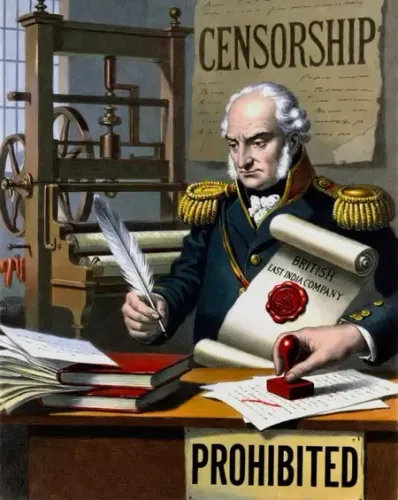
3. Fragility Led to Despotism: The inherent military weakness—a small European force reliant on distrusted Sepoys—necessitated extreme political measures, as reflected in the eventual censorship of the press, which aimed to obscure the truth about the government’s military and financial failures.
The policy of aggressive expansion, predicated on obstructing native military modernization, ultimately proved detrimental to the British themselves. It fostered a climate where 'the entire nation [was] provoked... into a spirit of rebellion.' The British succeeded in conquering extensive territories but failed to secure the allegiance of their subjects or even the welfare of their essential soldiers.
The strategic dread of indigenous modernization in India mirrored the trepidation a builder might experience upon realizing his palace's foundation is constructed from sand. He understands that if the inhabitants—or even a few astute instructors—discover the true nature of the materials, the entire grand structure will collapse, irrespective of the magnificence of the edifice above. The attempts to hinder the dissemination of European tactics were desperate endeavors to prevent the Indian soil from revealing the hollowness and foundational illegitimacy of British rule.
(The author is a researcher specializing in Indian History and contemporary geopolitical matters)
Point of View
Emphasizing the need for a nuanced understanding of historical contexts. As we navigate these themes, we remain committed to fostering informed discussions surrounding the legacy of British imperialism in India.
NationPress
21 Sept 2026
Frequently Asked Questions
Why was the British Raj fearful of Indian military modernization?
The British Raj feared Indian military modernization because it threatened their monopoly over military tactics and technology, which they believed was essential for maintaining control over the vast Indian territories.
How did the Maratha leaders' adoption of European tactics impact British rule?
The Maratha leaders' adoption of European tactics caused panic among British officials, as it suggested that Indian forces could potentially challenge British authority, undermining the Raj's stability.
What role did French officers play in the British perception of Indian military strength?
The British perceived French officers as a significant threat, believing that their presence could enhance the military capabilities of Indian forces, leading to increased resistance against British rule.
What were the consequences of the British distrust towards Indian soldiers?
The British distrust towards Indian soldiers led to a reliance on European troops for internal security, creating an unstable military structure that ultimately contributed to the fragility of the Raj.
How did British policies affect the lives of Indian soldiers?
British policies often disregarded the welfare of Indian soldiers, prioritizing European lives and resources, which contributed to discontent and resistance among the local population.