Israel creates special tribunal for Oct 7 Hamas attack suspects, death penalty enabled
Synopsis
Israel has revived the spectre of capital punishment — dormant since 1962 — with a new military tribunal law targeting Palestinian suspects from the October 7 attack. Rights groups warn the framework denies fair trial protections and could constitute a war crime under international law, setting up a major legal confrontation on the global stage.
Key Takeaways
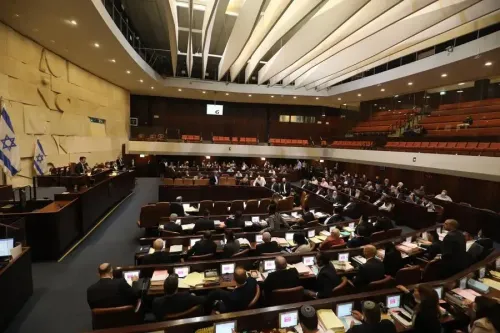
Israel's parliament approved a law creating a special military tribunal for Palestinian suspects linked to the 7 October 2023 Hamas-led attack.
The tribunal is authorised to impose the death penalty , a sentence not carried out in Israel since 1962 .
Executions must be carried out within 90 days of sentencing, with no provision for clemency.
The law follows 30 March legislation making the death penalty a default punishment for Palestinians convicted of deadly attacks.
Rights group Adalah warns the law denies fair trial protections and that any death sentence could constitute "a war crime" under international law.
The October 7 attack killed approximately 1,200 Israelis ; the subsequent Gaza offensive has killed at least 72,737 people , according to Gaza health authorities.
Israel's parliament has approved a law establishing a special military tribunal for Palestinians suspected of involvement in the Hamas-led attack on 7 October 2023, authorising the tribunal to impose the death penalty — a sentence that has not been carried out in Israel since 1962. The legislation has drawn immediate and widespread condemnation from human rights organisations and legal advocacy groups.
What the New Law Establishes
The newly approved law creates a dedicated military court framework to try Palestinian suspects linked to the October 7 attack. Critically, the tribunal is empowered to hand down the death penalty, reviving a punishment that has effectively been dormant in Israel for over six decades. The law also mandates that executions be carried out within 90 days of sentencing, with only limited grounds for delay and no provision for clemency.
Courts retain the option to impose life imprisonment, but only under undefined "special circumstances" — a vague threshold that critics argue gives judges insufficient guidance and defendants insufficient protection.
The March 30 Legislation That Preceded It
The new tribunal law follows legislation passed on 30 March that made the death penalty a default punishment for Palestinians convicted of deadly attacks. That earlier law drew sharp international criticism, with opponents describing it as discriminatory and unconstitutional. Critics argue it creates a differential legal framework based on identity, raising serious human rights concerns.
Notably, under the combined legislative framework, the death penalty applies to Israeli citizens convicted of murder only if the act was committed with the intent of "ending Israel's existence" — a clause that critics say effectively ensures the punishment will disproportionately target Palestinians while excluding Jewish Israelis accused of similar offences.
Rights Groups Sound the Alarm
Adalah, a legal advocacy group for Arab minority rights in Israel, said in a statement that "the bill denies suspects the basic procedural protections essential to a fair trial." The group added that any resulting death sentence would constitute "an arbitrary deprivation of life, absolutely prohibited under international law and potentially a war crime."
The criticism reflects a broader concern among international legal observers that the tribunal framework bypasses established norms of due process, particularly for defendants who may have limited access to legal representation within a military court structure.
The October 7 Attack and Its Aftermath
The 7 October 2023 Hamas-led attack killed approximately 1,200 people in Israel and resulted in more than 250 hostages being taken, according to Israeli figures. It triggered a massive Israeli military operation across Gaza that, according to Gaza-based health authorities, has killed at least 72,737 people and left the Palestinian enclave in widespread ruin.
The passage of these laws signals a significant hardening of Israel's legal posture toward those accused in connection with the attack, with implications that legal experts say will be closely scrutinised by international courts and human rights bodies in the months ahead.
Point of View
Where the same act triggers different standards depending on the accused's identity, is the clause that will face the most sustained challenge in international forums. What is missing from the domestic debate is a credible answer to Adalah's core charge: that the law creates a two-tier justice system. That silence will matter enormously if these cases ever reach the International Court of Justice or the International Criminal Court.
NationPress
25 Sept 2026
Frequently Asked Questions
What is the new Israeli tribunal law for October 7 suspects?
Israel's parliament has approved a law creating a special military tribunal to try Palestinians suspected of involvement in the Hamas-led attack of 7 October 2023. The tribunal is authorised to impose the death penalty, which has not been carried out in Israel since 1962.
Why are rights groups criticising the new Israeli law?
Rights group Adalah and others argue the law denies suspects basic procedural protections essential to a fair trial. They also warn that any resulting death sentence could constitute an arbitrary deprivation of life, prohibited under international law and potentially a war crime.
How does the death penalty apply differently to Israelis and Palestinians under this law?
Under the law, the death penalty applies to Israeli citizens convicted of murder only if the act was committed with intent to end Israel's existence. Critics argue this clause effectively ensures the punishment will disproportionately target Palestinians while excluding Jewish Israelis accused of similar offences.
What was the March 30 legislation that preceded this tribunal law?
On 30 March, Israel passed a law making the death penalty a default punishment for Palestinians convicted of deadly attacks. That legislation also drew sharp international criticism for being discriminatory and unconstitutional, and the new tribunal law builds upon that framework.
How many people were killed in the October 7 attack and the subsequent Gaza offensive?
The October 7 Hamas-led attack killed approximately 1,200 people in Israel and resulted in over 250 hostages being taken, according to Israeli figures. The subsequent Israeli military operation in Gaza has killed at least 72,737 people, according to Gaza-based health authorities.