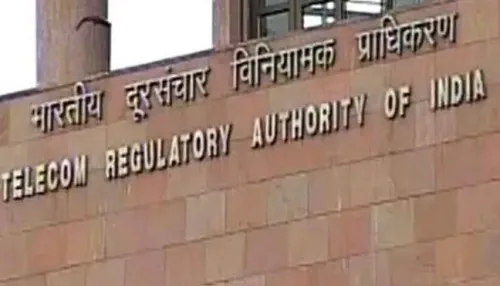
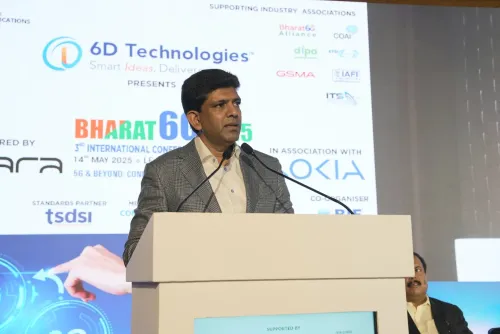
6G Rollout: India Extends 600 MHz Band Validity, TRAI Chief Reveals Bold Plan

Synopsis
India has extended the validity of the 600 MHz band and is fast-tracking 6G preparations, with TRAI Chairman Anil Kumar Lahoti unveiling sweeping spectrum reforms — including inter-band sharing, infrastructure leasing, and a hybrid fibre-FWA model — as India adds a record 17 million fixed broadband users in 2025-26.
Key Takeaways
India has extended the validity of the 600 MHz spectrum band , a key frequency for 6G deployment, as announced by TRAI Chairman Anil Kumar Lahoti on April 25, 2025 .
TRAI has recommended inter-band spectrum sharing and leasing of surplus spectrum to improve utilisation of available telecom resources.
India added a record 17 million fixed broadband users in 2025-26 , marking a historic surge in home connectivity.
TRAI advocates a hybrid fibre and Fixed Wireless Access (FWA) model to address future data demand, particularly as AI use cases expand rapidly.
Private 5G captive networks (CNPNs) have been enabled by TRAI guidelines but have yet to emerge as a major success, requiring greater industry collaboration.
TRAI's recommendations on indoor digital infrastructure integration at the building design stage have been formally accepted by the Government of India.
New Delhi, April 24: India is accelerating its march toward 6G technology, with Telecom Regulatory Authority of India (TRAI) Chairman Anil Kumar Lahoti announcing that the country has extended the validity of the 600 MHz spectrum band — a frequency range considered foundational for next-generation high-speed internet deployment. The announcement, made on Friday, April 25, 2025, signals a decisive policy push to future-proof India's telecom infrastructure ahead of the global 6G race.
Why the 600 MHz Band Extension Matters
The 600 MHz band is prized for its superior propagation characteristics — it can travel longer distances and penetrate buildings more effectively than higher frequency bands, making it critical for rural coverage and indoor connectivity. By extending its validity, TRAI is ensuring that telecom operators have long-term spectrum certainty as they begin investing in 6G-ready infrastructure.
This move comes amid a sharp surge in data consumption across India, driven by the proliferation of streaming, digital payments, and increasingly, Artificial Intelligence (AI) applications. Lahoti explicitly warned that mobile networks alone may not be sufficient to absorb this demand — a candid admission that underscores the urgency of India's telecom overhaul.
Spectrum Reforms: Sharing, Leasing, and Efficiency
TRAI has recommended a suite of structural reforms to maximise spectrum utility. These include inter-band spectrum sharing — allowing operators to pool frequencies across different bands — and leasing of surplus spectrum to prevent valuable airwaves from lying idle while demand spikes elsewhere.
The regulator has also proposed active infrastructure sharing among telecom operators. This includes mandatory sharing of government-funded infrastructure and voluntary sharing of privately-funded assets. If implemented effectively, this could dramatically reduce capital expenditure for smaller operators and accelerate network densification in underserved areas.
Notably, these recommendations arrive as India's telecom sector remains dominated by three private players — Reliance Jio, Bharti Airtel, and Vodafone Idea — following years of brutal consolidation. Infrastructure sharing policies could be a lifeline for financially stressed operators.
Private 5G Networks and the Captive Network Challenge
TRAI has issued guidelines enabling enterprises to deploy captive non-public networks (CNPNs) — essentially private 5G networks for industrial and enterprise use. However, Lahoti candidly acknowledged that this segment has not yet emerged as a major success story in India.
He stressed the need for greater collaboration among industry stakeholders, government bodies, and technology providers to unlock the full potential of private 5G. This is a significant admission — globally, countries like Germany, South Korea, and the United States have seen robust enterprise 5G adoption, while India's ecosystem is still nascent.
Fixed Broadband Surge and the Hybrid Connectivity Model
In a striking data point, Lahoti revealed that India added a record 17 million fixed broadband users in 2025-26 — a figure that reflects the country's accelerating shift from mobile-only to multi-mode connectivity. This surge is being driven by the expansion of fibre networks and growing affordability of home broadband plans.
To address future demand, TRAI is advocating a hybrid connectivity model combining fibre optics and Fixed Wireless Access (FWA). FWA uses wireless spectrum to deliver broadband to homes and businesses without laying physical cables — making it particularly suitable for semi-urban and rural deployments where fibre rollout is cost-prohibitive.
Indoor connectivity was flagged as a persistent structural challenge. Lahoti stressed that integrating indoor digital infrastructure at the building design stage — rather than retrofitting — is the only sustainable solution. He confirmed that TRAI's recommendations on this front have been formally accepted by the Government of India.
Machine-to-Machine Communication and the Broader Digital Ecosystem
TRAI has also proposed measures to strengthen Machine-to-Machine (M2M) communication — the backbone of the Internet of Things (IoT) economy. As India pushes toward smart cities, precision agriculture, connected healthcare, and industrial automation, robust M2M infrastructure becomes non-negotiable.
This comes amid India's broader Digital India ambitions and the government's stated goal of becoming a global 6G leader by 2030. The Department of Telecommunications (DoT) has already released a 6G Vision Document and established a Technology Innovation Group on 6G (TIG-6G), signalling that regulatory and policy groundwork is being laid in parallel.
As India positions itself at the frontier of next-generation telecom, the coming months will be critical — with spectrum auctions, infrastructure investment decisions, and international 6G standardisation processes all converging. Stakeholders across government, industry, and civil society will be watching closely to see whether India's regulatory ambition translates into on-ground connectivity gains for its 1.4 billion citizens.
Point of View
But the devil lies in execution — and TRAI's own admission that private 5G networks have failed to take off is a cautionary flag. The country is attempting to leapfrog into 6G while its 5G ecosystem remains underdeveloped and Vodafone Idea teeters on the edge of viability. The 600 MHz band extension and spectrum-sharing reforms are necessary but insufficient without aggressive investment commitments from operators. India's 2030 6G leadership ambition demands not just regulatory vision, but fiscal muscle and industrial partnership that currently remains elusive.
NationPress
7 Oct 2026
Frequently Asked Questions
What is the 600 MHz band and why has India extended its validity?
The 600 MHz band is a low-frequency spectrum range crucial for wide-area and indoor coverage, making it essential for 6G deployment. India has extended its validity to provide telecom operators with long-term spectrum certainty as they invest in next-generation infrastructure.
What is India's timeline for 6G rollout?
India aims to be a global 6G leader by 2030, with the Department of Telecommunications already releasing a 6G Vision Document and establishing a dedicated Technology Innovation Group on 6G. TRAI's current spectrum reforms are designed to lay the regulatory groundwork for this transition.
How many fixed broadband users did India add in 2025-26?
India added a record 17 million fixed broadband users in 2025-26, according to TRAI Chairman Anil Kumar Lahoti. This surge reflects growing demand for home broadband driven by streaming, remote work, and AI applications.
What is Fixed Wireless Access (FWA) and how will it help India?
Fixed Wireless Access (FWA) delivers broadband connectivity using wireless spectrum instead of physical cables, making it cost-effective for semi-urban and rural areas. TRAI recommends a hybrid fibre-plus-FWA model to meet India's rapidly growing data demand.
What has TRAI recommended for private 5G networks in India?
TRAI has issued guidelines for captive non-public networks (CNPNs), allowing enterprises to set up private 5G networks for industrial use. However, the TRAI Chairman acknowledged this segment has not yet achieved major success and requires stronger stakeholder collaboration.